Canton Tower
Guangzhou's 600 m twisted-lattice observation tower on the south bank of the Pearl River

Essential info
Visit details
Overview
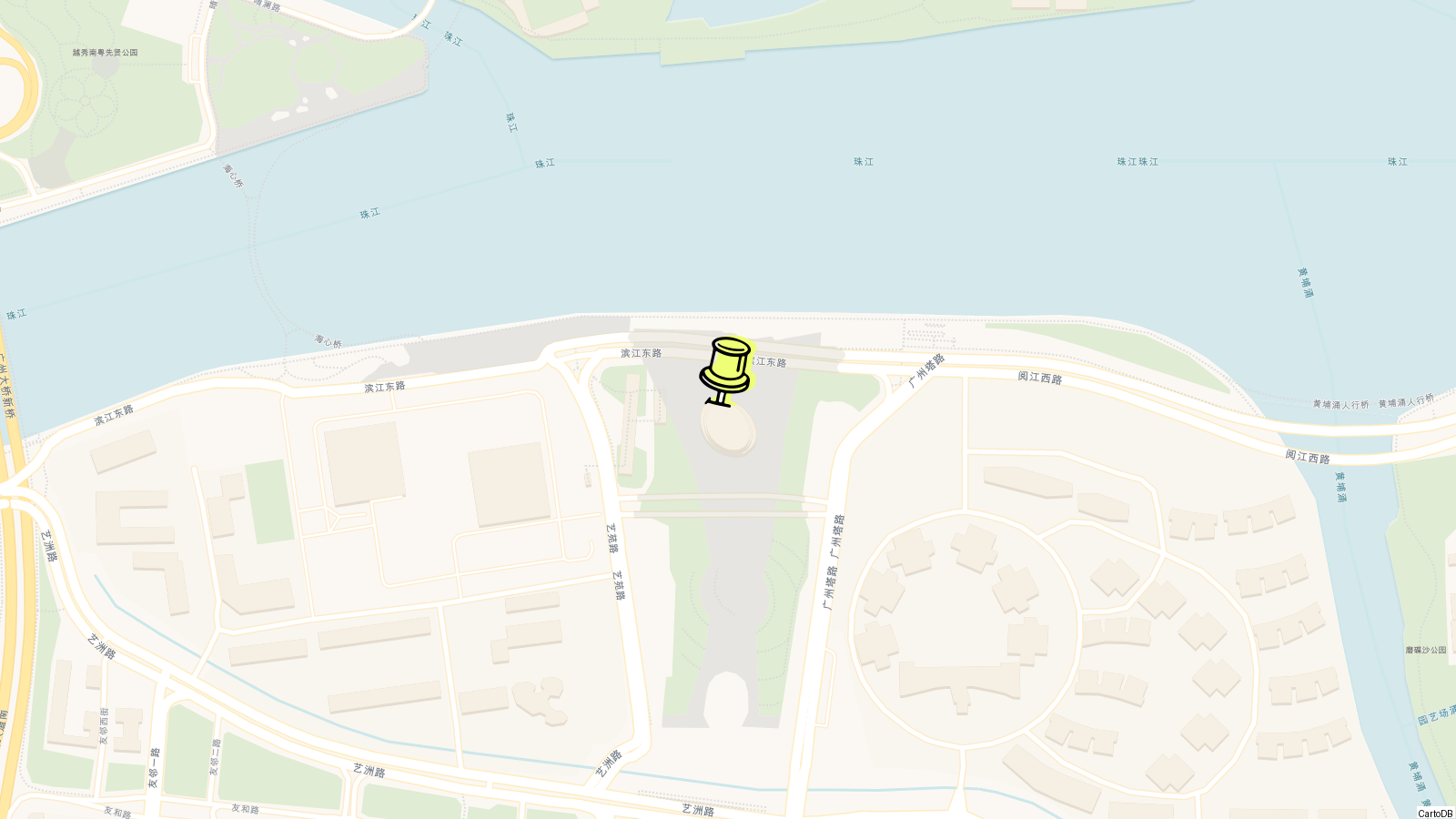
The Canton Tower is Guangzhou’s 600 m observation and broadcast tower on the south bank of the Pearl River, opened in 2010 for the Asian Games and still among the five tallest free-standing structures on earth. You come for the height, and for the shape: a steel lattice twisted around its own axis so that it pinches to a narrow waist halfway up, which is why everyone in the city calls it the Slim Waist (xiao man yao).
The twist is not decoration. The whole form is generated by two ellipses, one at ground level and one at 450 m, rotated against each other; the diagonal members stretched between them tighten into the waist and open out again above it, so the tower looks solid from one angle and see-through from another. Walk a few hundred metres along either bank and it changes character completely.
What you get for a ticket is stacked in layers: indoor decks on the 107th and 108th floors, an outdoor lookout at 450 m, the Bubble Tram (sixteen glass pods crawling round the rim of the roof), the 488 m open-air roof and the Sky Drop, a vertical drop ride from 485 m. Lower down there is a 4D cinema, tea rooms and an open-air spiral staircase through the waist itself. After dark the structure lights itself from within, with LEDs on every node of the lattice rather than floodlights at the base, and the view of it from the north bank is as much the attraction as the view from the top. Read this alongside the Guangdong guide for the rest of the city.
History
Guangzhou decided it wanted a landmark tower in the early 2000s, while Zhujiang New Town, the new business district on the north bank, was finally being built after a decade of stalled plans and the city was preparing its bid to host the 2010 Asian Games. In 2004 an international competition drew many of the big global practices; it was won by Information Based Architecture (IBA), a small Dutch office run by Mark Hemel and Barbara Kuit, working with the engineers Arup. Hemel had studied under Zaha Hadid, whose opera house would later go up directly across the river.
The hyperboloid lattice they proposed is an old idea: the Russian engineer Vladimir Shukhov patented the twisted-lattice form in 1899, and the Canton Tower is essentially a Shukhov structure scaled up to 600 m. Arup’s team, led by Joop Paul, reduced it to three kinds of element (columns, rings and braces) and used parametric modelling so that thousands of slightly different steel members could be fabricated as if they were standard parts.
The porous lattice at the base becomes dense at the waist, where the twist pulls the columns together like a wrung rope; views out from inside the waist are restricted for exactly that reason, and the structure opens up again above it as the column tubes taper. The main body stops at 450 m and a 150 m antenna mast, weighing 1,550 tonnes on its own, carries the height to its full figure; the complete tower weighs about 100,000 tonnes and has 112 floors.
Ground was broken in 2005, the tower topped out in 2009, and it opened to the public on 1 October 2010, not quite finished, a month before the Asian Games began. The Games’ opening ceremony was staged on Haixinsha Island in the river just to the north, with the new tower as the backdrop and fireworks launched from its structure. The rooftop observatory at 488 m only received its official opening in December 2011, when it took the title of highest outdoor observation deck in the world from the Burj Khalifa, a title it held until Dubai opened a higher deck in October 2014. Total construction cost was around 2.8 billion yuan.
The formal Chinese name is still the Guangzhou TV Astronomical and Sightseeing Tower, and the broadcasting role is real: TV and radio transmission equipment shares the structure with the decks, restaurants and rides. For its first year it was described as the tallest tower in the world, having overtaken Toronto’s CN Tower, until the Tokyo Skytree passed it; it stayed the tallest structure of any kind in China until the Shanghai Tower topped out in August 2013.
The night lighting was designed by Rogier van der Heide, then head of Arup’s lighting group. Instead of uplighting the tower from the ground, every node of the lattice carries its own LED fitting and can be controlled individually, which is what allows the colour changes and animations that run up and down the full height each evening, using about 15 per cent of the power a facade this size is permitted. The metro station beneath it was renamed from Chigang Pagoda to Canton Tower in 2013, once the tower rather than the Ming pagoda a few streets away had become the reference point.
Visiting
The tower is open 09:30 to 22:30, with the ticket office closing at 22:00. The official site, cantontower.com, does not load reliably from outside China, so the prices below come from a secondary source and were correct at the last check: the basic ticket for the two indoor decks is 150 yuan, or 228 with the 450 m outdoor lookout added; the Sky Drop is 180 and the Bubble Tram 150, each sold separately, and there are combination tickets that bundle them. Children between 1.2 m and 1.5 m pay half.
Everything starts underground. The metro station, bus stops, a food court, exhibition space and coach parking all sit in a podium at the base, hidden under a deck that also conceals the tower’s plant. From there you choose between slow panoramic lifts and high-speed double-decker ones.
The lower zone, between 80 m and 170 m, holds the 4D cinema, a games hall, restaurants, coffee shops and outdoor gardens with tea houses set inside the lattice. Above it is the Skywalk (sold as the Spider Walk): an open-air spiral staircase that starts at 170 m and climbs almost 170 m more, straight through the waist, with sections of transparent glass floor. It is roughly a kilometre of walkway and about 1,100 steps, so budget real time and decent shoes for it.
The main paid decks are near the top of the body. The indoor observatory at 449 m is a terraced elliptical room roughly half the size of a football pitch; the two-storey revolving restaurant and the tuned mass damper that steadies the tower in wind are in the same zone. A further set of stairs leads out to the open-air terraced roof above the top ring at 488 m. The Bubble Tram runs round the edge of that roof: sixteen transparent pods, each 3.2 m across and taking four to six people, on a track that follows the slope of the roof, so the ride is nearly horizontal rather than a true Ferris wheel. A circuit takes 20 to 40 minutes. The Sky Drop is a vertical drop ride from 485 m, with a seated version and a standing free-fall version.
The rides keep shorter hours than the decks. At the last check the Bubble Tram and Sky Drop ran 10:00 to 22:30 most days but started in the afternoon on Mondays, when maintenance happens. Arrive an hour or so before sunset, do the indoor deck in daylight, then take the roof or the tram as the lights come on across Zhujiang New Town. Guangzhou air is often hazy, and the city reads far better after dark than at noon.
Tips
- The night view is the point. Book a slot that spans dusk so you get the daylight skyline, the sunset over the river and the moment the tower’s own LEDs switch on above you.
- Avoid Mondays if you want the rides: the Bubble Tram and Sky Drop open late that day, and the last Monday of the month later still.
- Buy the 228 yuan deck-plus-450 m-lookout ticket rather than the basic 150: the difference is the outdoor air, and the indoor glass alone is a lesser experience.
- Take the metro. Line 3 and the APM people mover both stop at Canton Tower station directly under the tower; use Exit A, which also connects to the Haizhu Tram, reopened in July 2025 after renovation.
- The APM is worth using in its own right. It is a driverless line of nine stops from Linhexi down the spine of Zhujiang New Town, with a flat fare of 2 yuan and its own tickets, and it is the emptiest line on the network.
- The best full-length portrait of the tower is from across the water, not from under it: the open plazas of Zhujiang New Town run about 1.5 km from Huangpu Avenue to the riverbank and line up on the tower.
- The revolving restaurant at 424 m is a view with food attached, not the other way round; eat in the city before or after.
- Wear proper shoes and leave the bags light if you are doing the Skywalk: 170 vertical metres of open stairs with glass floors is a workout, not a stroll.
Nearby
Zhujiang New Town. Guangzhou’s business district faces the tower across the river. Its western half is a 1.5 km run of open plazas ending at the water, with the four cultural buildings (Guangzhou Opera House, Guangdong Museum, Guangzhou Library and the Second Children’s Palace) at the river end and the Twin Towers, the 438.6 m Guangzhou IFC and the 530 m CTF Finance Centre, standing either side of the axis. The Guangdong Museum is free with ID, open Tuesday to Sunday 09:00 to 17:00 and capped at 5,000 visitors a day, so go early.
Guangzhou Opera House. Zaha Hadid’s building, conceived as two river-washed rocks, opened in May 2010 with Turandot and is the largest performing arts venue in southern China, with 1,804 seats in the main hall. It has its own APM station.
Haixinsha Island. The island between Zhujiang New Town and the tower staged the 2010 opening and closing ceremonies from a three-tier 35,000-seat stand. It was run as a paid Asian Games park until September 2012 and is now free; the APM’s Haixinsha station opens straight into it, and it has the best ground-level view of the tower.
Chigang Pagoda. The 53.7 m red sandstone pagoda of 1619, one of three built to improve the city’s feng shui, gave its name to the metro station before the tower did. It is not open inside, but it is a short detour from Canton Tower station or its own stop on Line 12.
Pearl River night cruise. One- to two-hour evening cruises leave from Dashatou, Tianzi and Xidi piers for 50 to 200 yuan, the dearer ones with a buffet, and pass the lit tower on the way. Shamian Island, the old Anglo-French concession by Huangsha metro station, is the historic counterpoint if you have another half day in the city; Shenzhen is covered in the wider Guangdong guide.
Know this destination? Help us improve
Your local experience is valuable to other travelers.