Alhambra
You’ll need to book weeks ahead just to walk through the carved stucco rooms of the Nasrid Palaces and see the lions at the Alhambra's central fountain.

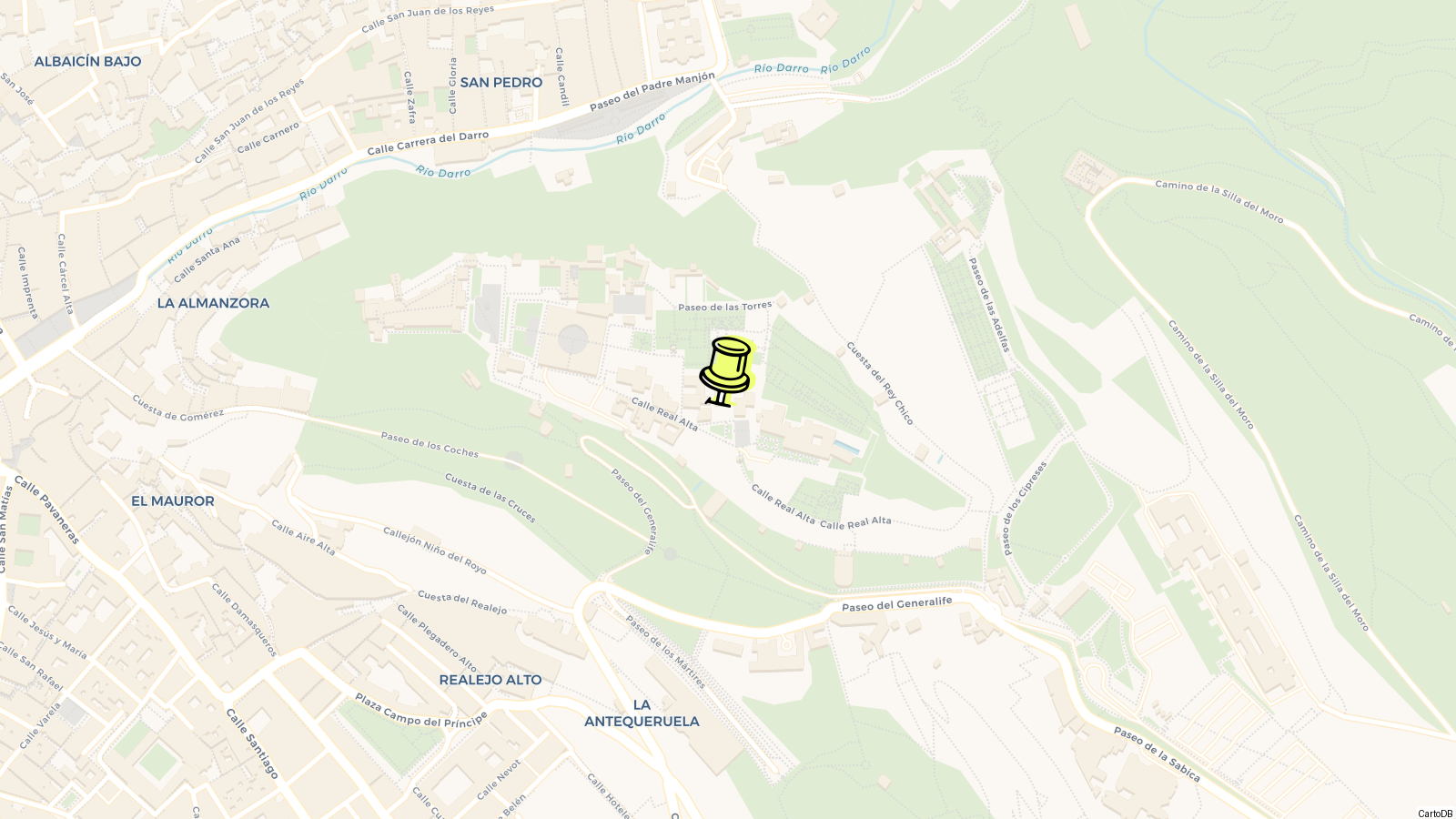
Visit details
Overview
You have to book your ticket online in advance to visit the Alhambra, and if you wait until a week before your trip, you’ll probably find everything sold out. General admission costs €19.09 per adult and gives you access to the Nasrid Palaces, the Generalife gardens, and the Alcazaba. This fortress-palace complex sitting 738 meters above sea level on Sabika Hill isn’t just the big thing you see from everywhere in Granada, it’s the most visited monument in Spain, with over 2.3 million people a year shuffling through its carved stucco courtyards and shaded cypress alleys.
The Alhambra isn’t a single palace, you’ll walk through military towers, a maze of Nasrid-era palaces, Renaissance halls built for Charles V, and the formal country gardens at Generalife. The palaces are known for patios with long reflecting pools, tiled walls that change color in the sun, ceilings latticed in thousands of tiny, intricate muqarnas vaults, and calligraphy running across nearly every surface. You’ll see the “Court of the Lions” with its marble animal fountain, the cool gloom of the “Hall of the Ambassadors”, and, if you luck into tickets, a night visit, where mosaic tiles pick up moonlight and the crowds finally thin out.
If you’re expecting a quick loop, forget it. Even a brisk walk with few stops takes a solid three hours, with your ticket time for the Nasrid Palaces enforced down to the exact minute, miss it and you’re out of luck. The reddish walls come from the iron-rich clay soil here,‘Alhambra’ comes from the Arabic ‘al-Ḥamrāʼ,’ meaning “the red fortress.” There are two basic ways up: bus C30 or C32 from the city center (€1.40, steady all day), or by foot, a steep but scenic climb that gives you glimpses of the Albaicín rooftops between the trees.
Palaces, Gardens, and Fortresses: What’s Inside
Inside, the palace complex is a patchwork of construction from every period since 1238, when Muhammad I of the Nasrid dynasty began expanding the old fortress into a royal city. Start at the Alcazaba for panoramic city views (go up the Torre de la Vela for the flag and bell), then make your way to the Nasrid Palaces: the Mexuar (the old administrative hall), Comares Palace (with the tiled Court of the Myrtles and Hall of the Ambassadors), and the iconic Palace of the Lions. Don’t skip the Partal Gardens for palm-framed pond reflections, and leave time for the Generalife at the far end, these are the sultans’ pleasure gardens, all water channels and sculpted box hedges.
Spanish Renaissance? Yep, That Too
Right in the middle, you hit an architectural curveball: the stark, circular Renaissance Palace of Charles V, started in 1527 but never finished. Pop in free (no ticket needed) for the massive courtyard, which looks like Rome landed on top of the Moorish palaces by accident. The Fine Arts Museum of Granada is housed here too, with paintings and artifacts to fill the gaps between garden strolls.
History
Construction of the Alhambra began in 1238, when Muhammad I Ibn al-Ahmar, the first Nasrid emir, decided to move his capital onto the Sabika hill above Granada. He wasn’t starting from scratch, there were already 9th-century fortress ruins here, and traces of even older fortifications built by the Zirids and later rulers, but what he wanted was a palace city, not just a military post. The most visible work from Muhammad I’s time is the Alcazaba, the compact citadel at the western tip, featuring the Torre del Homenaje and the Torre de la Vela, both formidable towers that look out over Granada. For his personal comfort, Muhammad had water brought in from the nearby mountains via the Sultan’s Canal, transforming the plateau into an inhabitable palace enclave instead of a windy, exposed outpost.
The original Alhambra was more than royal halls. By the 14th century, it was a small, self-contained town. There was a Friday mosque where the present-day Church of Santa María stands, multiple hammams (public baths), artisan workshops, a tannery, and even a market square right inside the palace walls. The Nasrid dynasty oversaw an ever-growing series of palaces, “mirador” towers, and lush courtyards, much of what visitors see now. The areas most tourists snap photos of, like the Comares Palace, the Mexuar, and the Palace of the Lions, all come from this period, especially under Yusuf I and Muhammad V. Their craftsmen covered every wall with carved stucco, geometric tilework, and elaborate muqarnas vaults. Wall poetry, inscribed in Arabic, often addresses you directly: “I am the garden adorned with beauty.”
The Nasrid emirate managed to keep Granada independent for almost 250 years, but when Muhammad XI surrendered to Ferdinand and Isabella in January 1492, the Alhambra became the Spanish monarchs’ base camp. They moved in, signed the Alhambra Decree (which ordered the expulsion of Jews from Spain) from within its halls, and even received Christopher Columbus, who pitched them his Atlantic voyage plans here.
After the conquest, the Spanish royal family claimed the Nasrid palaces for themselves, while local governors took up residence in the side structures. Charles V, in 1527, ordered the construction of his own massive Renaissance palace right in the middle of the complex, demolishing parts of the Islamic palaces in the process. The big, round building with columns you’ll see during your visit, the Palacio de Carlos V, remains unfinished to this day. It’s a brick-and-stone shock to the Nasrid architecture, but gives a good perspective on how Spanish kings wanted to stamp their identity on the site.
The Alhambra fell into neglect for most of the 18th and 19th centuries, inhabited at times by squatters, soldiers, prisoners, even goats. The French army’s occupation (1808-1812) did the worst damage, with dynamite taking out whole sections. An earthquake in 1821 didn’t help. By the time Washington Irving arrived in 1829 and wrote “Tales of the Alhambra,” the place was in romantic ruins, crawling with artists and bohemians.
That “romantic ruin” phase shaped European perceptions of the Alhambra as a place of mystery and lost grandeur, and inspired a wave of drawings, engravings, and literary references. Local restoration efforts began in fits and starts, with varying ideas of what “authenticity” meant. The Contreras family (starting with José Contreras in 1828, followed by his son and grandson) launched extensive restoration campaigns, sometimes simply recreating what they believed “Moorish” style should look like, adding Perso-Arabic domes that weren’t original, and patching over ruins so European visitors got the exoticism they expected.
By the 20th century, attitudes to conservation shifted, with Leopoldo Torres Balbás (chief architect from 1923) reversing many 19th-century inventions and restoring missing elements only when solid archaeological evidence existed. Torres Balbás was big on modern scientific methods and stripped the Alhambra of “Oriental” fantasy touches. If you notice how bare or geometric some rooms and arches look, that’s due to this approach.
A few moments stand out from the 20th and 21st-century story: the Alhambra was declared a National Monument in 1870, UNESCO named it a World Heritage Site in 1984, and administrative control passed to the Andalusian government soon after. Restoration is never-ending. On any visit, you’ll spot scaffolding somewhere, even as recently as October 2023, the “Torre de las Infantas” (Infants’ Tower), usually closed, was transiently open to visitors during special openings.
Today, the Alhambra is a patchwork of architectural eras. Nasrid palaces show off original 14th-century courtyard layouts, complex water channels, Arabic calligraphy, and those famous tile mosaics. Charles V’s palace stands in heavy contrast, imposing and columned. Restoration efforts mix careful science and some guesswork: colors were once much more vivid (reds, blues, gold highlights now mostly faded or gone), pool sizes and plantings often reflect archaeological findings. None of it is static, expect to see ongoing work or special access areas, and accept that some rooms may be closed on any given day.
For a preview of the scope, the entire complex runs about 700 meters end to end, with over a dozen towers, five main palaces, and countless minor structures. Don’t expect a single grand “throne room”: the Alhambra is fragmented, and a big part of what you’re seeing was private, family spaces, women’s quarters, service passageways. The sense of an actual “city within a palace” comes best in the medina area, which once housed support staff, artisans, and soldiers. If you wander into areas away from the crowds, notice how you can hear the irrigation channels, the same water system, in spirit, that supplied the sultans’ gardens.
Visiting
General admission is €19.09, and there are no walk-up tickets. You have to book online at https://tickets.alhambra-patronato.es/en and will get an entry slot specifically for the Nasrid Palaces; this time is strictly enforced, and if you miss your window, you don’t get in. Plan on spending about three hours for a full visit, not including snack breaks or getting to and from the city centre.
Orientation and Entry
The main entrance, used for all ticketed visits, is about a 20-minute uphill walk from Plaza Nueva, but most people take the C30 or C32 minibus from the city (buses run every 8–15 minutes, €1.40 each way). Direct taxis from Plaza Nueva cost €8–10. There’s a paid parking lot next to the ticket pavilion (budget €2–3/hour).
Tickets are scanned at the main entry pavilion; you’ll need your passport or ID to match the ticket. From there, paths lead toward the Palacios Nazaríes (Nasrid Palaces), the Alcazaba (fortress), the Palacio de Carlos V, and the Generalife gardens. Visits are self-guided except for the Nasrid section, which is lock-step guided by your chosen time slot.
Nasrid Palaces
Expect most people to race straight to the Palacios Nazaríes once their time approaches. The flow winds through a series of rooms and courtyards. Highlights: the Mexuar’s wood-and-plasterwork, the intricate tile- and stucco-covered Salón de Comares, and the famous Patio de los Leones with its fountain ringed by twelve marble lions. Carved Arabic inscriptions, geometric patterns, and honeycomb “muqarnas” vaults are everywhere. Photography is allowed, but you’ll get jostled. Once you exit, there’s no re-entry, so linger as much as the staff lets you.
Deep Dive: Palace Route
The Nasrid Palaces are not a single building, but three connected complexes: Mexuar, Comares, and the Palace of the Lions. The entry sequence is controlled: first, the functional Mexuar (originally administrative hall), then the golden-tiled Cuarto Dorado, and from there to the Comares Palace and its Hall of the Ambassadors (look up, the ceiling represents the Islamic seven heavens). From here, paths snake toward the Palace of the Lions; the fountain and arcaded courtyard are the Alhambra’s icon, mid-morning is when the crowds clog up here the worst. Most tours shove you through in 30–40 minutes, but if you’re not with a guide, double that. Exits drop you out by the Partal gardens or back to the main path.
Alcazaba
If you prefer ramparts and tower climbs to courtyards, slip over to the Alcazaba next, look for Torre de la Vela, the 25-meter-high watchtower with city views. Climbing is up steep, crumbling steps, and there’s no elevator. Most tourists skip the old dungeons and cisterns but poke around. The inside is mostly ruins; focus is on the views and imagining the living quarters and guard rooms that once filled the space.
Palacio de Carlos V and Museums
This chunky Renaissance palace was plunked into the Alhambra in the 16th century. The double-circle courtyard is cool, but what’s inside is worth your time: the Alhambra Museum, focused on Nasrid artifacts (pottery, wood marquetry, jewelry, ancient keys), and the Fine Arts Museum upstairs (Spanish painting, especially 16th–19th century Granada). Both are included in the main ticket.
Generalife Gardens
Save the Generalife for last: hydrangea-lined walkways, fountains, and long water rills cut through summer palace grounds. You get mountain views and, depending on the month, a lot of shade or none at all. The best part is the upper gardens, most tours never reach them, so afternoons tend to be quieter.
Garden Seasonality
Late spring (May–June) and early autumn (September–October) are prime for roses, jasmines, and the sound of water running in all the acequias (irrigation channels). In August, heat bakes the lawns and shrubs brown unless there’s been late rain. You can spot the medieval irrigation system and old orchard sections, which are usually bypassed by big tours.
Night Visits and Seasonal Quirks
Night visits (April–October Tue–Sat 22:00–23:30, Oct–March Fri–Sat 20:00–21:30) cover the Nasrid Palaces by dimmed light but skip the Generalife and Alcazaba. This is worth doing if regular tickets sell out or you loathe crowds, but you’ll need to keep your ticket type straight; they’re different from daytime access.
The complex occasionally opens less-visited towers like the Torre de las Infantas for short periods, usually in October. If you’re in town and see a sign for this, pay the extra couple of euros. These limited-time spots are rarely crowded and show a different side of the Alhambra.
Logistics and Visitor Flow
Most people do the Alhambra in this order: Nasrid Palaces at their appointment time, then Generalife, then circle back to the Alcazaba (or flip the last two, depending on your slot). There are snack bars and bathrooms at the entrance and at the Gate of Justice, but nothing inside the palaces themselves, use the facilities before you line up.
Surviving the Rush
The site welcomes more than two million visitors annually, so expect crowds at every step unless you grab the earliest or latest slots. Weekends and Spanish holidays are the worst. If you want moments alone, go off peak: midweek in November, early in the morning, or for a night visit. In midsummer, stick to shaded sections like the Generalife upper garden and palace interiors after noon, heat waves over 38°C are not rare.
Tips
-
Book your ticket as early as possible (the official site releases them about three months out). Don’t chance it, peak dates can sell out weeks in advance, especially if you want a specific time for the Nasrid Palaces.
-
Your ticket has a timed entry for the Nasrid Palaces. If you miss that slot, even by a few minutes, they won’t let you in and there’s no way to reschedule. Set an alarm.
-
Plan for at least 3 hours to see the full complex without rushing: Alcazaba, Nasrid Palaces, Generalife gardens, and the museums.
-
Wear comfortable shoes. The site is huge (expect 5-7 km of walking with stairs, uneven ground, and lots of standing).
-
There’s nowhere inside to buy a proper meal until you exit, snack bars are limited and mostly serve basic sandwiches, chips, and drinks at tourist markup.
If you want to pause for lunch, your only real sit-down option is the Parador restaurant near the Palace of Charles V, which serves a decent menú del día (around €30) and is the only spot with shaded terrace views inside the complex. Otherwise, wait until you’re back in Granada for better food and prices.
-
Water fountains are located by the entrance, the Plaza de los Aljibes, and in the Generalife gardens. Bring a refillable bottle. In July and August it gets brutally hot; shade is rare.
-
Backpacks larger than 40x40 cm aren’t allowed inside the Nasrid Palaces or Generalife. There’s a bag check at the main entrance, free with your ticket.
-
If you’re staying in town, take the C32 (Alhambra bus) from Plaza Isabel la Católica, €1.40 each way, or a taxi (about €8-10 from the center). Walking up the Cuesta de Gomérez is doable but it’s a hard, 20-minute climb.
-
Photography is allowed, but flashes, tripods, and selfie sticks are banned. The best light for photos is before 10 am or late afternoon; noon is harsh and busy.
-
March–May and September–October have the most pleasant weather and fewer school groups. July–August afternoons are nearly 40°C; go early or late.
-
Download the official Alhambra audio guide app (about €5; free Wi-Fi by main entrance for the download) if you don’t want to pay €7 for the physical audio guide. Most signage is minimal and not always in English.
-
The Granada Card tourist pass (€49.06) includes Alhambra admission and works if general tickets are sold out, but you won’t get to pick your Nasrid Palace time slot.
-
The Alhambra closes in two stages: most parts lock gates at either 18:00 or 20:00 depending on season, but the bookshop and toilets at the main pavilion stay open a little longer. Staff start ushering everyone out 20-30 minutes before closing.
Night visits
You can book a special night visit (Nasrid Palaces, 22:00–23:30 Tue–Sat April–October; 20:00–21:30 Fri–Sat rest of year), but these don’t include the Alcazaba or gardens. It’s a very different and quieter vibe, but you’ll need a completely separate ticket. Tripods are still banned.
Know this destination? Help us improve
Your local experience is valuable to other travelers.