Dujiangyan
Li Bing's 3rd-century BCE irrigation works on the Min River, still in use and listed by UNESCO with Mount Qingcheng

Visit details
Overview
Dujiangyan is the irrigation system the Qin state cut into the Min River around 256 BCE, and it still waters the Chengdu plain without a dam. Li Bing, the Qin hydraulic engineer sent to run the newly conquered region of Shu, designed it after studying the floods that spring meltwater sent down from the mountains each year, and the three structures he laid out are still doing the job, feeding 668,700 hectares of farmland. UNESCO inscribed it in 2000 together with Mount Qingcheng, the Taoist mountain behind it, as a single World Heritage property.
You come for a piece of engineering rather than a monument. The site is a wooded riverside park where the river divides around an artificial island, spills over a low weir and squeezes through a cut in the hillside, and it all works with the river’s own behaviour instead of against it: the inner channel takes about 60 per cent of the flow in the dry season and about 40 per cent in flood, with no gates to operate. Add a suspension bridge across both branches, two temples on the slopes above, one of them holding the oldest known stone statue of a person in China, and a free hill park looking down on the split, and it fills a solid half day.
It is an easy trip from Chengdu. The intercity railway takes about 30 to 40 minutes and Liduigongyuan station is a few minutes’ walk from the entrance. The scenic area itself suggests around three hours for the visit. Mount Qingcheng, the other half of the listing, is a different kind of day, mostly uphill and mostly temples, and is covered under nearby.
History
Qin conquered the kingdom of Shu in 316 BCE, turned it into a commandery, moved tens of thousands of settlers in from the north and began reorganising the land into rectangular plots; diverting the Min River east onto the Chengdu plain was part of that programme. Li Bing arrived as governor under King Zhaoxiang of Qin, in 277 BCE according to the Records of the Grand Historian or 272 BCE according to the Chronicles of Huayang. The river he had to deal with is 735 km long, the largest tributary of the Yangtze, and at peak discharge carries 5,000 to 6,000 cubic metres per second. Too much water in spring, too little in autumn, and all of it reaching the plain through one valley.
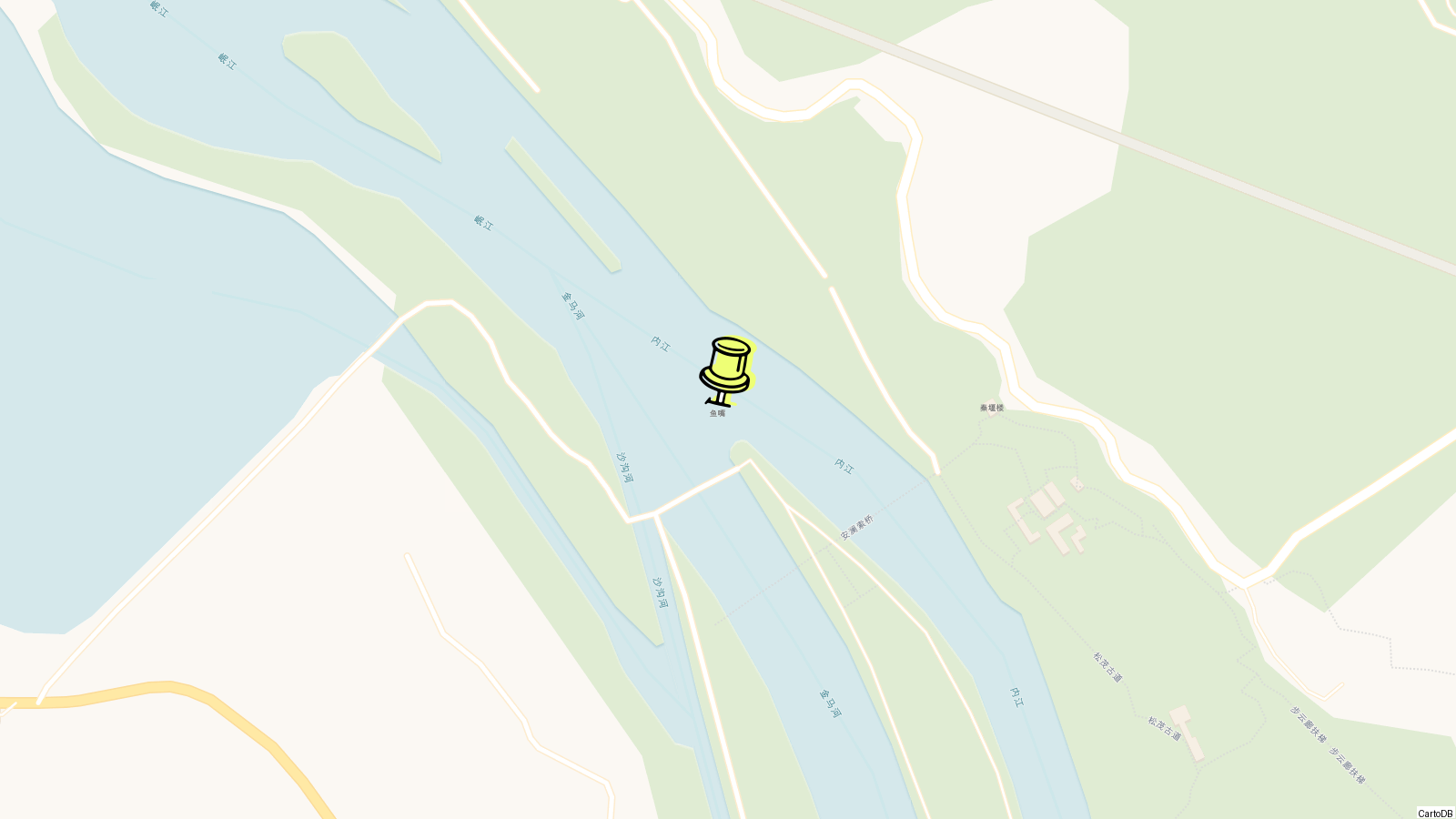
His answer, dated to around 256 BCE, was to shape the river rather than block it. The Fish Mouth (Yuzui) is an artificial levee that splits the Min into an inner and an outer stream. The Flying Sand Weir (Feishayan) is a 200-metre-wide opening between the two, where the swirl of the current throws surplus water and silt back into the outer stream. The Bottleneck (Baopingkou) is a 20-metre-wide channel gouged through the mountain that passes the inner stream on to the fields, its narrow mouth acting as a check gate. Nothing has to be opened or closed.
Gunpowder did not exist, so the channel was cut by heating the rock with fire and dousing it with water until it cracked. The levee took four years to build and the channel eight. The dykes were made from long sausage-shaped baskets of woven bamboo filled with stones, called zhulong, pinned to the riverbed by wooden tripods called macha, a construction that gave under flood pressure rather than shattering and could be renewed piece by piece. It was the largest and most carefully planned public works project yet seen in the eastern half of Eurasia, and Li Bing was remembered for it as the vanquisher of the river god, ranked alongside Yu the Great, the legendary tamer of floods.
The two temples on the site are where the engineering turns into worship. Fulong Temple, founded in the third century on Lidui, the rocky hill the Bottleneck was cut from, holds a stone statue of Li Bing carved in 168 CE under the Eastern Han: 2.9 m tall, 4.5 tonnes, pulled out of the river in 1974 and the oldest known stone statue of a human in China. Erwang Temple (Two Kings Temple), on the slope above the Fish Mouth, is a Qing dynasty wooden complex of 10,072 square metres with statues of Li Bing and of Erlang Shen, the god local tradition made his son; the historical record shows no such link, and the parentage was attached so that a revered man would not be left without descendants. Below it, the Anlan suspension bridge, 261 m across both branches of the river, stands where the Zhupu Bridge once did; it was rebuilt in 1803 by He Xiande and his wife and was known for a while as the Couple’s Bridge.
On 12 May 2008 a magnitude 7.9 earthquake struck with its epicentre in Wenchuan County, about 80 km west-north-west of Chengdu; the official toll was 69,196 dead. Dujiangyan was the closest city to the epicentre and three of its schools collapsed, among them Juyuan Middle School. The 2,200-year-old works came through: early inspections found the Fish Mouth cracked but not seriously damaged, and it went on diverting water. Mount Qingcheng’s temples were damaged in the same quake.
Visiting
The scenic area opens at 08:00 all year. It closes at 17:00 from 1 January to 28 February and at 18:00 from 1 March to 31 December, and day-ticket sales stop half an hour before closing. Adult admission is 80 CNY. Visitors aged 6 to 18 and full-time students with ID pay half, children aged 6 and under or up to 1.3 m tall go free, and so does anyone aged 65 or over. Book on the official site at djy517.com/online.html: it is one ticket per named person, you enter your passport number, and you show the passport at the gate. The hotline is +86 28 96526.
The classic route starts at the town end of the site and works upstream, which is also the order in which the water logic makes sense in reverse. You enter through Lidui Park and climb past Fulong Temple to the Bottleneck, where the inner stream narrows through the rock, then follow the levee north along the inner stream to the Flying Sand Weir and finally the Fish Mouth, where the river splits. At the Fish Mouth the Anlan Bridge crosses both streams to the far bank, and stairs climb to Erwang Temple, which is included in the ticket and has the one view that takes in all three structures at once. Come back over the bridge and retrace the levee, or leave through the north side if your onward transport is that way.
Three hours is the official estimate and about right if you walk the whole loop at an ordinary pace. Allow four with the climb to Erwang Temple and a proper stop at Fulong Temple. The levee is flat; the temple stairs are the only real effort.
When to come is mostly a question of water and rain. The river is high and fast in summer, when the works are at their most obviously useful, but summer here is also hot, humid and wet: July averages 266.5 mm of rain and August 273.4 mm. September to November is the most comfortable stretch, with the river still carrying plenty of water and the worst of the humidity gone; winters are mild, damp and generally frost-free. Early April brings the Water Releasing Festival and its crowds; pick a weekday if you want the bridge to yourself.
Tips
- Get off at Liduigongyuan. Two stations serve the town. Liduigongyuan, at the end of the 6 km Lidui branch, is a short walk from the entrance; Dujiangyan station is on the eastern outskirts and needs bus 4 or a taxi.
- Book the train both ways. Fares are 5 to 15 CNY and the trains sell out on weekends and holidays; the line opened on 12 May 2010, runs at up to 220 km/h and connects cross-platform with Chengdu Metro Line 2 at Xibu, the first interchange of that kind in China.
- Bus if the trains are full. Coaches from Chengdu’s Chadianzi bus station leave every 10 to 20 minutes and take 60 to 80 minutes; a taxi or Didi runs about 150 to 200 CNY one way and 1 to 1.5 hours.
- In town, pay by phone. Local buses cost 1 to 2 CNY and take WeChat Pay or Alipay, but the displays are Chinese only, so keep your hotel address written in Chinese; taxis start at 4 CNY. A tram with two lines and 17.3 km of track opened in 2024.
- Eat the river. Local specialities are grilled Min River fish, rabbit, bean jelly and tofu pudding, plus hotpot; the Nanqiao night market runs from 17:00 to 23:00.
- Don’t count on doing Mount Qingcheng the same afternoon. The front mountain alone is 2.5 to 4 hours on foot to the summit and it shuts at 17:30 in summer and 17:00 the rest of the year; with the cable car and an early start it is possible, otherwise sleep in town.
- Pack a rain shell. Annual rainfall is around 1,200 mm and the levee paving is slick when wet.
Nearby
Mount Qingcheng. Qingchengshan station is 5 to 7 minutes by train from Liduigongyuan. The mountain has 36 peaks, a summit above 1,500 m and a claim to be one of the birthplaces of Taoism: Zhang Daoling, the first Celestial Master, founded the Way of the Five Pecks of Rice here in 142 CE, and eleven temples followed, from Jianfu Palace at the foot, Tang in origin, to Shangqing Palace at the top, whose buildings go back to the Jin dynasty. The front mountain is the temple side, shaded forest paths with a cable car for the lazy; the back mountain is a 5 to 7 hour day of waterfalls and plank walkways for people who like their hiking rougher.
Yulei Mountain Park. The forested hill directly above the irrigation works, free to enter, with the overview of the river split that you cannot get from the levee itself.
Dujiangyan Panda Base and Panda Valley. The panda base is the only place in the world where you can be photographed holding a giant panda, at a price to match; reserve ahead, and get there for 09:30 when the animals come out of their dens. Panda Valley, the quieter of the two, charges 55 CNY and opens 07:30 to 17:00.
Back to Chengdu. Half an hour by train, so most people go home the same evening. If you are staying longer in Sichuan, the Leshan Giant Buddha is the other big day out from the city.
Know this destination? Help us improve
Your local experience is valuable to other travelers.