Leshan Giant Buddha
A 71-metre Tang dynasty Maitreya carved into the cliff where three rivers meet, the largest stone Buddha in the world

Essential info
Visit details
Overview
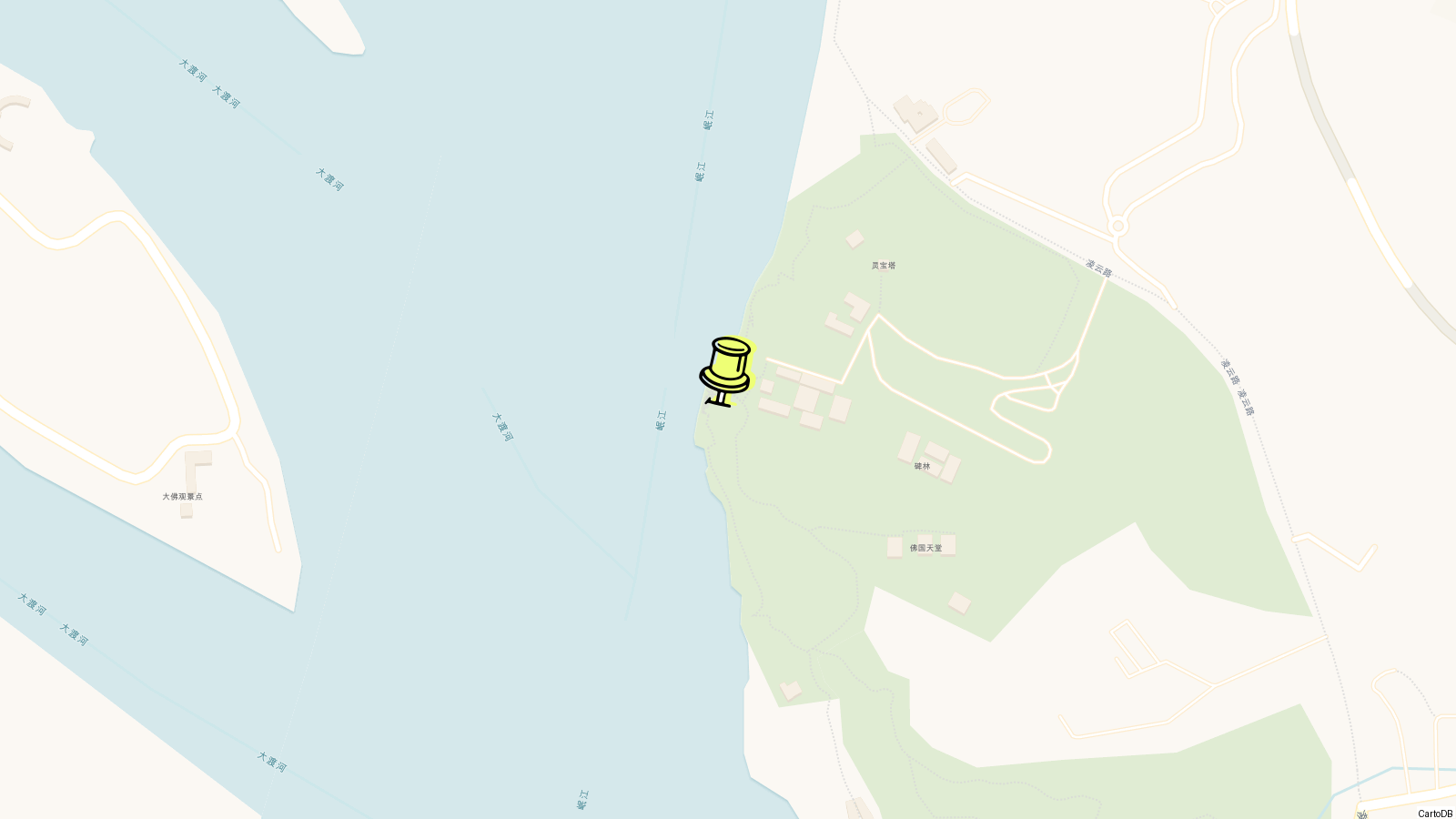
The Leshan Giant Buddha is a 71-metre seated Maitreya cut into a red sandstone cliff in the eighth century, the largest and tallest stone Buddha in the world and the standard day trip out of Chengdu. He sits at the foot of Lingyun Hill with his hands on his knees and his toes at the water, where the Min, Dadu and Qingyi rivers run together beside the city of Leshan, about 120 km south of Chengdu.
The scale is the point. The head alone is 14.7 m high and 10 m wide, the ears are 7 m long, the fingers 8.3 m, and the instep, at around 8.5 m wide, has room for about a hundred people standing on it. Stood upright he would be roughly the height of the Statue of Liberty; a local saying has it that “the mountain is a Buddha and the Buddha is a mountain”, because the ridge he sits in is said to look like a sleeping Buddha from the river, with the statue as its heart.
The figures Wikipedia gives, drawn from the scenic area’s own material, run to a 1,021-curl hairstyle, 5.6 m eyebrows, a 5.6 m nose, eyes and mouth each 3.3 m across and shoulders 28 m wide. The smallest toenail is big enough for one person to sit on. Everything is carved from the living rock except the ears, which were made of wood and finished with mud, then fixed to the head. The Buddha faces across the river towards Mount Emei, and is proportioned according to the Buddharupa rules for statuary, in the calm style of the Tang dynasty.
You see him two ways: on foot, by way of a plank stairway cut into the cliff beside his right shoulder that drops to a platform at his feet, or from the water, on a sightseeing boat that holds position in front of him so you can take in the whole figure at once. Since 1996 he has been inscribed by UNESCO together with Mount Emei, one of China’s four sacred Buddhist mountains, as a single mixed cultural and natural property: the Mount Emei Scenic Area, including Leshan Giant Buddha Scenic Area. Most people do the two together over two days from Chengdu, the Buddha first.
History
The Buddha exists because the river junction below him kept killing people. Boats coming down from the west were thrown against the cliff where the three rivers meet, and around 722 a monk called Haitong, from the Lingyun Temple on the hill above, set out to carve a colossal Maitreya into the rock face, believing the Buddha’s presence would calm the water. Maitreya is the Buddha of the future, and the choice was deliberate: a figure who was supposed to bring order and protection, set where the boatmen most needed it.
Haitong died with only the head and shoulders roughed out, and the money ran out with him. His disciples took up the work again years later with funding from a local official, Zhangchou Jianxiong, and got as far as the knees before he was recalled to the court at Chang’an and the site fell silent a second time. Roughly seventy years passed before Wei Gao, the regional military governor (jiedushi), paid for the last stretch, and the disciples’ successors finished the statue in 803, more than eighty years after it was begun.
Wikipedia’s own lead gives the construction span as 712 to 804 and its history section as 722 to 803; the sources it draws on disagree by a decade at the start, and the end date is a matter of how you count completion. What is not disputed is the sequence of three patrons, the two long pauses, and the fact that the man who began it saw only the top of the head finished. The statue was carved from Cretaceous red bed sandstone at Qifeng Peak on Lingyun Hill, and the surrounding cliffs hold Han dynasty cave tombs (the Mahao Cliff Tombs) that predate the Buddha by several centuries.
The rivers did calm, and not because of merit. So much rock was cut from the cliff and dumped into the channel that the currents changed, and the eddies that had been pulling boats under disappeared. Haitong had promised a safe passage and delivered one, by engineering rather than the route he intended.
The builders also gave the statue a drainage system that still works. Hidden gutters run through the hair, collar and chest, and holes behind the ears and in the chest carry rainwater out of the body so the interior stays dry; the system has kept the sandstone from washing away for 1,200 years. A thirteen-storey wooden pavilion was built over the figure at the same time to keep sun and rain off. By the early Northern Song the pavilion had collapsed and the body was covered in moss; both were repaired under Emperor Renzong, and the pavilion was rebuilt, but the shelter was finally destroyed by the Mongols in the wars at the end of the Yuan dynasty and never replaced. The Buddha has sat in the open ever since.
Modern protection began in 1956, when Sichuan province listed the statue as a cultural relic, and the UNESCO listing followed in 1996. Weathering, acid air from regional industry and the sheer number of visitors have all taken a toll, and the body now carries lichen, ferns, mosses and shrubs that researchers are studying for their effect on the rock. A World Bank-backed repair programme started in March 2002, renovating the statue from the chest up and strengthening the cliff, with a second phase from June 2002 on the rock at the feet and the eroded stone below the waterline. Visitor numbers climbed from around 1.4 million a year in the early 2000s to between 2.3 and 2.8 million a year by 2005 to 2007, and the management now sets limits to protect the stone.
Visiting
The scenic area runs from the North Gate, above the Buddha’s head, to the South Gate near the Wuyou Temple, and the classic visit is a one-way loop between the two. You enter at the top, pass through the Lingyun Temple grounds, reach a railed terrace level with the ears, then take the plank stairway that switchbacks down the cliff on the Buddha’s right to the platform at his feet. The steps are steep and narrow, and the view changes at every turn: shoulder, lap, knees, then the toes at eye level. From the foot of the statue a path continues south to a footbridge and the Wuyou Temple on its small island, and out at the South Gate. Allow three to four hours for the whole loop.
The queue for the stairway is the practical problem. Chinese tour groups arrive in the morning, and on a busy day you can wait around two hours at the top before you start down; late afternoon is far quieter, and a sensible plan is to see the temples and the cliff-side carvings first and leave the Buddha for last.
Winter hours are shorter; the official notice covers only the summer season, so check the mini-program before a visit between October and March. The park’s ticket offices are at the two visitor centres, the North, South and West gates and the Wuyou Temple, and a free sightseeing bus shuttles between the North Visitor Centre and the South Visitor Centre by way of the North Gate, the Oriental Buddha Capital and the South Gate, leaving every ten minutes or when full. Use it if you arrive at the wrong end.
The second way to see the Buddha is from the river, and it is the only way to see all of him at once. The daytime water tour costs 70 CNY, sold separately from park admission, and runs 07:30 to 18:00 in summer from the North and South Visitor Centres and the Wuyou pier; departures shift with the water level and the weather. The boat crosses to the statue, holds for about ten minutes while everyone goes up to the top deck for photographs, and comes back, around 40 minutes in all. It also shows you the two guardian figures carved into the cliff either side of the Buddha, which you cannot see from the stairs. Boats take 35 passengers, so expect a wait at busy times.
The 2024 notice also lists a summer night programme. A night ticket for Lingyun Hill and the Oriental Buddha Capital costs 158 CNY (79 CNY for ages 6 to 18 and for students), with entry 19:30 to 21:30; the foot of the Buddha is closed after dark, so you see him lit from the cliff paths only. A night cruise on the three rivers from the Wuyou Temple pier runs at 20:00 and 21:00 for 138 CNY, and a combined night ticket with the cruise is 228 CNY. All of these are subject to suspension when the river is high, and the hotline above is the place to confirm.
If the river is low, there is a third view. In winter a rubble island appears in front of the statue, ending perhaps 200 m short of the feet, and you can reach it by a 1 CNY ferry from the city’s south bank and a walk of about 2 km for a panorama that costs nothing.
Tips
- Trains from Chengdu. The Chengdu to Leshan to Emeishan intercity line runs from Chengdu East, Chengdu South and Shuangliu Airport stations to Leshan Station, taking between 52 minutes and about 1 hour 20 minutes depending on the service, with a fare of 54 CNY. Leshan Station opened in December 2014 and combines rail, city bus, coach and taxi under one roof.
- Station to Buddha. Bus K1 leaves from the bus station building to the right as you exit the railway station and reaches the scenic area in 30 minutes for 2 CNY, with stops through the city. It runs back to the station until 18:00; after that bus 3 does the job in 45 minutes. City buses 13, 601 and 605 also stop at the park.
- Go late, not early. The stair queue is at its worst in the morning. Arriving after lunch and doing the temples first is the single most useful thing you can do with this page.
- Footwear. The plank pathways are steep and narrow; wear something with grip.
- Skip the park food. Cafés inside the scenic area are expensive for what they are; if you must, pick one with air conditioning in summer. Eat in town instead: Leshan’s own dishes include tian pi ya (sweet-skinned roast duck, sold vacuum-packed as a souvenir), bo bo ji (chicken and vegetables on skewers in a spicy sesame broth), qiao jiao niu rou (a spread of boiled, fried and grilled beef dishes) and dou fu nao with ka bing for breakfast. Zhanggongqiao Jie is the busy evening eating street.
- Chinese New Year. The Buddha’s busiest period is the Spring Festival, when people come from across China to pray for luck. Weekends and public holidays are also much heavier than weekdays.
- Discounts. Student and senior reductions exist beyond the free entry for under-6s, but you will need to ask at the ticket window, and some Chinese helps.
Nearby
Wuyou Temple. On a small island south-west of the Buddha, reached on foot over a walk bridge, and part of the standard loop. It began in the Tang dynasty as Zhengjue Temple, founded by the master Huijing, took its present name under the Song, and was rebuilt many times; the buildings you see are Qing. Its Five Hundred Arhats hall was smashed by Red Guards during the Cultural Revolution and remade between 1986 and 1989, and in 1983 it was named a National Key Buddhist Temple, the only one in Leshan.
Mahao Cliff Tombs. Han dynasty cave tombs cut into the same red cliffs inside the scenic area, a reminder that people were carving this rock long before Haitong.
Oriental Buddha Capital. A separately ticketed modern park a short walk south of the Buddha, signposted as you leave the statue, with thousands of reproduction Buddha statues and Buddhist carvings. Fine if you have a spare hour, not worth a detour.
Leshan Giant Buddha Museum. About 2 km north of the scenic area on Lingyun Road; buses 4, 13 or 602 to Minjiang No. 1 Bridge East get you close.
Mount Emei. The other half of the UNESCO property and the highest of China’s four sacred Buddhist mountains at 3,099 m, with the site of the country’s first Buddhist temple, seventy-six Ming and Qing monasteries, and a 50 km footpath that takes days; cable cars shorten the climb to the temples at the Golden Summit. Emeishan Station is the last stop on the same intercity line from Chengdu, so the natural sequence is Buddha, then mountain, then train home. Watch the macaques: they take food from tourists and bite when pestered.
Know this destination? Help us improve
Your local experience is valuable to other travelers.