Valencia Cathedral
Locals joke that any slow project is “longer than the Cathedral’s works”,its patchwork of styles has been evolving since 1262.

Visit details
Overview
You pay €9 to get into Valencia Cathedral, and for that price you’re walking into a building that’s been growing and changing since 1262, sometimes brutally fast, sometimes so slow that Valencians have a saying for when a project drags on: “Això és més llarg que l’obra de la Seu.” That’s a reference to just how many architectural styles made it into these walls: the bulk is Valencian Gothic, but you’ll spot Romanesque facts at the Almoina gate, an elaborate Baroque main entrance, stray Renaissance and Baroque touches, and 18th-century Neoclassical covers slapped on in later “cleanups.”
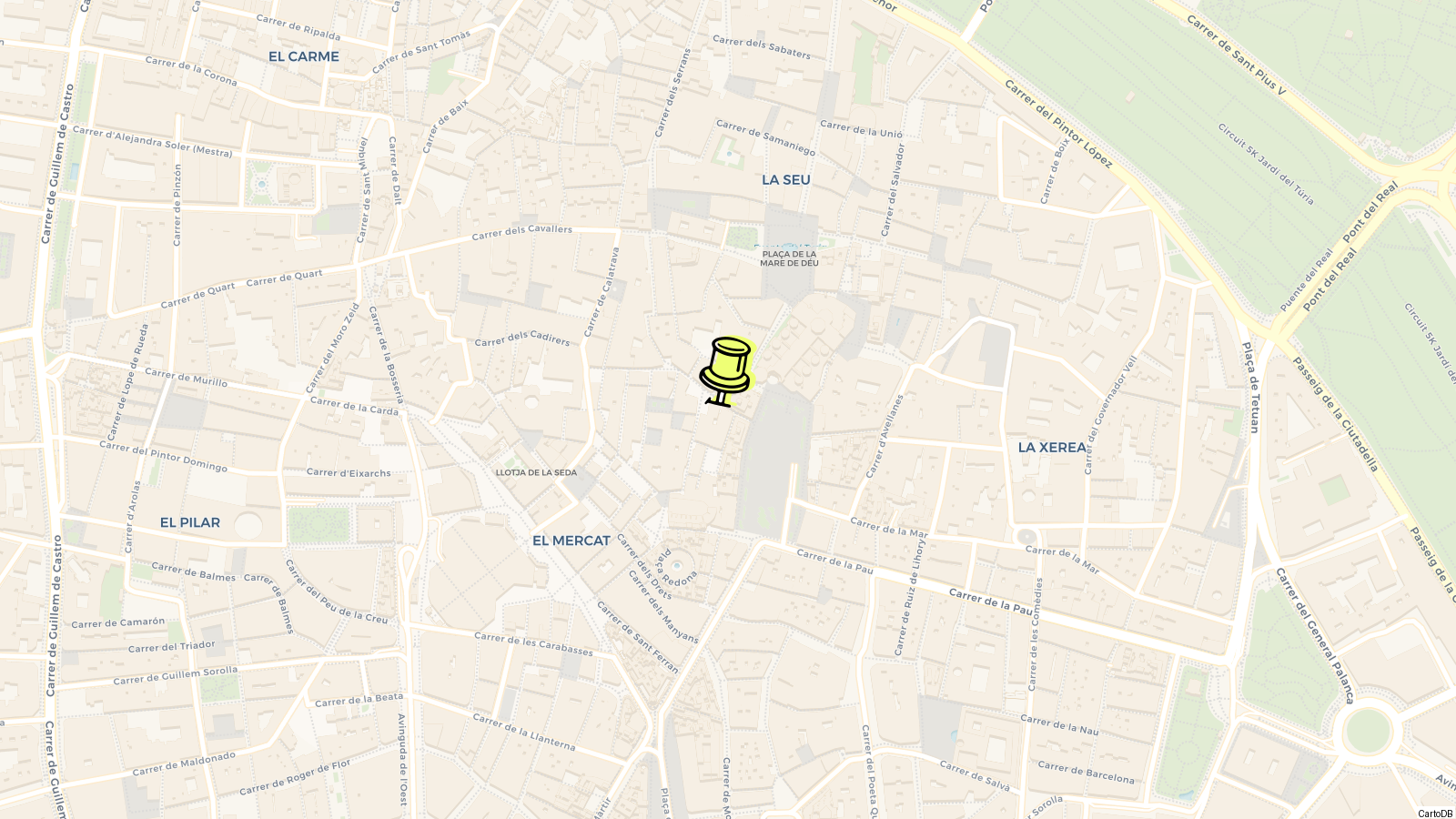
You’ll find the cathedral in the heart of the Ciutat Vella, sharing its plaza with the city’s old Roman center and popping up in your photos from Plaza de la Virgen, Plaza de la Reina, and Plaza de la Almoina. Some people come for the legend: one of the side chapels holds the so-called Holy Chalice, often claimed to be the Holy Grail, delivered to Valencia in 1436 by a king with a sense of drama. Others come for the Miguelete Tower, the climb gives you the best city view for the effort. On your left as you enter you’ll see spreads of 15th-century paintings by artists commissioned under the local pope in Rome’s wild years. Restoration work since the 1970s reversed much of the Neoclassical suppression, so today you’re seeing more of the original Gothic feel, minus some of the earlier Baroque and Neoclassical layers that got stripped away.
The cathedral isn’t just a monument to power, early phases were funded by local merchants who wanted to put their new Christian city on the map after the Reconquista. Stones made their way here from places as close as Burjassot and as far as Benidorm, making the construction uneven and sometimes a headache for later architects. The site itself sits on top of an old mosque, and underneath that, remains of a Visigothic church; you can see some of the archaeology at the Almoina Archaeological Centre a few steps away.
In high season, roughly May, June, September, October, you’ll be joining about 700,000 others queueing at the ticket office each year. With its location and mixture of styles, this is the one religious building in Valencia you’ll actually overhear locals referring to by name, not just in front of tourists.
History
Groundbreaking for Valencia Cathedral started on June 22, 1262, right on top of what used to be the city’s main mosque. The old mosque stuck around after the Christian conquest in 1238, Qur’anic inscriptions and all, until Bishop Andreu d’Albalat gave the order to tear it down and start fresh. They found even earlier ruins underneath, including remains of a Visigothic church, at the Almoina Archaeological Centre just next door.
If you visit the Almoina Archaeological Centre, you can actually walk above pieces of Roman forum, Visigothic basilica, and yes, the old mosque that once stood where the cathedral rises now. It’s catacombs-meets-time-machine: glass walkways, ancient mosaics, water pipes, and city walls from three ages of Valencia, the Romans, the Visigoths, and the Moors, all stacked under the modern plaza.
The first parts to go up were the ambulatory with eight chapels, plus the Almoina Romanesque gate. They hauled in stone from nearby Burjassot and Godella, but also from as far as Xàbia and Benidorm, by boat. Over the next fifty years, the crossing, most of the nave, and the Apostles’ Gate took shape. The city was expanding across centuries, so the architectural style kept shifting with each phase: original Romanesque, then pure Valencian Gothic, then slices of Renaissance and finally plenty of Baroque and Neoclassical riffs. There’s a good reason locals joke, “Això és més llarg que l’obra de la Seu”: building this cathedral really did take forever, only getting its full length (94 meters) and width (53.6 meters) around the late 1400s, when Pere Compte and Francesc Baldomar fused in the Miguelete tower and chapter house.
Chronologically, you can actually trace the centuries by architectural mood swings:
- 1270s–1300: Ambulatory and chapels set the initial Romanesque and early Gothic bones.
- 1300–1350: Transept and nave expand; the “cimbori” (eight-sided dome above the crossing) begins.
- 1350s–late 14th c.: Old chapter house built, today it’s the Chapel of the Holy Chalice.
- Late 1400s: Arcada Nova joins everything together; they link the Miguelete tower (finished in the mid-1400s) to the main body.
- 1700s: Big baroque makeover, led by German architect Konrad Rudolf (who only started the main Iron Gate, leaving it to the Vergara brothers to finish).
- 1774: Total Neoclassical “cleanup” steered by Antoni Gilabert Fornés, the old pinnacles got ripped off and stucco covered most of the Gothic bones.
- 20th century: After being burned during the Civil War (1936–9), the choir was moved, then, in the 1970s, the attached canon houses were demolished so the cathedral could breathe.
- 1972–1999: Another phase: removing the Neoclassical plaster to bring back more of the Gothic look, finally sealing the current state.
It mattered a lot to people who controlled it. After the Reconquista in 1238, James I the Conqueror gave orders to dedicate the church to Saint Mary, and the whole “Christian territory, not Muslim” statement was part of why it went up so quickly at first. But it wasn’t a royal vanity project: the city’s rising merchant class poured in money, so you get a very local flavor, less obsessed with lavish facades than with reclaiming the city’s core.
By 1492, the pope had upgraded Valencia’s bishopric to a metropolitan see, making this church the main Catholic anchor for the region. As revolutions in taste swept through Spain, the cathedral kept getting remade: a Baroque gate here, a Neoclassical overcoat there. In 1931, the Spanish government finally tagged it as a protected historic and artistic landmark. Burns and destruction during the Civil War meant a lot of the old choir and decorations were lost, and the place needed more restoration after, much of the Neoclassical stuff got peeled off starting in 1972.
These days, you see all the layers. There’s a Romanesque doorway right next to a Baroque portal; inside, the main altar paintings from the Italian Renaissance finally got brought into daylight after being hidden under centuries of “improvements.” Fresco cleanings in the 1800s revealed 15th century works by Jacomart, Francesco Pagano, and Paolo da San Leocadio, each era leaving something for the next renovation crew to dig up.
One of the defining relics here, the so-called Holy Chalice, was donated in 1436 by King Alfonso V of Aragon. It dates to the 1st century and sits in its own chapel, claim to fame as the “Holy Grail” (yes, that one) used at Masses by popes and visited on pilgrimages.
Local authorities doubled down on restoration in the 1990s, especially leading up to the big exhibition “The Image’s Light” in 1999. After that, the Generalitat Valenciana gave it another round of cultural landmark status. Today, the cathedral is a catalog of how Valencia’s power, and taste, shifted through seven centuries, always visible in the plaza, always under construction in one way or another.
Visiting
You’ll enter off Plaza de la Reina or Plaza de la Virgen, Google doesn’t struggle to find the door, and you’ll spot people queuing beneath the big “Catedral” sign. Tickets cost €9 for adults, paid at the counter right inside the entrance or online at catedraldevalencia.es/en/index.php to skip the line. Reduced admission (€6) is for pensioners, people with disabilities, and kids up to 12; under 8s are free.
Main Spaces
First, you’ll find yourself in the nave. If you’re here between Monday and Friday, the cathedral is open from 10:30 to 18:30; Saturday it closes an hour earlier; Sundays only allow entry after 14:00, and the place is nearly always busier then.
If you want to see the main highlight, head straight for the Chapel of the Holy Chalice (Capilla del Santo Cáliz), which is to the left of the main altar. That’s the one with the supposed Holy Grail behind glass, and just as striking (seriously, look up) is the star vault ceiling painted with the apostles and the Coronation of the Virgin. Don’t expect Indiana Jones drama, just a stream of visitors taking photos.
The main nave has side chapels with 15th-century paintings, some by local hands, some by Italian artists brought in by a Pope from Valencia. The altar itself hides a set of paintings that were covered up for decades, only rediscovered after a cleaning in the late 1800s.
The museum takes up rooms over three floors, mostly up staircases off the main chapel area. You’ll see religious art, processional monstrances, carved relic chests, and the usual haul of reliquaries.
Miguelete Tower
If you’ve got energy, climb the Miguelete (El Micalet) bell tower, accessible from a separate door to the left outside the cathedral. Admission is extra and not included in the standard combo ticket. It’s 207 steps up a narrow spiral, but the 360° rooftop view of Valencia’s old town is worth it if you don’t mind heights or elbows in tight stone stairs.
What’s Actually in the Museum?
The actual museum, opened in 1761, takes up a surprisingly large part of the building. You’ll see:
- 15th-century painted panels from dismantled altars (not all labeled in English)
- Processional monstrances, including the city’s giant Corpus Christi one
- Tapestries, silverware, and textiles from the cathedral’s treasury
- A small archaeology display with bits of Visigothic and Roman masonry
If you’re a relic hunter, peek in the circular chapel off the old Chapter Room, three closets stuffed with “reliquaries” that look like they’d make Indiana Jones roll his eyes.
Tickets cover everything except the tower, which is always paid separately. Family tip: if you have a kid or mobility issues, skip the climb. There’s no lift.
Opening Hours Table
| Day | Hours |
|---|---|
| Mon-Fri | 10:30–18:30 |
| Saturday | 10:30–17:30 |
| Sunday | 14:00–17:30 |
The Miguelete Tower: daily 10:00–18:45, all year.
Booking, Access, and the Crowd Situation
High season (April-June; September) means big tour groups, slow-moving school parties, and lines, especially for the tower. Save yourself trouble and book online. The cathedral is wheelchair accessible for main sections, but the tower is not. No food or big bags allowed inside; you’ll get a polite but direct warning and a bag check at the entrance. You can call ahead at +34 661 90 96 87.
All signage has English and Spanish. There are QR codes dotted around if you want to follow a self-guided audio tour. Guided tours run about 30 minutes and, as of 2026, include entry to the tower for €8 (but check at the counter, as this sometimes changes in busy weeks).
Visiting During Religious Events
During major Catholic festivals (Corpus Christi, Holy Week), whole sections of the cathedral close to tourists and open only for worship. If you want to see the Corpus Christi monstrance carried in procession, time your visit for the feast; otherwise, it just sits in the treasury room.
Masses are ongoing in some side chapels even during tourist hours. Visitors can join, but the main altar is off-limits to tourists during services. Guards do not hesitate to redirect photo-takers wandering into the wrong space.
Digital Tracking
Valencia Cathedral now uses sensors and cameras to track tourist flow. In theory, this means smoother visitor management; in reality, it sometimes means staff will route you a certain way or briefly hold people at chokepoints to prevent gridlock in the Holy Grail chapel. As of 2026, most people barely notice.
Tips
-
Sundays the cathedral doesn’t open for visits until 14:00, so don’t show up in the morning unless you’re attending mass. Saturdays it closes earlier (17:30), and on weekdays it’s open 10:30–18:30. Double-check on public holidays in case of special schedules.
-
The line is usually worst late morning and mid-afternoon, especially March–June. Book your slot ahead online at catedraldevalencia.es/en/index.php if you want to avoid waiting.
-
Backpacks aren’t allowed in the main nave, if you bring one, they’ll send you to the cloakroom near the entrance. Small purses are fine.
-
The cathedral is wheelchair-accessible, with ramps at the main entrance and an elevator for the museum section, but the climb to the Miguelete Tower is stairs-only (207 steps, no elevator, no shade). If you want to get the bell tower view, go early before it gets crowded or too hot.
-
Photography: allowed without flash, but they’re strict if you wander into mass or private prayer areas, especially during Sunday services.
-
Audioguide rental is included in the standard €9 ticket, get it, the English explanations are actually clear and point out details you’d otherwise walk past.
-
Take a light jacket, inside is usually cooler, especially in spring.
-
Valencia Tourist Card holders get 20% off entry, but it doesn’t lower the tower fee.
-
There’s no dress code enforcement, but if you’re in beachwear or strap tops, expect a frown or a loaner shawl offered by the staff.
Smart phone and network tip
The cathedral walls are thick; you’ll have poor signal in several chapels and the museum section. Download the audioguide app or map in advance if you don’t want to rely on patchy LTE.
Tech crowds
Starting mid-2026, the cathedral runs pilot projects using sensors and occasional drone flyovers to manage visitor flow, nothing intrusive for visitors, but don’t be surprised if staff suggest you pause or follow posted arrows on crowded days.
Skip mass if you’re not here for it
The cathedral’s main nave is sometimes closed or restricted for weddings or mass, especially Saturdays after 17:00. You can usually still see the museum and side chapels, but the classic aisle-to-altar view can get blocked by security ropes.
Know this destination? Help us improve
Your local experience is valuable to other travelers.