Tian Tan Buddha
The 34-metre bronze Buddha on Lantau's Ngong Ping plateau, 268 steps above Po Lin Monastery

Visit details
Overview
The Tian Tan Buddha is a 34-metre seated bronze Buddha on the Ngong Ping plateau of Lantau Island, finished in 1993 for Po Lin Monastery and reached by a 25-minute cable car ride from Tung Chung. It weighs over 250 tonnes, was assembled from 202 bronze plates over a steel frame, and you climb 268 steps from the plaza to the platform under its lotus throne. Everyone in Hong Kong calls it the Big Buddha. The formal name comes from Tian Tan, the Temple of Heaven in Beijing, whose circular altar the monks copied for the three-tier base after visiting it in 1979.
It earns the trip because nothing else in the territory puts Buddhist practice, hill country and heavy engineering in one frame. The monastery sits at about 400 metres on a plateau between Lantau Peak and Nei Lak Shan, so the cable car climbs over Tung Chung Bay and the North Lantau ridges to get there, and from the platform you look south to the South China Sea and back across the plaza to the monastery’s roofs. When the monastery’s monks first pitched the idea in the 1970s they had just seen the Great Buddha of Kamakura and the big Buddha at Changhua in Taiwan, and the Hong Kong version was built to stand comparison with both. When it was inaugurated it was the largest seated outdoor bronze Buddha in the world.
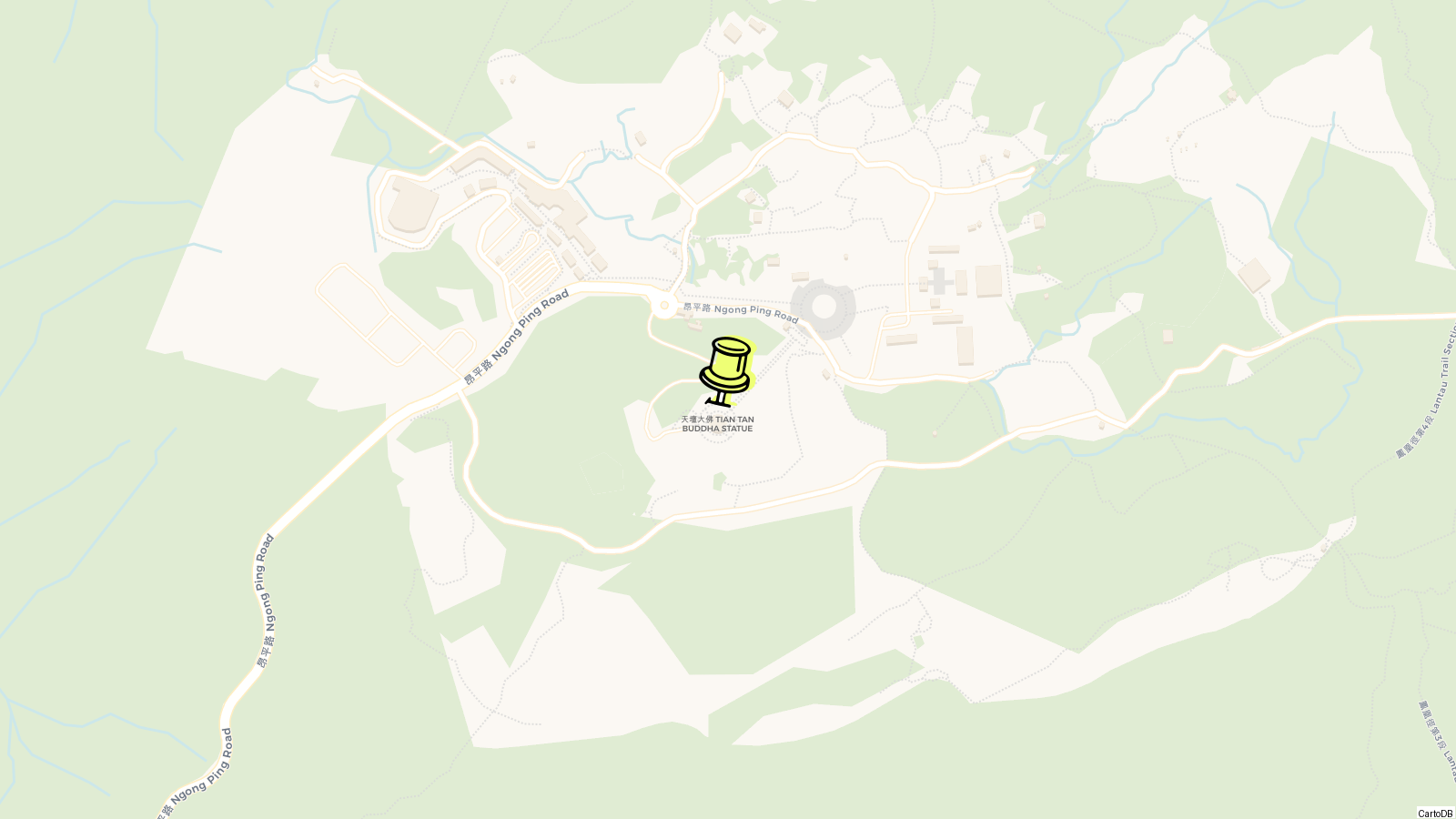
The site is a triangle. The cable car terminal and Ngong Ping Village occupy one corner, Po Lin Monastery another, and the Buddha on its own hill the third, all joined by a broad paved avenue that takes about ten minutes to walk end to end. The outside of the statue and the platform are free; only the exhibition halls inside the base charge admission. Add the monastery halls, the vegetarian kitchen and the Wisdom Path columns behind the monastery and you have an unhurried three hours, which is what most people should plan for.
History
Po Lin Monastery came first. In 1906 three Chan monks, Da Yue, Dun Xiu and Yue Ming, arrived from the Jiangtian Monastery at Jinshan in Jiangsu, cleared the thorn scrub on the plateau and built a stone hut, then a thatched one; the place was simply the Big Thatched Hut until 1924, when Ji Xiu became first abbot and renamed it Po Lin. The halls you walk through today are mostly later: the Main Shrine Hall of Buddha was completed in 1970, and the Grand Hall of Ten Thousand Buddhas behind it went on the drawing board in 2000 and was finished in 2014.
The Buddha itself dates from a 1973 trip abroad, and the following year the government granted 6,567 square metres on Mount Muk Yue, the hill beside the monastery, for a statue. A 1979 visit to the mainland, the first time these monks had seen the cave sculptures of Longmen and Dunhuang, settled the design. The face was modelled on the Vairocana Buddha at Longmen, the robes on a Sakyamuni figure in Cave 360 at Dunhuang, and the base on the altar of the Temple of Heaven.
Sculptor Hou Jinhui of the Guangzhou Institute of Fine Arts began the plaster model in April 1982 and completed a one-fifth scale version in February 1984 after eight revisions. The right hand is raised in the mudra of imparting fearlessness; the left rests palm-up on the lap in the mudra of fulfilling wishes, and each palm carries a dharma wheel. Around the throne sit six smaller bronze figures, the devas, offering flowers, incense, a lamp, ointment, fruit and music, one for each of the Six Perfections: generosity, morality, patience, zeal, meditation and wisdom.
The casting was done by a rocket plant, not a foundry. The Nanjing Chengguang Machinery Plant, part of China’s astronautics industry, enlarged the model using stereo photography and more than 3,900 survey points, cast 202 bronze plates between 10 and 13 millimetres thick, and trial-assembled the whole statue in three sections before shipping. The Beijing Institute of Aerodynamics tested a model in the wind tunnel it used for satellites and rockets, which is why the figure has sat through three decades of typhoons without complaint.
The bronze arrived by sea in April 1989 and was welded on site from the bottom up in eight layers, with more than five kilometres of weld; the last plate went on at a topping ceremony on 13 October 1989. The inauguration waited until 29 December 1993, reckoned in the Chinese calendar as the day of the Buddha’s enlightenment, and drew monks from mainland China, Taiwan and further afield. In 2000 it was voted fourth among Hong Kong’s ten engineering wonders, behind the Lantau Link, the airport passenger terminal and the convention centre extension, and first among private projects.
Salt air and acid rain then did their work on the bronze and its coating. From 2 June 2020 the statue was scaffolded for a full renovation, its oxidised skin taken off by alumina blasting and a new protective coat applied; it reopened on 10 December 2022.
Visiting
Ngong Ping 360 is how most people arrive. The Tung Chung terminal is a five-minute walk from Exit B of Tung Chung MTR station, itself about 30 minutes from Hong Kong station on the Tung Chung line, and the ride to the Ngong Ping terminal takes about 25 minutes. The cable car runs 10:00 to 18:00 on weekdays and 09:00 to 18:30 on Saturdays, Sundays and public holidays. A standard cabin round trip is HK$295 for adults and HK$150 for children aged 3 to 11; the glass-floored Crystal Cabin is HK$365 return, and a combo with one leg in each cabin type is HK$330. If the service is suspended for weather you can swap the date or get a refund at either terminal.
From the upper terminal you walk through Ngong Ping Village, a themed street of shops and the Walking with Buddha attraction, and it is about ten minutes on foot to the monastery. The steps and platform of the Buddha are open 10:00 to 17:00 daily (the monastery’s visitor page gives 17:30 as final closing, so treat 17:00 as the last safe time to start the climb); Po Lin Monastery itself opens 09:00 to 18:00 and the vegetarian kitchen 11:30 to 16:30.
The climb and the base
The 268 steps are broad and not steep, but there is no shade, and a small winding service road exists for visitors who cannot manage them. At the top you circle the lotus throne past the six devas and get the full view over the plateau. Beneath the statue are three exhibition floors, the halls of the Universe, of Benevolent Merit and of Remembrance, holding a relic said to be part of the Buddha’s cremated remains; this is the only ticketed part of the site. The souvenir shop, selling items blessed in the monastery’s services, is in the Hall of Merits on the first floor of the base.
The monastery
Po Lin’s main buildings line up on a single axis facing the Buddha: the Mountain Gate, then the Hall of Skanda Bodhisattva, the Main Shrine Hall of Buddha and finally the Grand Hall of Ten Thousand Buddhas, with the Bell Tower and Drum Tower and the smaller halls arranged symmetrically either side. The Main Shrine Hall is a seven-bay, double-eaved building in Ming and Qing palace style, and holds three bronze Buddhas representing past, present and future. The Grand Hall behind it follows Song-dynasty models and contains a shrine, an exhibition hall, a meditation hall and the scripture library.
The two halls in front of the Buddha Hall, dedicated to Ksitigarbha and Amitabha, host the Thus Come Thus Gone exhibition on the statue’s origins, construction, decay and 2020 to 2022 repair, open 10:00 to 17:00 seven days a week. Between the monastery gate and the Buddha’s steps is Di Tan, the Altar of Earth, a square built to the same Temple of Heaven pattern as the statue’s base.
The vegetarian kitchen
The kitchen is to the left of the Main Shrine Hall as you face it. Dishes change with the season and are portioned to the number at the table; a standard meal is a soup, a deep-fried dish and a vegetable dish with rice. Wikivoyage gives a snack at HK$23 and full meals at HK$60, or HK$100 for the deluxe version. The snack counter next door does steamed cakes, noodles and savoury dim sum; the house-made bean curd dessert and the mango-filled glutinous rice dumplings are the ones people queue for.
Tips
- Go on a Saturday, Sunday or public holiday only if you can be on the first car at 09:00; on weekdays the cable car does not open until 10:00, so the plateau is quieter but your day starts an hour later.
- Buy cable car tickets only from the official Ngong Ping 360 website, its ticket offices or authorised agents; tickets from other sellers are voided without refund.
- Children under 12 must ride with someone aged 15 or over, infants up to 2 go free, and the senior fare applies only to Hong Kong residents with a JoyYou or Senior Citizen card.
- Only water may be consumed in the cabin, so eat before you board.
- Travelling with bags? Left luggage is HK$100 per piece at the Tung Chung terminal and at the Holidays 360 information centre in Ngong Ping Village, no booking needed, collected before closing time.
- The mango dumplings at the monastery snack counter are made in small quantities each day; if you want them, eat before the Buddha, not after.
- Groups can book a vegetarian meal in advance on (852) 2985 4736; individuals ask at the kitchen reception or the booth at the Buddha entrance.
- The monastery’s wooden prayer bracelets are sold only near the statue, so buy there rather than expecting them in the village shops.
- General enquiries to the monastery go to (852) 2985 5248 or info@plm.org.hk.
Nearby
The Wisdom Path is a 20-minute walk from the cable car terminal along Ngong Ping Road and the Ngong Ping Fun Walk, past the old Ngong Ping Tea Garden. It is 38 hardwood columns, 8 to 10 metres tall and laid out in a figure of eight on the hillside, 37 of them carved with the Heart Sutra in the calligraphy of the scholar Jao Tsung-I; the column at the top of the loop is left blank for emptiness. It opened on 20 May 2005 and is free.
Lantau Peak rises directly behind the Wisdom Path to 934 metres, the second-highest summit in Hong Kong. Most hikers start from Ngong Ping, a climb of roughly 500 metres, and some sleep at the hostel on the plateau to be on top for sunrise; Wikivoyage rates it a hard climb and advises against it between June and October. It sits on section 3 of the 70-kilometre Lantau Trail, the 4.5-kilometre leg from Pak Kung Au to Ngong Ping timed at 2 hours 45 minutes.
Tai O, the stilt-house fishing village on Lantau’s west coast, is about 15 minutes away on bus 21 from the Ngong Ping terminus. Shopfronts sell salted fish and shrimp paste, boats go out to look for Chinese white dolphins, and the 1902 police station on the hill by the ferry pier is now the nine-room Tai O Heritage Hotel.
For a loop that skips Tung Chung on the way back, take bus 2 down to Mui Wo, about 35 minutes, and the Sun Ferry from there to Central Pier 6: the fast boat takes 30 minutes, the slow one 50 and lets you stand outside. Hong Kong Disneyland is two MTR stops from Tung Chung if you are combining Lantau’s two big draws in one day.
Know this destination? Help us improve
Your local experience is valuable to other travelers.