Museum of Macau
Macao's three-floor history museum dug into the Jesuit-built Mount Fortress above the Ruins of St Paul's

Visit details
Overview
The Museum of Macau is the city’s history museum, opened on 18 April 1998 inside Mount Fortress, the Jesuit fort of 1617 to 1626 that sits directly above the Ruins of St Paul’s. It’s the one place in Macao that sets out the whole story in order, from the first Portuguese traders through four centuries of Chinese and Portuguese life on the peninsula to the post-handover city, and the fort it lives in is a World Heritage monument in its own right.
The building is the reason to come as much as the collection. Rather than putting up a new museum, the planners dug two of the three exhibition floors under the fort’s artillery platform and converted the old weather observatory on top into the third, so the fort’s outline and its cannon-lined walls were left as they were. Planning began in April 1995, construction in September 1996, and the finished museum covers about 2,800 square metres, some 2,100 of them exhibition space.
The visit therefore has a shape that most museums lack: you go in at the foot of a 52-metre hill, work through the floors, and finish on the ramparts of the fort with a view over the peninsula. Entry is MOP 15, and it’s free on Tuesdays and on the 15th of every month, which makes it one of the cheapest sights in the city and an easy add-on to the Ruins of St Paul’s next door.
Visiting
The museum is open 10:00 to 18:00, Tuesday to Sunday, with last entry at 17:30. It closes on Mondays unless the Monday is a public holiday. Adult tickets are MOP 15, students with a card pay MOP 8, and groups of ten or more pay MOP 10 a head. Children of 12 and under, seniors of 65 and over, Macao residents and tour guides go in free, and everyone goes in free on Tuesdays and on the 15th of each month.
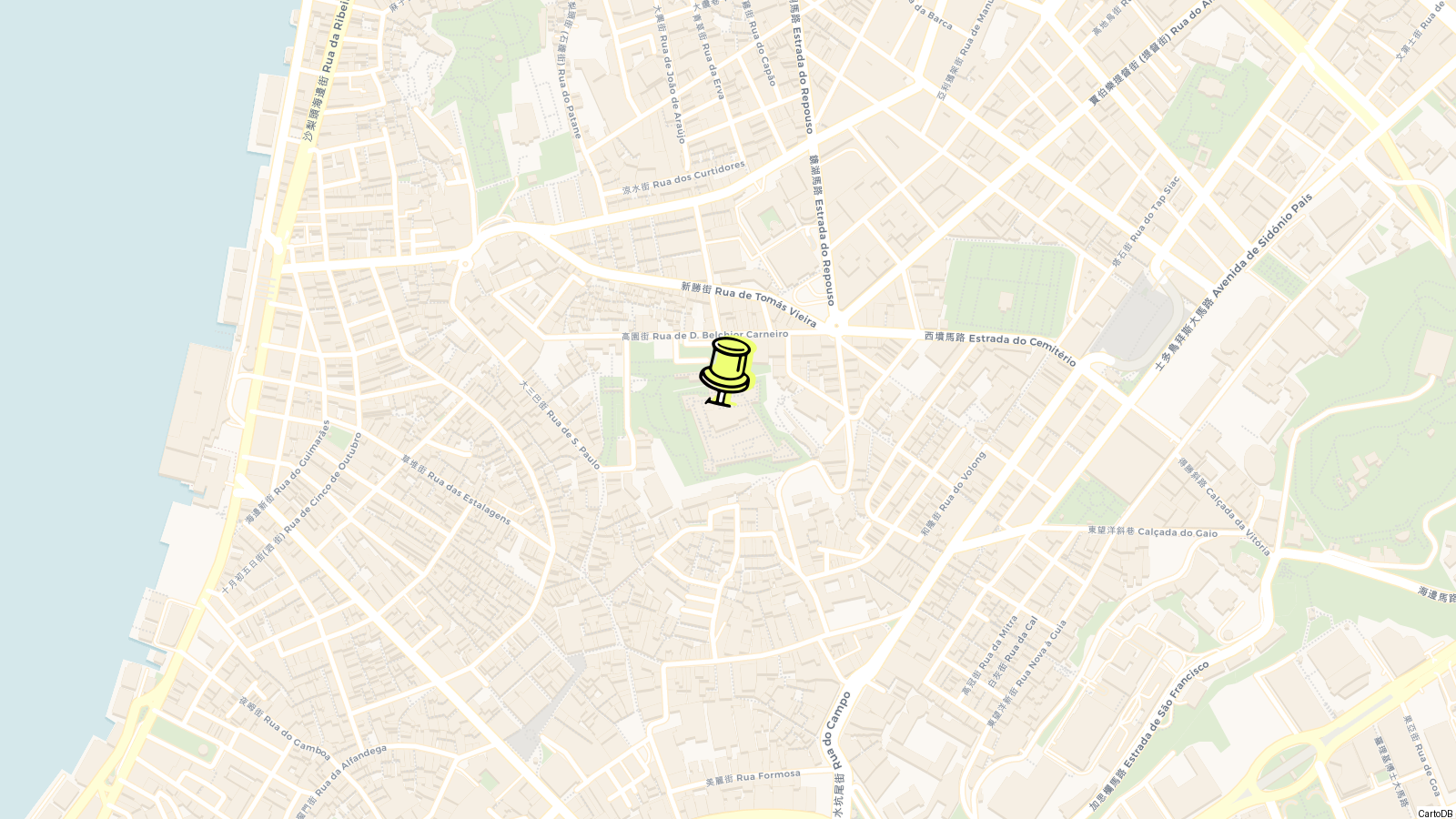
Most people arrive from the Ruins of St Paul’s, since the fort sits directly east of the facade. An escalator on the east side of the ruins carries you up the hill to the fort, which saves the climb. If you’re coming by bus, routes 3, 3A, 10, 10A, 17 and 18 are among those listed by the museum as stopping nearby; the official address is 112 Praceta do Museu de Macau.
The three floors
The display runs upward through three floors, each with its own theme.
The first floor is the history floor: Macao’s early years and the culture that grew out of trade between Chinese and Portuguese merchants. It’s the most text-heavy part of the museum and the one to give the most time to if you want the background before walking the rest of the historic centre.
The second floor covers folk customs: the traditions and folk arts of Macao, its religious ceremonies and its festivals. This is the floor with the most to look at rather than read, and the one that explains the temples, processions and street rituals you’ll see outside.
The third floor, in the converted observatory building on the platform, is contemporary Macao: city life now, and the way writers and artists have portrayed the place. The museum’s exhibition gallery for temporary shows is also on the third floor, and its hours match the main museum, Tuesday to Sunday 10:00 to 18:00.
The fort on top
From the top floor you walk out onto the fort platform. Mount Fortress is a separate, free space, open 07:00 to 19:00, so you can come up here without a museum ticket, and many people do. The summit is a tree-covered park with a panoramic view over the peninsula, the cannon still lined along the walls. Allow around two hours for the three floors and the platform together; an hour is enough if you’re only after the fort and a quick pass through one floor.
There’s a museum shop selling books, painting albums and the museum’s own souvenirs, plus a café for a break and a South Gate snack bar doing Portuguese coffee, drinks and pastries.
History
The fort came first, and it came because of pirates. The Jesuits built Mount Fortress between 1617 and 1626 on the hill east of their church of St Paul, mainly to protect their own property in the young settlement. It was part of the same complex as the College of the Mother of God, whose church front is what survives today as the Ruins of St Paul’s.
The fort’s one real test came before it was even finished. In 1622 a Dutch fleet tried to take Macao, and the guns on the hill helped drive off the landing force of about 800 men; the Portuguese governor then took the fort from the Jesuits in 1623. From 1623 to 1749 it was the residence of the governors of Macao, starting with the first of them, Francisco Mascarenhas, and it stayed the city’s principal military defence for more than three centuries.
What you see on the platform today is the shape of that fort: roughly 8,000 square metres, with small watchtowers on two corners of the south-eastern wall, and 32 muzzle-loading cannon once ranged around the parapets.
The observatory ran on the summit from 1966 until 1996, when it moved to Taipa. Its departure freed the hill for the museum project, which was planned from April 1995 and built from September 1996, in the last years of Portuguese administration before the 1999 handover.
The design brief was shaped by the monument itself. The fort’s platform couldn’t be built on, so two exhibition floors were sunk beneath it, and the top floor was made by converting the observatory’s ground-level building, keeping its original look. The result is a museum you barely notice from outside: from the Ruins of St Paul’s the hill looks much as it did when the fort was a barracks.
The museum opened on 18 April 1998. Seven years later, in 2005, Mount Fortress was inscribed with the rest of the Historic Centre of Macau on the UNESCO World Heritage list, alongside the Ruins of St Paul’s, Guia Fortress, Senado Square and the Leal Senado, St Dominic’s and St Anthony’s churches, Na Tcha Temple, a section of the old city walls and Mandarin’s House.
Why the fort matters to the listing. UNESCO describes the Historic Centre as a testimony to the meeting of aesthetic, cultural, architectural and technological influences from East and West. Mount Fortress and Guia Fortress are the two fortifications in the inscription; the rest are churches, temples, civic buildings and squares. The inscribed area is two separate core zones on the peninsula totalling just over 16 hectares, with a buffer of about 107 hectares around them.
Tips
- Go on a Tuesday or on the 15th of the month and admission is free for everyone; on any other day the MOP 15 ticket is still one of the cheapest in Macao.
- Free days are the busy days. Arrive at 10:00 when the doors open and you’ll have the first floor largely to yourself for a while.
- Don’t do the fort without the museum, or the museum without the fort. The platform is free from 07:00, so if you’re an early riser you can see the view first, then come back for the museum at 10:00.
- Wheelchair users and anyone who can’t manage steps should use the south gate of Mount Fortress on Caminho dos Artilheiros, where lifts run from the gate passage. Wheelchairs can be borrowed at the ticket office, and there’s parking for disabled visitors; the museum’s access line is +853 8394 1204.
- The general enquiries number is +853 2835 7911 and the email is info.mm@icm.gov.mo, useful for checking whether a public-holiday Monday opening applies to your dates.
- Bring a student card: it halves the price to MOP 8.
- Short on time? The first two floors carry the historical and folk material that justifies the ticket. The contemporary floor is quicker and can be walked through on the way to the platform.
- The museum publishes its own photography and filming guidelines; check the facilities page before bringing a tripod or filming for anything other than personal use.
- Skip the museum café if you want an egg tart. Margaret’s Café e Nata, a short walk down the hill towards Senado Square, sells them hot by the plateful, around 10 patacas each, with pastries and sandwiches besides.
Nearby
The Ruins of St Paul’s are at the foot of the hill, directly west of the fort. The stone facade, all that survived a fire during a typhoon on 26 January 1835, stands at the top of 68 steps and was built by the Jesuits between 1602 and 1640, with Japanese Christian craftsmen expelled from Japan among those who worked on it. Behind the facade, the crypt and the small Museum of Sacred Art are free and worth 15 minutes for the relics of Japanese and Vietnamese martyrs.
Na Tcha Temple, built in 1888 and just 8.4 metres long, stands behind the ruins to the left as you face them, with the surviving 1569 section of the old city walls beside it; both are on the World Heritage list.
The St Lazarus Church District, 15 minutes’ walk east, is a quiet quarter of restored colonial-era houses that has been the centre of Macao’s design and small-press scene since the 2000s, with the Albergue SCM (an 18th-century former hospice now used for exhibitions) and a few independent cafés and ceramics shops; it’s busiest on weekend afternoons.
Senado Square (Largo do Senado) is the downhill walk from the ruins: 3,700 square metres of wave-pattern Portuguese pavement, pedestrianised in the early 1990s, with the Leal Senado building of 1784 closing its southern end. Wong Chi Kei on the square is the standby for rice and noodles and stays open late.
Mandarin’s House, on the far side of the historic centre, is another piece of the same UNESCO inscription and a quieter counterweight to the Senado Square crowds.
Know this destination? Help us improve
Your local experience is valuable to other travelers.