Giant Wild Goose Pagoda
Tang brick pagoda of 652 built to store the sutras Xuanzang carried back from India, now the emblem of Xi'an

Essential info
Visit details
Overview
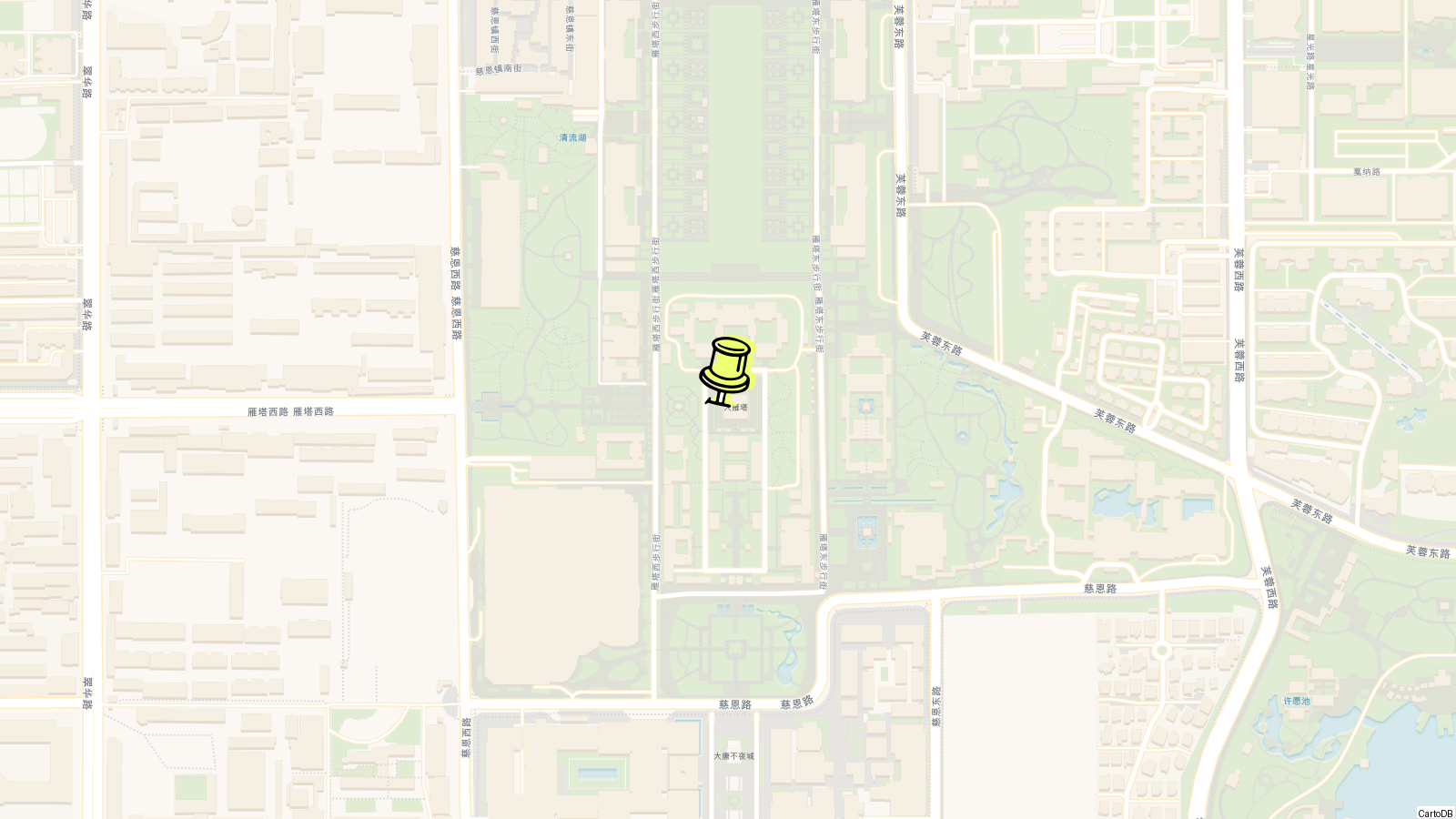
The Giant Wild Goose Pagoda (Dayan Ta) is a 64.1-metre, seven-storey Tang brick pagoda in southern Xi’an, built around 652 to store the Sanskrit scriptures that the monk Xuanzang carried back from India. It stands in the northern part of Daci’en Temple, a working Buddhist monastery founded in 648. It is also the building the city chose for its official emblem in 1988.
You come for three things. The first is the climb: 248 steps up a square tower whose rooms are painted with scenes of Xuanzang’s journey west, with brick archways on all four sides of every floor looking out over the southern city. The second is the temple courtyard around it, quieter than the squares outside and still in daily use. The third is the setting: a south square with a statue of Xuanzang, opened in 2001, and a north square of 300 by 450 metres, finished in 2003, where the fountain shows draw much of Xi’an on summer evenings.
Since 22 June 2014 the pagoda has been a World Heritage component of Silk Roads: the Routes Network of Chang’an-Tianshan Corridor, a joint listing by China, Kazakhstan and Kyrgyzstan that covers 33 sites along about 5,000 km of the old trade routes, 22 of them in China. The Silk Roads logic is straightforward here: the building exists because a Chinese monk walked to India and back, and what he brought home needed somewhere fireproof to live.
The listing groups the pagoda with two other Xi’an Buddhist sites, the Small Wild Goose Pagoda and Xingjiao Temple. The pagoda has had national-level protection since 1961, and since 2013 a height-control buffer zone has limited new buildings around it to between 6 and 60 metres depending on distance, which is why the tower still reads as the tallest thing on its skyline from the squares.
History
Daci’en Temple came first. Crown prince Li Zhi, the future Emperor Gaozong, founded it in 648 in memory of his mother, Empress Zhangsun. The court put Xuanzang in charge of the new temple, and it was there that he founded the East Asian Yogacara school of Buddhism.
Xuanzang had left Chang’an in 629 (some sources say 627), at the age of 27, defying an imperial ban on travel abroad. He crossed Central Asia to India, studied at Nalanda under the monk Silabhadra, and came back through Kashgar, Khotan and Dunhuang with a caravan of twenty packhorses carrying some 657 Sanskrit texts. He reached Chang’an in the first month of 645, sixteen years after leaving Chinese territory, and Emperor Taizong welcomed him with a procession.
He refused the civil posts Taizong offered and spent the rest of his life translating. With imperial support he ran a translation bureau in Chang’an that drew collaborators from across East Asia and is credited with some 1,330 fascicles of scripture in Chinese, though that still covered only 75 of the works he had brought back. He died on 5 February 664 at Yuhua Palace, in present-day Tongchuan, aged 61. His travelogue, the Records of the Western Regions, is still a primary source for seventh-century India, and nine centuries later it gave Wu Cheng’en the frame for the Ming novel Journey to the West, which is why the monk in the murals inside the pagoda is the same figure Chinese children know from television.
In 652 Xuanzang oversaw the building of a pagoda in the Indian style to house the scriptures. That first tower had five storeys, an outer skin of brick over an earth core, and stood about 60 metres high. It was already crumbling by the reign of Wu Zetian, who funded its demolition and replacement with a seven-storey square pavilion-style tower in 704. It was later enlarged to ten storeys, wrecked in war, and rebuilt again as seven.
The shape you see today dates from a repair of 930 to 933 under the Later Tang. By the Northern Song, the pagoda was all that was left of Ci’en Temple. The Ming rebuilt the temple around it in 1466, and in 1604 a restoration reinstalled the ladders inside each level and wrapped the Tang structure in a new 60-centimetre skin of brick, which is the surface you touch now.
The tower began to lean in the Kangxi period of the Qing, and groundwater pumping made it worse after 1945. By 1996 the top was 1.0105 metres off vertical, so the city sealed more than 400 wells around the site; from 1997 the pagoda started to settle back, and by the end of 2006 it had recovered 9.4 millimetres, at roughly a millimetre a year. The internal staircase was replaced in 1954, lightning protection went up in 1962, and the 2008 Wenchuan earthquake caused leaks at the top that were repaired in 2012.
Visiting
The site is three zones with three levels of access. The north and south squares are open public space. Daci’en Temple is ticketed. The pagoda climb needs a second ticket bought inside the temple. At the last check, temple admission was 40 CNY and the climb 25 CNY on top, with the temple open 08:00 to 17:30 (ticket office closes 16:30) and the climb 08:30 to 17:00; these figures come from a local listings site rather than the temple itself, and the price has changed several times in recent years, so treat them as a guide and confirm on the day.
Inside the gate the temple runs on a north-south axis: the Shanmen entrance, the Hall of the Four Heavenly Kings, the Mahavira Hall, bell and drum towers either side, the sutra library, the Xuanzang Sanzang Hall and then the pagoda itself at the northern end, with a small forest of monks’ memorial pagodas beyond. Daci’en has been one of China’s National Key Buddhist Temples since 1983, so expect incense, resident monks and services rather than a museum.
Stop at the south door of the pagoda before you climb. In brick niches either side are two stone tablets: Emperor Taizong’s “Preface to the Sacred Teachings of the Great Tang Sanzang”, written in 648 for Xuanzang’s translations, and Emperor Gaozong’s “Record” of the same preface, both cut in the calligraphy of Chu Suiliang and still clearly legible. Coiled dragons top the steles and the bases carry dancing musicians. The ground floor has stone doors on all four sides with Buddhas and Heavenly Kings carved on the lintels; the west lintel shows Amitabha preaching.
The tower sits on a base about 4.2 metres high and 48.8 metres across from north to south. The lowest storey is 25 metres a side and each level tapers above it, with square pillars, balustrades and dougong brackets in brick imitating timber at every floor line. The rooms narrow as you rise: nine bays on the first two floors, seven on the third and fourth, five from the fifth up. The interior walls also carry engraved Buddha figures attributed to the seventh-century painter Yan Liben.
The climb is 248 steps on a wooden stair, with an archway on each side of each floor for the view: the temple roofs and the squares below, the Qujiang district to the south, and the whole southern half of the city on a clear day. Allow 90 minutes to two hours for temple and climb together.
Outside, the north square’s fountain runs free shows several times a day, with a reduced timetable in winter; the 9pm summer show is the big one, with lights and music, and crowds arrive well before it. Getting here is easy: Dayanta metro station, on Lines 3 and 4, sits on the north side of the north square (Line 3 opened in November 2016, Line 4 in December 2018). By bus, the 610 (signed You 8) links the railway station, the Bell Tower, the Small Wild Goose Pagoda, the Shaanxi History Museum and the pagoda; the 609 comes from the Bell Tower via the South Gate; the 500 runs from the railway station in twelve stops.
Tips
- Book the Shaanxi History Museum first and come here after it. Entry to the museum is free but only with a real-name reservation on its WeChat account, and it is closed on Mondays; the pagoda takes walk-ups, the museum does not.
- Check the lean for yourself. Stand on the temple axis in front of the Mahavira Hall (Daxiong Hall) and sight the pagoda against its roofline; the tilt that reached a metre in 1996 is visible from there.
- The ticket office closes an hour before the temple and the climb shuts before the courtyard does, so arrive by mid-afternoon if you want to go up.
- The stair is wooden, narrow and unventilated. Xi’an summers are hot with intense midday sun, and spring and autumn are the comfortable seasons; if you are here in July, climb in the first hour after opening.
- The best free photograph is from the south square, with the statue of Xuanzang in the foreground and the tower behind; the north square gives you the fountain and the pagoda in one frame at night.
- Do not bank on bus 610 for a tight schedule. It is the useful tourist route but can leave you waiting half an hour; the metro is the reliable way in and out, especially after the evening fountain show empties the square.
Nearby
Shaanxi History Museum, 91 Xiaozhai East Road, is 800 metres north-west of the pagoda and next to Xiaozhai metro station on Lines 2 and 3. It holds more than 370,000 objects, with the Tang gold and silver of the Hejia Village hoard and the Tang tomb murals as the reasons to go; the main halls are free, the Tang murals gallery costs 270 CNY, and the main building is open 08:30 to 19:00.
Small Wild Goose Pagoda, 72 Youyi West Road, is the natural second half of a Tang pagoda day. Completed in 709 at Jianfu Temple, it lost its top two storeys and 2 metres in the 1556 earthquake and now stands 43 metres and 13 storeys. The temple grounds are free with a ticket, the pagoda costs 50 CNY, and it is closed on Tuesdays. The Xi’an Museum shares the site, with around 2,000 of its 110,000 artefacts on show, and requires an app booking.
Tang Paradise (Datang Furongyuan), a 67-hectare theme park built around a willow-lined lake to the south-east, stages an evening lake show with lasers and projections on water screens; its own metro station, Datang Furongyuan, is on Line 4. The Great Tang All Day Mall pedestrian district, around Zhenguan Culture Square, starts just south-west of the pagoda.
Know this destination? Help us improve
Your local experience is valuable to other travelers.