Small Wild Goose Pagoda
Xi'an's quieter Tang pagoda of 707 to 709, thirteen storeys since the 1556 earthquake, in the free grounds of the Xi'an Museum

Essential info
Visit details
Overview
The Small Wild Goose Pagoda (Xiaoyan Ta) is an early Tang brick pagoda of 707 to 709, standing in the grounds of Jianfu Temple just south of the Xi’an city wall, and the quieter of the city’s two World Heritage pagodas. You come for the tower itself, one of very few structures in the city that a resident of Tang Chang’an would still recognise, and for the free Xi’an Museum that shares the compound.
Both of Xi’an’s pagodas were built for the same job: storing Buddhist scriptures carried back from India. The Giant Wild Goose Pagoda held Xuanzang’s overland haul from 652; this one went up half a century later for the texts of the monk Yijing, who went by sea. It started at fifteen storeys and 45 metres. The top two storeys fell in the earthquake of 1556 and were never replaced, so the tower you see is thirteen storeys and 43.4 metres, with a slightly ragged crown. It is a plain tapering shaft of grey brick with stacked-brick eaves and no ornament beyond its carved stone door frames, and the standard Chinese comparison is a bamboo shoot pushing out of the ground. It looks its age in a way the re-clad Giant pagoda does not.
In 2014 it was inscribed as one of 22 Chinese components of the Silk Roads: the Routes Network of Chang’an-Tianshan Corridor World Heritage property, alongside the Giant Wild Goose Pagoda, the Daming and Weiyang palace sites and Xingjiao Temple. Shaanxi has no shortage of Tang sites, but few are this intact.
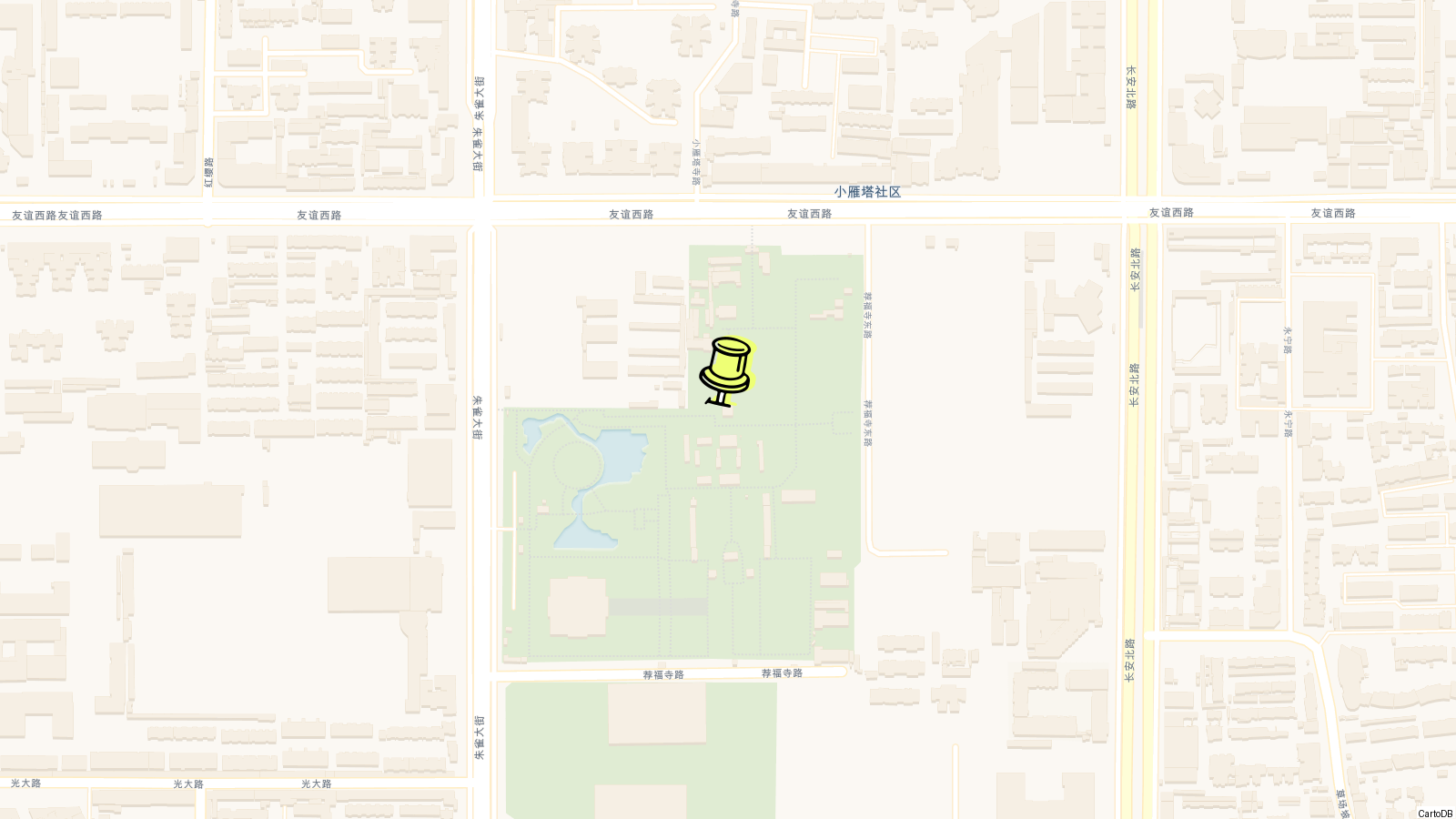
The compound has three parts: the temple courtyards with the pagoda and its bell pavilion, the Xi’an Museum building opened in 2007, and the gardens between them. Entry to all of it is free. Allow half a day if you do the museum properly; the pagoda and temple alone take about an hour.
History
Jianfu Temple came first, and it started as a house. It was the residence of the future Emperor Zhongzong, converted into a temple in 684, one hundred days after the death of his father Emperor Gaozong, to earn the dead emperor merit in the afterlife; its first name was Xianfu, “offered blessings”. Wu Zetian renamed it Jianfu in 690 and wrote the name board herself. It became one of Chang’an’s main translation houses for scriptures arriving from India, and the astronomer-monk Yi Xing studied here with the Indian masters Śubhakarasiṃha and Vajrabodhi.
The pagoda went up between 707 and 709 under Zhongzong, by then restored to the throne, in a separate pagoda courtyard across a street from the temple gate. It was built for Yijing. Born Zhang Wenming in 635, he sailed from China in 671 along the maritime route, spent ten years at the monastic university of Nalanda, wrote his travel record while studying in Srivijaya on Sumatra, and came home in 695 after 25 years away with around 400 texts, welcomed at Luoyang by Wu Zetian in person. He translated more than sixty of them into Chinese before his death in 713.
Yijing is the maritime counterpart to Xuanzang. Where Xuanzang walked through Central Asia, Yijing took ships through south-east Asia, and his Record of Buddhist Practices Sent Home from the Southern Sea is one of the main sources for the kingdom of Srivijaya, where he found more than a thousand monks and advised Chinese pilgrims to stop for a year or two to learn the monastic rules before going on to India. In 689 he ran out of paper and ink in Sumatra and sailed back to China to fetch more before returning to finish his work. His translations include the Golden Light Sutra and a version of the Diamond Sutra, both in 703, and the Medicine Buddha sutra in 707, the year work began on the pagoda that would hold them.
The temple lost most of its monks in the Huichang suppression of Buddhism, when it was allowed to keep only 20 for upkeep, and was largely destroyed in the wars at the end of the Tang. The brick pagoda was all that survived, and by the Northern Song the temple had been moved into the pagoda courtyard, which is the arrangement you see today. The Ming rebuilt it. A Tibetan monk called Shaosiji took charge in 1426, found the buildings derelict and completed a reconstruction in 1449, and the Zhengtong Emperor wrote the “Imperial Jianfu Temple” board that still hangs. The Qing renovated again, most heavily in the 31st year of Kangxi, and added the scripture hall and the south gate late in the dynasty.
The earthquake of 23 January 1556, centred on Huaxian east of Xi’an, is counted among the deadliest ever recorded, with roughly 100,000 direct deaths and a total loss of about 830,000 people from the imperial registers once famine and migration are counted. The pagoda’s hollow single-wall brick shaft flexed rather than fell, which is why it stands at thirteen storeys rather than none.
The twentieth century was rougher than the Ming. Soldiers occupied the temple for most of the Republican period, the Nationalist Northwest headquarters sat here in the 1940s, and when the city changed hands in 1949 the tower was found pocked with bullet marks. It was listed in China’s first batch of nationally protected monuments in 1961, and a full restoration in 1965 gave it new wooden floors and stairs, a lightning rod and iron hoops around the second, fifth, seventh, ninth and eleventh storeys. The grounds opened to the public in 1980, the Xi’an Museum opened on the temple’s old footprint on 18 May 2007, and the World Heritage listing followed on 22 June 2014.
Visiting
Entry is free but ticketed. Book a slot online or at the ticket office up to five days ahead, take your passport, and pick one of four entry windows: 08:30 to 11:00, 11:00 to 13:00, 13:00 to 15:00 or 15:00 to 17:00; you may go in 30 minutes before your window opens. The site is open 08:30 to 18:00 with last admission at 17:00, daily from May to October and closed on Tuesdays from November to April except on public holidays; hours may be extended in July and August. The address is 72 Youyi West Road; take metro line 2 or 5 to Nanshaomen, leave by exit F and walk six minutes west to the north gate.
Start at the pagoda. It stands on a square brick platform 3.2 metres high with stone steps up the north and south sides, and the ground floor has doors on those two faces only, each under a bow-shaped stone lintel carved with vines and offering deities in the early Tang manner. Every storey above has a course of corbelled brick eaves and a pair of round-arched windows north and south, and the shaft narrows as it rises. Measured in 1989, the tower is 43.4 metres high on a base 11.38 metres square.
Beneath the platform is a Tang underground palace of grey brick, facing south: a rectangular front chamber, a short vaulted passage and a square rear chamber 2.7 metres on each side under a domed roof. Surveys have detected a second chamber below it that has never been opened. The foundation is a rammed-earth hemisphere, which is the usual explanation for why the tower rocks and settles in a quake instead of toppling.
Climbing is a separate paid ticket. The most recent listing we found had it at ¥30 (students ¥15), but Wikivoyage reports being charged ¥50 in 2021 on a ticket still printed with the old price, so expect either. Inside is a single hollow shaft with wooden floors and a mix of wooden stairs and brick steps, steep and narrow, taking you up through the thirteen surviving storeys. Children under 1.2 metres are not admitted and the climb is suspended in heavy rain.
The temple courtyards between the pagoda and the museum hold the Ming gate, halls and the bell and drum pavilions, a small iron bell of 1494 on a frame beside the bell pavilion, and more than ten pagoda trees (Chinese scholar trees) reckoned to be over a thousand years old.
The museum building beyond holds about 130,000 objects, of which around 2,000 are on show at any time, in more than 16,000 square metres of galleries laid out under the architect Zhang Jinqiu; it was rated a national first-grade museum in 2012. Give it 90 minutes; it is smaller and calmer than the Shaanxi History Museum and never needs the same fight for a ticket.
Tips
- Go in the morning. The first entry window opens at 08:30 and the tour groups arrive after lunch; the local advice is 09:00 to 11:00.
- If your spare days in winter fall on a Monday and a Tuesday, put this site on the Monday: the Shaanxi History Museum shuts on Mondays, this one on Tuesdays.
- Foreigners cannot use the self-service machines at Xi’an’s free museums, which read only Chinese ID cards; collect your booked ticket from a staffed counter with your passport.
- Time it for the gardens if you can: cherry blossom from late March to early April, hydrangeas north-east of the pagoda from late May to June, lotus from mid-June to mid-July, and maples and ginkgo from late October to November.
- Wear shoes with grip for the climb. The steps are around 20 centimetres high.
- Keep your hands off the brick inside. A 2013 inspection found the interior scratched with visitors’ graffiti dating back to the 1970s, including on the top storey and on the “do not carve” notice itself.
- An AR guide device is hired at the entrance for ¥80 and runs in English, Chinese, Japanese and Korean.
- Groups of ten or more are asked to book three days ahead by phone; the museum’s general number is +86 29 8780 3591.
- Look at the tower from the north gate path before you go in. The 2013 city regulation caps building heights in a zone stretching from Wenyi Road to Hanguang Road and south to the Second Ring Road precisely so that the pagoda stays the tallest thing in view.
Nearby
Metro line 2 strings the neighbours together: from Nanshaomen it is one stop north to Yongningmen and one stop south to Xiaozhai.
South Gate and the city wall. Yongningmen is the main gate of the Ming rampart begun in 1370, 14 kilometres around and 12 metres high. Entry is ¥54, the South Gate stays open until 23:00, and bikes are hired on top for ¥40 per two hours plus a ¥200 deposit.
Forest of Stelae (Beilin Museum). Inside the wall at 15 Sanxue Street, about 800 metres north-east of Yongningmen station: nearly 3,000 inscribed stones collected since 1087, including the Nestorian Stele of 781. ¥60 (¥50 December to February), or ¥100 combined with the wall.
Shaanxi History Museum. At Xiaozhai, the next stop south, the province’s main collection; the main halls are free with a booking on its WeChat account, and it closes on Mondays.
Giant Wild Goose Pagoda. About 800 metres from the Shaanxi History Museum, on metro line 3 at Dayanta; ¥40 for the temple grounds with the climb extra. Tourist bus 610 (signed 游8) links this site, the Shaanxi History Museum and the Giant pagoda in one loop, though it can leave you waiting half an hour.
For lunch, the Muslim Quarter’s food alleys behind the Drum Tower are two stops north at Zhonglou.
Know this destination? Help us improve
Your local experience is valuable to other travelers.