Aljafería
Spain’s only 11th-century Islamic palace outside Andalusia, Aljafería was called the Palace of Joy when Abú Ya'far al-Muqtádir began building it in 1065

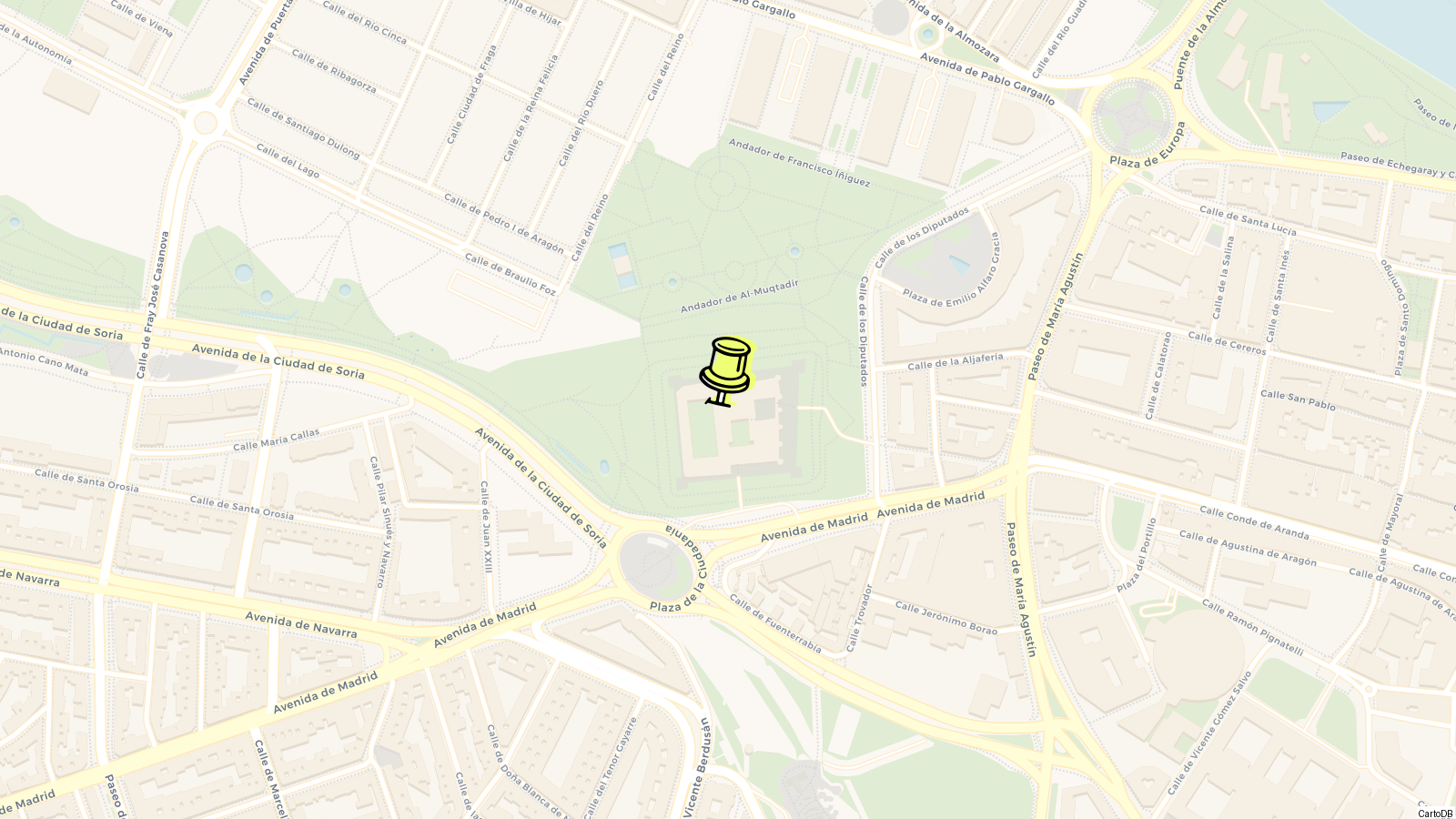
Essential info
Visit details
Overview
Aljafería sits less than 2 km west of Plaza del Pilar, but most people don’t realize it’s the only large 11th-century Islamic palace left standing outside Andalusia. Its construction started in 1065 under the taifa king Abú Ya’far al-Muqtádir, who named it “Qasr al-Surur”, Palace of Joy. The original Arabic name, Al-Yafariyya, morphed into Aljafería over centuries.
Today the palace is still in daily use. The Cortes of Aragón, Aragon’s regional parliament, meets here, which means you’ll occasionally see government types in suits ducking into inner courtyards. Don’t expect an Alhambra-scale operation: for €7 you get to walk through grand Islamic arches, Mudejar halls, and Gothic chapels all under one roof. It’s part museum, part government building, not at all a palace frozen in time.
You’ll see the evolution of architectural styles in a single circuit, horseshoe arches and stucco from the Taifa period, ornate ceilings and halls added by the Catholic Monarchs in the 15th century, Renaissance bastions outside, plus 20th-century restoration that rescued it from near ruin. Unlike many showpiece monuments, here you can get right up close: you’ll stand inside the Troubadour Tower, with graffiti scratched by Inquisition-era prisoners, and duck into the oratory where the original mihrab survives.
What really sets Aljafería apart is that it isn’t just a museum. It’s both a historic symbol and a building Aragon actually uses, one that’s survived conquest, the Inquisition, and military occupation. Most visitors skip it in favor of the Basilica del Pilar, but locals will tell you, if you care about the story of Zaragoza, this is where you actually see it.
Quick tour of what you’ll see
After you pass through the modern security checkpoint, you’ll enter through the thick outer walls built by Philip II’s Italian engineers. The first courtyard is usually empty, then you cross into the ancient corazón of the palace: the Patio de Santa Isabel, with orange trees and water channels, a nod to its Islamic original. Spend a few minutes here to orient yourself.
Head to the north side to find the Gold Hall (Salón Dorado), where medieval yesería covers the walls, though much of the original polychromy is lost. Don’t miss the small mosque (mihrab survives) tucked in the northeast, or the 10th-century Troubadour Tower just west. Upstairs, the Mudejar and later royal rooms show a mashup of architectural styles, including the 15th-century chapel of San Martín.
If parliament is in session, some spaces may be off limits, but you’ll always get the essential loop: the tower, the palace courtyard, the Gold Hall, and at least one of the grand staircases built during the Catholic Monarchs’ expansion. Count on about 90 minutes for a visit, longer with a guided tour.
History
The Aljafería was started in 1065 under Abú Ya’far al‑Muqtádir, ruler of Zaragoza’s taifa dynasty. He called it Qasr al‑Surur, the Palace of Joy, which might sound optimistic considering how many armies and institutions have taken it over since then. The core was an Islamic fortified palace, with elaborate stucco arches and geometric ornamentation you’ll still spot today if you scan the arcades and ceilings of the main halls.
But the oldest part of the complex is actually the Torre del Trovador, a thick-walled five-story defensive tower built in the late 10th century under Muhammad Alanqur, before the good times even started. The doorway was positioned two meters up, climbable only by ladder, to keep out unwanted guests. Later it doubled as a prison, especially notorious when the Inquisition set up inside the palace in 1486. You can still see prisoners’ graffiti carved into the stone, next to views that inspired both a 19th-century Spanish play and Verdi’s “Il trovatore.”
Once Alfonso I conquered Zaragoza in 1118, the palace shifted over to Christian royal hands and saw the usual repairs and church conversions, but kept most of its Islamic layout for nearly two centuries. It was Pedro IV “the Ceremonious” (1336-1387) who expanded things seriously. He added the Gothic-Mudéjar Chapel of San Martín and built out the palace’s floorspace, but still left the heart of the earlier palace intact.
The Catholic Monarchs got their turn in 1488, using Mudéjar bricklayers to lay out an ornate new royal section, including a ceremonial staircase and the coffered “Hall of the Lost Steps”. Check the ceilings for the yoke and arrows, classic Catholic Monarchs symbols still left from their reign.
By 1593, the royal glory days were long gone, and a new engineer (Spannocchi from Siena) was hired to reshape the palace into a military fortress. He dug a huge moat, added thick new bastions, and constructed functional rooms for housing regiments. Troops bunked here, not nobles. The walls and structural layout you see when you first walk up date from this phase, or from the heavy 18th-century barracks remodeling ordered under Charles III.
Queen Isabella II visited in 1845 and was so alarmed at the palace’s condition she organized restoration work, but it wasn’t until 1947 that the big rescue efforts began in earnest. Francisco Íñiguez spent decades stabilizing and reconstructing the palace, balancing Islamic, Mudéjar, Gothic, and later elements (not always seamlessly, you’ll spot it if you look for stucco differences between sections). Work carried on after his death in 1982 and continues every few years as budgets allow.
The Aljafería wears its centuries in public: Islamic courtyard, Gothic-Mudéjar chapel, Catholic Monarchs throne rooms, Renaissance military defenses, and 20th-century restoration projects all layered in one walkable complex. Today it also has a political life again, the Cortes de Aragón, the regional parliament, meets inside, and official meetings sometimes cut off sections from tourist access.
Inquisition, Prison, and Troubadours
The Inquisition set up shop in the Aljafería in 1486, using both the main buildings and the Troubadour Tower as holding cells and tribunals. The graffiti you see scratched into the tower’s walls date from this era up into the 19th century, when the site was still a prison under the governments of the time, even fodder for local legends and the later García Gutiérrez drama that inspired Verdi.
UNESCO and Modern Life
After the end of military use in the 20th century and several decades of restoration, UNESCO listed the Aljafería as part of the “Mudéjar Architecture of Aragon” World Heritage grouping in 2001. The interplay of Islamic and Mudéjar details makes it a case study for architecture students, not just a backdrop for touring dignitaries or local schoolkids. It’s not unusual to see an official car or delegation here; just check the daily schedule if you want to avoid the sections closed for government meetings.
Visiting
Entry for the Aljafería is €7 per adult, or €9 if you want a guided visit; book your ticket ahead on the official site because tours in English are limited and walk-up availability is unreliable, especially on weekends. Summer hours (April–October) run 10:00–14:00 and 16:30–20:00 daily; in winter (November–March) it’s 10:00–14:00 and 16:00–18:30, with only the morning slot open Sundays. Your ticket is tied to a time slot. Count on 90 minutes minimum, 2 hours if you really explore. Entry is wheelchair accessible.
Once inside, skip the Parliament wing (off-limits anyway) and focus on the palace itself. The first part you’ll hit is the open Courtyard of Santa Isabel, a sunken rectangle of bitter orange trees and white gravel, bracketed by horseshoe arches and porticos. On the north side, the Golden Hall (Salón Dorado) faces you, peek at the multi-lobed arcades, then head in to see what’s left of the polychrome stuccos and intricate geometric patterns overhead.
If you follow the signs east, you’ll find the tiny oratory: a private mosque for the original rulers. Look for the mihrab in the southeast corner. Head up a narrow set of stairs to reach the so-called Palace of the Catholic Monarchs. The grand staircase is all carved yeserías and late-Gothic wood. Upstairs, the main throne room is supported by five octagonal pillars, and the ceiling is a grid of gilded wooden panels, stand here and trace the coats of arms high up, and try to picture how cramped the place would have felt with all of Ferdinand and Isabella’s court packed in.
Head to the Torre del Trovador (Troubadour Tower), the squat brick keep in the northeast corner. The inside is raw and stark: thick walls, uneven stone floors, old graffiti. This tower was used as a prison by the Inquisition for centuries. From the ground floor, climb up to see the oldest Islamic arches, simpler and heavier than the fluttery ones in the Golden Hall.
Full walkthrough for the curious
- Entry/check-in: Arrive 10–15 minutes before your booked slot. If you booked a guided visit, meet your group by the main entrance. Only one tiny bag allowed, bigger bags get left in lockers.
- Courtyard of Santa Isabel: Spend a minute here. Photograph the reflection of the arches in the narrow pool to the south (original; the north pool was rebuilt in the 20th-century).
- Golden Hall / Salón Dorado: Main event for Taifal-era architecture. Check the column capitals and the yesería work. The west royal bedroom is lost, but you can see the outline.
- Private mosque / Oratory: Usually quiet. Interior has some original paint and carefully restored arch motifs in blue, red, and gold.
- Mudéjar halls (upper level): Walk up. These long, rectangular rooms were added by Peter IV. The ceilings here are wood with geometric star patterns; east side room has an octagonal wood dome overhead. Don’t miss the intricate doorways circumscribed in “alfiz.”
- Palace of the Catholic Monarchs (upper N wing): Gilt artesonado ceiling, grand staircase, chunky coats of arms.
- Chapel of San Martín: Gothic-Mudéjar mix, lots of pointed arches. Portal outside has a double-alfiz. Entry isn’t always possible; sometimes locked for official events.
- Tower of the Troubadour: You may need to double back. Access can be confusing, but check for a small sign near the north wall. If open, climb; if not, look through the window at ground level.
- Military section (west): Skip unless you’re into 18th–19th-century garrison architecture. Much of it is closed, used for Cortes offices.
There’s minimal signage explaining the rooms, but the best details are in the stonework, ceilings, and brick. If you want more context, go for the guided tour, otherwise, download the official PDF from the website before you come.
Special exhibitions (like 2024–25’s Goya show) are included with ticketed entry, but note that these can close part of the palace for weeks, and draw a crush of out-of-town visitors, expect lines at the entrance and in key halls during big events. The rest of the year, the palace stays fairly calm even on weekends.
Tips
-
The Aljafería runs two schedules: summer (April–October) and winter (November–March). Afternoon closing shifts earlier in winter, so double-check your ticket’s entry time. Sundays in winter are only open in the morning (10:00–14:00).
-
Tickets for English-language guided visits sell out days ahead, especially on weekends or when big exhibitions are mounted. Book directly at reservasonline.aljaferia.com.
-
Bags larger than a daypack are not allowed inside. There’s a free cloakroom at the entrance, but it sometimes fills up, especially during field trips in spring.
-
If you want to see the parliamentary chambers (the Cortes), visit on Saturday afternoons or Sunday mornings when they’re often included in the route. On weekdays, they’re usually closed to visitors due to plenary sessions or official business.
-
No food allowed inside, but there’s a small bar/cafeteria in the visitor center area, think coffee and snacks, not meals. For a real lunch, Plaza San Francisco or Calle Manifestación (20min walk) have better options.
-
The most peaceful time is early afternoon, right after the building reopens (16:30 in summer, 16:00 in winter): school groups are gone and tour bus crowds haven’t rolled in yet.
-
During major exhibitions (like the 2024–25 Goya show), ticket checks are strict and backpack-size enforcement gets real. Arrive a bit earlier and expect a security scan line.
-
Accessibility is pretty good: ramps, elevators, and accessible bathrooms are available. Still, some upper rooms and towers have steep stairs or uneven floors that can’t be fully adapted.
-
The palacio’s Moorish plasterwork and wood ceilings are best seen in natural light, so a sunny morning will give you the sharpest photos.
Getting There
The Aljafería is about a 20-minute walk west from Plaza del Pilar. Taxis will drop you at the gate (Plaza de la Aljafería). The closest tram stop is “CaixaForum” (about 12 minutes on foot) and the Delicias train/bus station is also walkable (15 minutes, not very scenic). Bus lines 34 and 51 stop nearby.
Free Entry Days
On the first Sunday of the month, and the first Monday afternoon, entry is free, but expect lines and big crowds, especially before lunch.
Kid Logistics
Aljafería isn’t stroller-friendly in the upper floors or towers. Kids under 12 enter free, but older kids need a ticket. If you’re with a family, bring a sheet of paper: the Tower of the Troubadour has graffiti carved by prisoners, and kids like to make pencil rubbings.
Photography
Tripods aren’t allowed. Phone photos are fine everywhere except the main parliamentary chamber on busy days. Flash is discouraged, those polychrome details aren’t getting any younger.
Know this destination? Help us improve
Your local experience is valuable to other travelers.