Casa Batlló
You’ll pay €29 for entry, but there’s a psychedelic “Cube” digital room inside Casa Batlló that Gaudí definitely never saw coming

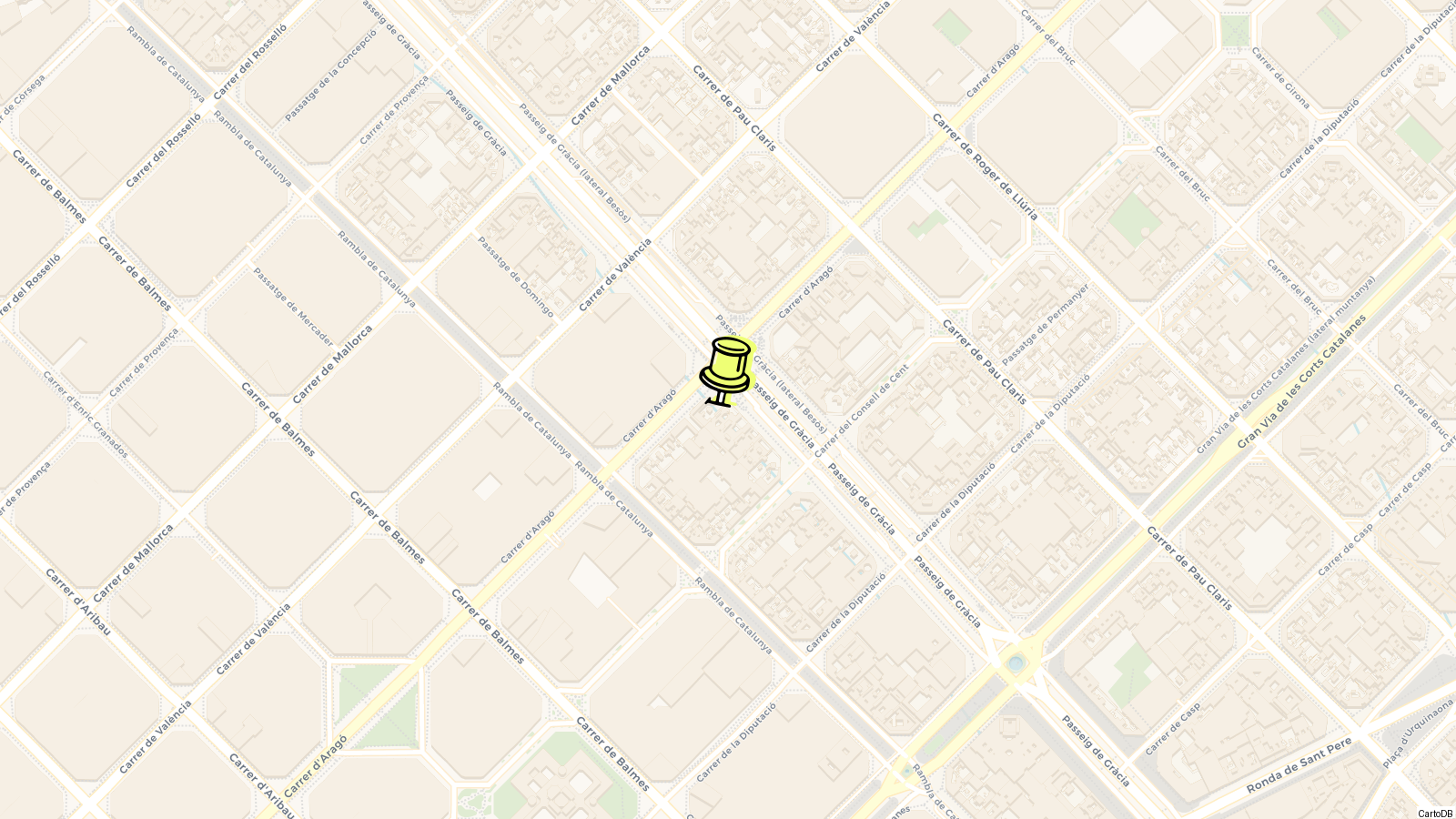
Visit details
Overview
Casa Batlló sits at Passeig de Gràcia, 43, right in the heart of Barcelona’s Eixample neighborhood, and charges €29 for a standard adult ticket bought online, which gets you access from 9:00 to 21:00 plus an audioguide and the “Cube” digital experience. Designed by Antoni Gaudí as part renovation, part architectural flex, it’s the building with the swirling, skeletal façade that locals call the “Casa dels ossos” (House of Bones).
Once inside, you walk through spaces where hardly a single element runs straight. Everything bends, curves, or splinters, window frames, railings, even the interior walls. The central lightwell shimmers in shades of blue, getting darker the higher you go, and the roof above it is unmistakable: arched like the back of a dragon, complete with iridescent tiles and spiky ridges. The rooftop chimneys look sculpted more for theater than for utility.
Casa Batlló gets some serious traffic: around 930,000 people a year, which is a ton for a single building of less than 500 square meters footprint. There’s a reason for the hype. The place isn’t just an outlier on the block; it’s a UNESCO World Heritage Site, and the showpiece of the Illa de la Discòrdia, a whole row of architectural weirdness from Barcelona’s Modernisme boom. The house’s nickname, “House of Bones,” sticks: the balconies are shaped like skulls, the pillars like femurs. The effect is more organic than anything else in the neighborhood.
The main floor, originally the Batlló family’s apartment, is over 700 m² and opens onto a huge, curling window bowed over Passeig de Gràcia. Don’t miss the mushroom-shaped fireplace alcove, which couples used for “courting” with a little privacy (or at least as much as you get with festival crowds tramping by). The upper stories, loft (all white catenary arches), and roof are all open to the public. Museum-like, yes, but don’t expect glass cases, the drama is the architecture itself.
The building’s address, Passeig de Gràcia, 43, puts you a 4-minute walk from both Casa Amatller and Casa Lleó Morera, so you can see three Modernista facades practically back-to-back. If you want to see Gaudí’s work without the Sagrada Família’s chaos, Casa Batlló is the compact, eccentric option.
More detail: why Gaudí’s choices matter
Gaudí’s goal was to avoid straight lines altogether. The entire façade is covered in broken ceramic tile (trencadís), grading from orange to blue. The main roof arch is a direct reference to the dragon of the Saint George legend, a favorite theme in Catalonia, stabbed by the angled turret-cross.
It’s not just surface weirdness. The blue central lightwell (the “atrium”) actually gets darker higher up to balance out Barcelona’s daylight, so every floor gets an even wash of light. The private rooms have built-ins designed by Gaudí, including a famous oak “confidant” bench.
Casa Batlló has gone through several lives: a private home, insurance company offices, almost a venue for demolition, and since 2002, a full visitor experience. Events are staged here on summer nights, and its ground-floor shop is at the top of every compiled “best museum shops in Barcelona” list.
Design & architecture
The bone-like balconies on the façade aren’t props: locals actually call it “Casa dels ossos” (House of Bones) because the sandstone columns look like femurs, and the balcony railings suggest jawbones with teeth. Gaudí avoided straight lines like the plague. The front is a rolling, almost liquid surface, covered in trencadís (broken-ceramic mosaic) that shifts from oranges and greens up into blues, supposedly like a pond with water lilies, though plenty of people just see an excuse for wild color splashes.
The “dragon back” roof is the one you’ll see on souvenir t-shirts: arched, with overlapping ceramic scales in shifting colors, and a spine-turret capped by a cross-shaped finial pointing to the cardinal directions. It’s a fair bet Gaudí meant for the roof to evoke the legend of Saint George slaying a dragon, Catalans can’t resist weaving that story in.
Step inside, and you’ll see Gaudí wouldn’t let even the handrails, ceilings, or skylights be boring: light pours through stained glass, and doors, walls, and banisters are all weird biomorphic shapes, designed for specific functions (ventilation, light, making a fireplace feel like a mushroom cave). The fireplace in the main floor salon is set inside a structure that hugs two people, a “courting corner” for Batlló’s daughters.
Climb up, and you encounter the blue light well, a shaft expanding upwards, lined with tiles that are paler at the bottom and deep indigo at the top. This isn’t a random fade: the variation compensates for the brighter natural light streaming in higher up, so every floor sees more even lighting. The windows get bigger lower down for the same reason.
The attic and loft are pure Gaudí minimalism: all white, arches upon arches, a ribbed tunnel effect that’s both spare and hypnotic. These used to be workspaces for the servants, now they’re what most people photograph the moment they’re allowed up there.
What’s actually original?
The wild façade dates from the 1904–1906 remodel Gaudí carried out for the Batlló family, but the foundation is from the 1877 structure. Some windows, the main staircase and halls, and several inner walls are original, but Gaudí’s team (which included Domènec Sugrañes, Josep Canaleta, and Joan Rubió) reworked everything from the basement to the rooftop.
Gaudí even specified the ironwork, doorknobs, furniture, and railings. Some pieces, like the iconic oak chairs and prayer desk, were designed in 1906 for the Batlló family and replicas appear throughout the house today.
Roof terrace
Head to the roof and you get two sets of photo ops: the four ornate chimneys decorated with trencadís, and the “dragon’s spine” running the length of the roof. Some details: the chimneys are grouped to prevent backdrafts (functional, not random whimsy), and that bulb-topped tower isn’t just a decorative nod, it sports ceramic monograms for Jesus, Mary, and Joseph, which is pure late-career Gaudí.
Façade mechanics
Look for the cast-iron arms above one narrow balcony toward the top of the building. These are actual supports for a pulley system, used for hoisting furniture in and out through windows, because the stairways are tight.
Where the trencadís stops, the glasswork starts, over 330 round pottery discs, often with glass inserts, reflecting light like ripples in a pond. The sand-colored lower façade is sculpted into what feels like opened mouths (hence the other nickname, “house of yawns”), and the main floor windows are set with fine stained glass that throws colored blobs on the mosaic floors.
This isn’t just ornament for ornament’s sake: ventilation, daylight, and temperature control are all embedded in the design. Tilted wooden shutters, air-vent holes hidden in decorative wood, roof shapes that channel rain to cisterns, Gaudí obsessed over these details. Every fanciful shape does something.
Barcelona’s city council didn’t give Casa Batlló its “best building” award in 1906 (Gaudí lost to a more conventional entry), but its 2005 listing as a UNESCO World Heritage Site speaks for itself. When you’re on Passeig de Gràcia, you can’t miss it, none of its neighbors on the so-called Illa de la Discòrdia look even remotely similar.
Visiting
You enter through a rounded doorway straight off Passeig de Gràcia, where they’ll scan your pre-booked ticket (buy online if you can, it’s faster and cheaper; official: casabatllo.es/en/online-tickets). Bags get checked, then you’re handed headphones and a “smart guide”, a phone-sized audio/video device keyed to numbers around the house.
The self-guided route starts with the Noble Floor, once the Batlló family’s private apartment. You’re herded up a sweeping staircase under a ceiling full of swirling plaster, past a mushroom-shaped nook that doubled as a fireplace and a seat for two. Parquet floors, colored-glass doors, a study facing Passeig de Gràcia, you can sit in a few places, but most things are roped off.
You then follow the winding stairs to the Central Atrium (lightwell), a vertical shaft tiled in dozens of blues. Step near the windows to see how Gaudí tweaked the tile color as you climb: darker blues at the top, lighter at the bottom, so the shaft feels evenly lit.
The next stop is the Loft. This space is intentionally plain, just arch after arch of whitewashed brick like a ribcage, since it was built as laundry rooms and storage. A few windows frame skyline views. They sometimes project animations or digital art here.
On the rooftop, you’re face-to-face with the tiled “dragon spine” (the city loves to interpret it as a nod to St. George and the dragon) and four mosaic chimneys. The terrace is busy, but you can snag photos with the city below. If it’s too windy, staff may block roof access.
Back inside, everyone exits via a different staircase, with a peek at the blue-tile light well, leading to the shop and down to the immersive “Cube” digital experience (included in a standard €29 ticket). Expect a queue for the Cube. The gift store is worth a browse: Travel & Leisure once put it on its shortlist of the world’s best museum shops. Then you spill out right where you started.
What you actually see on each level
Noble Floor: Original Batlló family main living spaces. Look for: undulating walls, stain-glass windows, the mushroom fireplace. You can stand at some windows and see the procession along Passeig de Gràcia.
Atrium: The “light well”, blue-tiled walls, chunky old iron elevators (rarely used for guests). Gaudí designed this for better airflow and light to every unit.
Loft: Bare, stark, catenary arches with minimal decoration. Modern uses: projections, digital installations, or event space.
Rooftop: Gaudí’s roofscape, rainbow mosaic dragon scales, snaky spire, twisted chimneys. The angled tiles are slick if wet, and it gets crowded on weekends.
Immersive experiences (“Cube”, “Beyond the Façade”) change regularly. Current “Cube” ticket is digital-projection-heavy, about 10 minutes long, and vaguely trippy. “Magical Nights” adds rooftop concerts and a glass of cava starting from €59, but that’s a different ticket.
Accessibility: There’s an elevator, but its use is restricted, and some staircases are unavoidable, call ahead if mobility is a concern.
Photos: Allowed nearly everywhere (no flash or tripods). Staff don’t rush you, but peak times get packed, so early and late slots are cheaper for a reason.
Time: The full circuit, including Cube and shop, is about 60–90 minutes. Add 20–30 minutes if you linger or hit a bottleneck.
History
Casa Batlló started life in 1877 as a regular flat block built for Lluís Sala Sánchez, just another multi-story building along Passeig de Gràcia in Barcelona’s expanding Eixample district. In 1903, it got a new owner: Josep Batlló, a textile tycoon with factories around the city and enough cash to live wherever he liked. Batlló deliberately chose this location not because the building was beautiful (it wasn’t), but because this street was where every well-to-do family in Barcelona wanted to be seen, with the “Illa de la Discòrdia” hosting several architect-designed mansions side by side.
Batlló asked Antoni Gaudí for a complete teardown and fresh build. Gaudí talked him out of it, convinced him to keep the old bones, and cooked up a renovation that started on paper in 1904 and wrapped up in 1906, with his team, Domènec Sugrañes, Josep Canaleta, and Joan Rubió, handling all the technical details. Gaudí shifted the main family residence to the “principal” floor and famously expanded the building’s central light well, flooding the interior with daylight in a way nobody else on the block had managed. He added new stories, rebuilt facades, ripped out almost every right angle, and covered the front in broken ceramic shards, setting the tone for the Barcelona Modernisme that tourists photograph today.
Batlló and his wife Amàlia Godó lived there till the 1950s. Gaudí’s design won admiration but didn’t take the city’s architecture prize, the jury that year went for someone safer. After Josep’s death in 1934 and Amàlia’s in 1940, their children kept the house until they sold it in 1954 to Seguros Iberia, an insurance company that ran offices out of the gutted interiors. That era’s renovations didn’t care much about Gaudí’s details.
Between the mid-20th century and the 1990s, Casa Batlló wore a lot of hats. In the 1970s, some interior rooms were redone, and the balconies restored to original color. In 1984 (the same year Gaudí’s works got early UNESCO status), the exterior got dramatic lighting for the Mercè festival. When the current owners took over in 1993, they started long, careful restorations to bring the house back to its early-1900s style. By 1995, the building was hosting big events and parties, imagine having cocktails under the “dragon’s back” roof instead of in your average hotel ballroom.
In 2002, the house opened to the public for the first time as part of the “International Year of Gaudí.” The visitor route kept expanding: first just the noble floor, then the loft, roof, and central atrium, each layer revealing more of Gaudí’s obsessive detail. The big UNESCO World Heritage Site designation came in 2005, finally cementing the building’s status as essential Gaudí. Now, close to a million people walk through it every year, seeing the same wild colors and organic shapes that shocked Batlló’s neighbors in 1906.
Tips
-
Book as far ahead as possible. Casa Batlló pulls around 930,000 people a year and time slots sell out, especially weekends, public holidays, and May–September. Tickets at the door cost more and you risk missing your preferred entry time, so stick to their official website.
-
Go first thing or late evening for fewer crowds. 9:00 AM and the last entry window (7:45 PM for daytime tickets, 8:30 PM for “Night Visit”) have a much better visitor-to-space ratio. If you want the place (almost) to yourself and don’t mind paying, the “Be the First” pass (€45, 8:30 AM access) gets you in before the regular crowds.
-
Each ticket includes an audioguide and access to the Cube digital experience, but “Magical Nights” (visit + rooftop concert) and immersive exhibitions are extra, read descriptions, as the basic €29 ticket won’t get you into everything.
-
Accept that you’ll wait at the entrance even with a timed ticket. Security and bag check can add 5–15 minutes during busy times. Don’t book a tour elsewhere in town on a tight schedule.
-
Ignore Passeig de Gràcia’s street touts: stick to tickets bought at the official site or desk. Most “skip-the-line” upcharges are unnecessary unless it’s a peak tourist week.
-
Plan for stair climbing. The main elevator is original (and tiny, slow, or reserved for accessibility). You’ll do plenty of steps, especially to reach the rooftop.
-
The shop on the ground floor is much more than postcards, some design objects are actually worth a stop, and Travel & Leisure once named it one of the best museum shops in the world.
-
Large bags aren’t allowed inside. There’s a luggage check but it’s not designed for big suitcases, leave those at your accommodation.
-
If you’re sensitive to crowds, avoid Barcelona’s major festivals (Saint George’s Day in April, La Mercè late September). Casa Batlló is a go-to for group visits during these periods.
-
Kids under 13 go free with an adult ticket, but strollers aren’t permitted inside, bring a baby carrier if needed.
-
No food or drink is allowed in the exhibition areas, but there are plenty of cafés one block up or down Passeig de Gràcia if you need a break before or after.
Want those rooftop summer cocktails?
The “Magical Nights” ticket (from €59) gets you early-evening entry, plus a rooftop concert and a drink. These run May–October, starting 8:00 PM for the visit and 9:00 PM for the music. It isn’t a cheap night out, but the views and crowd are good if you want atmosphere over solitude.
-
Passeig de Gràcia is a pickpocketing hotspot any time there are crowds at the entrance. Secure your phone and wallet before queuing.
-
If ticket prices make you wince, the immersive exhibit “Beyond the Façade” runs €15, a cheaper way to get a sense of Gaudí’s vision, though you’ll skip the actual historic interiors.
Know this destination? Help us improve
Your local experience is valuable to other travelers.