Sé Cathedral of Angra do Heroísmo
The largest church in the Azores, rebuilt after 1980

Essential info
Visit details
Overview
The Sé of Angra do Heroísmo is the largest church in the Azores and the cathedral of the whole archipelago, begun in 1568 on the site of the 15th-century church of São Salvador when the Crown, under the Cardinal-King Henrique, finally paid for a seat worthy of the diocese created in 1534; it is a broad, plain Mannerist church in the Portuguese “arquitectura chã” style, with twin bell towers holding 32 bells, that fills a block of the World Heritage town centre.
It has been through the island’s disasters: the earthquake of 1980 wrecked it, a bell tower fell in 1983 during the repairs, and a fire in 1985 destroyed the gilt altars, the organs and the painted ceilings, so the interior is largely a reconstruction. Open daily, with Sunday hours around the Masses.
History
Álvaro Martins Homem began the first church in 1461 and it was finished in 1496; Pope Paul III made it the seat of the new bishopric of the Azores on 3 November 1534, and the first bishop arrived in 1535 to find it too small. The council petitioned in 1536 and 1557, pleading the islanders could not pay, and only in 1568 did the Crown decide to build at its own cost, funding it with 3,000 cruzados a year from the royal rights on woad from São Miguel; Luís Gonçalves Cotta drew the Mannerist plan, the first stone was laid on 18 November 1570, and the building, worked on by Jerónimo de Ruão among others, was finished outside around 1618 and inside through the 17th century, with a clock added to the towers in 1782.
An organ built for a church in Macau, wrecked in a storm off the island, was given to the cathedral by Maria I; the Liberal junta of 1829 melted its silver and small bells for coin in the fort; in 1899 the Gaza king Gungunhana and his fellow exiles from Mozambique were baptised here. The earthquake of 1 January 1980, the tower collapse of 1983 and the fire of 25 November 1985 followed, and the rebuilt church is a regional monument.
Visiting
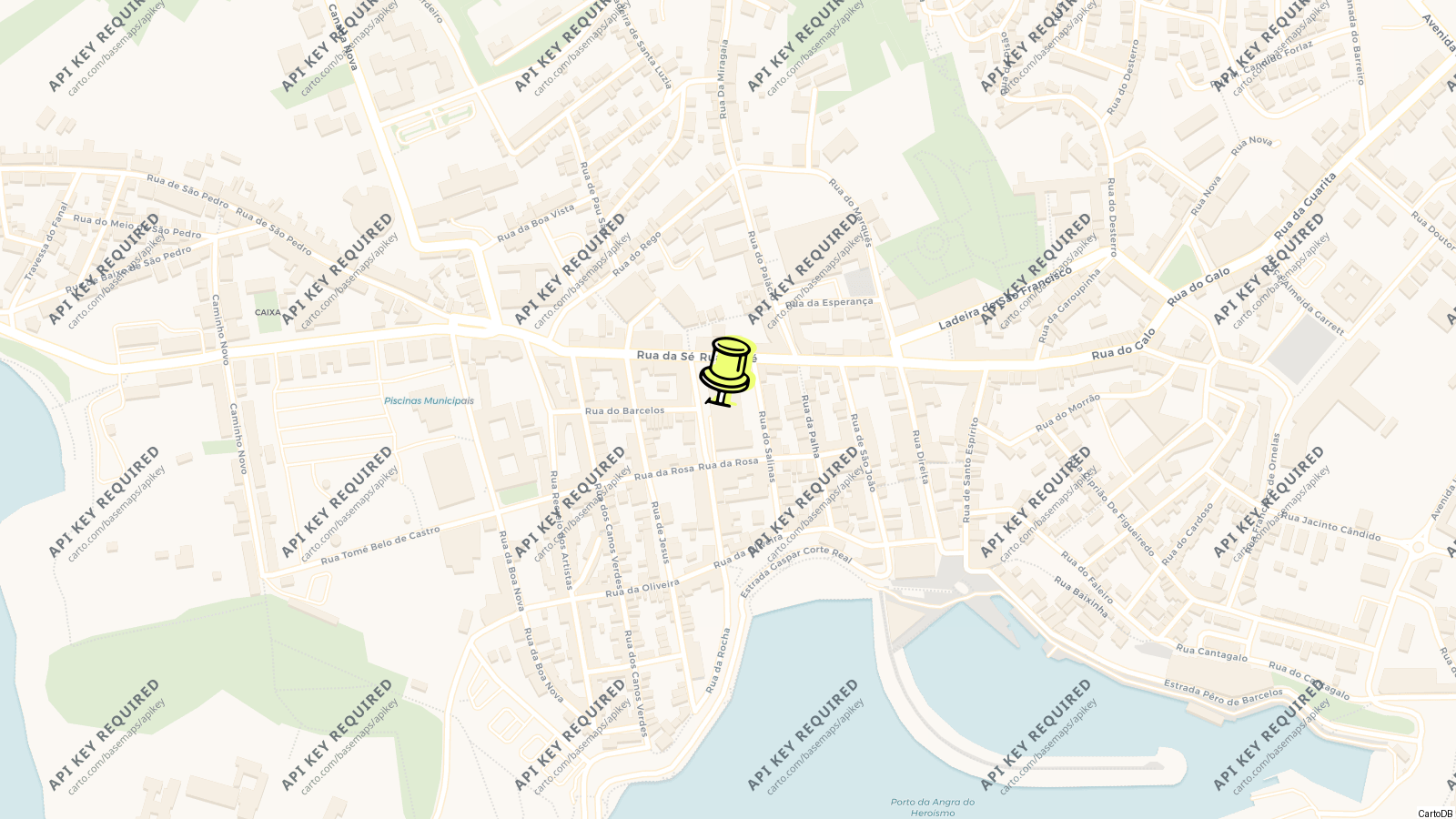
The facade is symmetrical and severe, two towers with two tiers of bells framing a plain front on a churchyard with a staircase down to the Rua da Sé; the church is oriented north rather than east, because the site donated in the 1560s left no room for the traditional axis. Inside are three aisles without a transept, chapels along the sides built by the brotherhoods, and a chancel on Doric columns; the silver altar frontal survived the 1829 requisition and the 1985 fire and is the treasure, and the grand sacristy and the hall of the ecclesiastical tribunal are behind.
The statue of John Paul II outside marks his visit of 11 May 1991; the square and the streets around are the grid of the 16th-century town, laid out on the model of the Renaissance city.
Tips
- Weekday mornings between the early Mass and lunch are the time; on Sunday the church is in use from 09:00 and again in the evening.
- The fire took the Baroque; look for the silver frontal and the stonework rather than the altars.
- The Monte Brasil fort where the Liberals melted the bells is 15 minutes’ walk and has the view over the whole town.
- Angra’s other churches, the Misericórdia on the harbour and São Gonçalo, are the ones with intact gilt interiors.
Nearby
- Praça Velha and the town hall: two minutes.
- Palácio dos Capitães Generais: three minutes.
- Monte Brasil and the São João Baptista fort: 15 minutes.
- Angra do Heroísmo harbour: five minutes downhill.
Know this destination? Help us improve
Your local experience is valuable to other travelers.