Forbidden City
The Ming and Qing imperial palace at the heart of Beijing, home to 24 emperors and now the Palace Museum

Essential info
Visit details
Overview
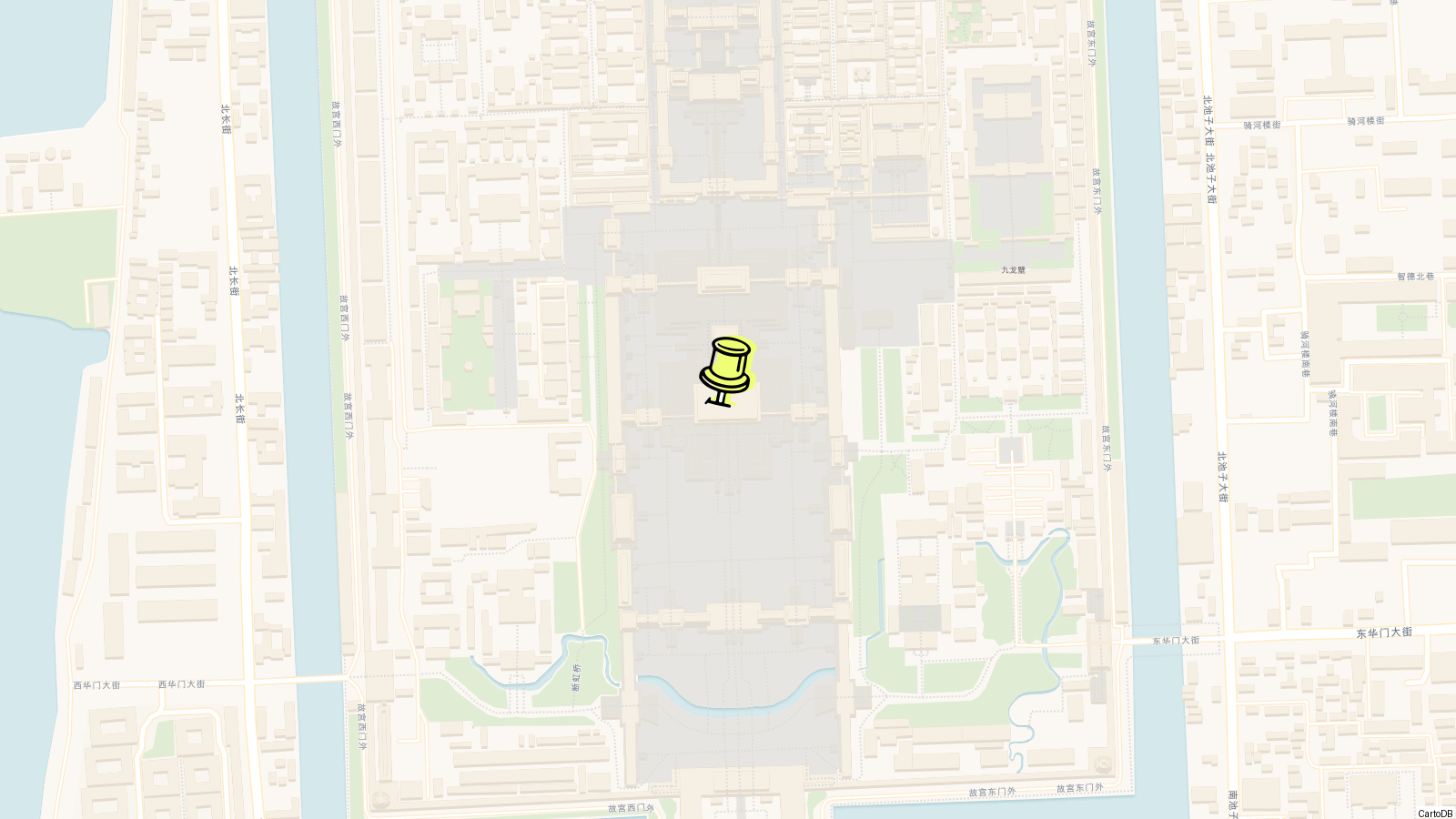
The Forbidden City is the Ming and Qing imperial palace at the centre of Beijing, home to 24 emperors between 1420 and 1924 and the largest preserved palace complex still standing anywhere. It is a walled rectangle of 72 hectares, 961 metres from north to south and 753 from east to west, with 980 surviving buildings behind a 7.9-metre wall and a moat 52 metres wide. You come for the scale and the order of it: one north-south axis runs from the Meridian Gate up through three ceremonial halls on a marble terrace, then on into the tighter courtyards where the imperial household actually lived.
Almost every roof is glazed in yellow, the emperor’s colour. The two exceptions are the library, tiled black because black stood for water and so for protection against fire, and the Crown Prince’s quarters, tiled green for wood and growth. Details like that run through the whole site.
Since 1925 the complex has been run as the Palace Museum (Gugong Bowuyuan), and that is the name on tickets, signs and the booking site; Chinese speakers simply call it Gugong, the old palace. The museum holds about 1.86 million objects built on the Ming and Qing imperial collections, and it took in more than 17 million visitors in 2018, a figure reported at the time as the highest of any museum in the world. UNESCO listed the palace in 1987, and in 2024 it was inscribed a second time as part of the Beijing Central Axis.
Allow a full day if you want the galleries as well as the halls, and about two hours if you stick to the central axis. Everyone enters from the south and leaves to the north or east, so the palace works as a slow walk in one direction through five centuries of court ritual, with detours left and right into porcelain, paintings, clocks and the retirement palace of the Qianlong Emperor.
Visiting
Hours and tickets
Peak season runs from 1 April to 31 October: gates open at 08:30, last entry is 16:00 and the site closes at 17:00. From 1 November to 31 March it is 08:30 to 16:30 with last entry at 15:30. The palace is closed all day on Mondays except on public holidays. Admission is 60 CNY in peak season and 40 CNY from November to March, with a separate 10 CNY ticket each for the Treasure Gallery and the Clock Gallery; those two stop admitting ten minutes after the main last-entry time. Students on undergraduate courses or below pay 20 CNY with ID, and visitors aged 60 and over pay half.
Daily numbers have been capped at 80,000 since 2015. Since 2 July 2011 the route has been one-way from south to north: everyone enters at the Meridian Gate (Wumen) and leaves by the Gate of Divine Prowess (Shenwumen) on the north side or the East Glorious Gate (Donghuamen). The main halls cannot be entered; you look in from the doorway.
Outer Court
The Meridian Gate is the one with two wings projecting forward. Inside it, a wide square is crossed by the Inner Golden Water River and its five bridges, whose balustrades are carved to look like clouds. Side gates off this square lead west to the Hall of Military Eminence, the paintings and calligraphy gallery, and east to the Hall of Literary Glory, the porcelain gallery. Ahead is the Gate of Supreme Harmony, which has been closed for restoration work since 3 August 2026, so expect scaffolding.
Beyond it, a three-tiered white marble terrace carries the three halls that are the point of the whole complex. The Hall of Supreme Harmony rises about 30 metres above the square and is the largest surviving wooden building in China; the Dragon Throne inside has five dragons coiled round its back and arms, and the hall was used for enthronements and imperial weddings. The square Hall of Central Harmony behind it was where the emperor rested before ceremonies, and the Hall of Preserving Harmony was used for rehearsals and for the final stage of the imperial examination. The great carved stone ramp is on the north side of this terrace.
Inner Court
Through the Gate of Heavenly Purity, the axis continues with the Palace of Heavenly Purity, with a tablet reading ‘Justice and Honour’ above the throne; then the small square Hall of Union, which holds the 25 imperial seals of the Qing; then the Palace of Earthly Tranquility, built as the empress’s bedchamber, later a shamanist shrine, and still containing the imperial wedding suite. To either side are the Six Western and Six Eastern Palaces, the consorts’ quarters. The Yanxi Palace in the eastern group is closed for a conservation survey from 1 September to 31 October 2026.
On the west, the Hall of Mental Cultivation is back on the official list of open areas, and the Grand Council offices sit around it. On the east, the Hall of Ancestral Offerings houses the Clock Gallery, mostly European mechanical clocks, including an automaton that writes calligraphy. Further northeast, the Palace of Tranquil Longevity was built for the Qianlong Emperor’s retirement as a palace in miniature, with its own outer court, inner court and garden; he was too busy instructing his son to use it. A glazed Nine Dragon Screen marks the entrance, and the Treasure Gallery inside covers precious metals and stones.
The axis ends at the Imperial Garden, small and dense with pavilions, ponds and old trees, and the Gate of Divine Prowess beyond it. Only about two-fifths of the palace area is open, and wandering off the main line leads to quiet courtyards and padlocked dead ends in equal measure. The four corner towers, with 72 ridges each, are best seen from outside across the moat.
History
Yongle’s palace (1406 to 1420)
The Yongle Emperor, third ruler of the Ming, moved the capital from Nanjing to Beijing and had the palace built between 1406 and 1420, with Kuai Xiang recorded as its architect. The work took 14 years and more than a million workers; whole logs of nanmu (Phoebe zhennan) came from the forests of the southwest, marble from quarries near Beijing, and the floors of the main halls were laid with ‘golden bricks’ fired in Suzhou. The soil dug out for the moat was heaped up just to the north to make the artificial hill that is now Jingshan Park.
The biggest single stone, the carved ramp behind the Hall of Preserving Harmony, is 16.57 metres long and weighs around 200 tons; it was most likely dragged from the quarry on sledges over a road of ice. Yongle moved in before the palace was finished, and the three main halls burned down less than a year after completion in 1420; rebuilding them took 23 years.
The layout is a diagram of the cosmos. The emperor, standing for Yang and the heavens, lived in the Palace of Heavenly Purity; the empress, for Yin and the earth, in the Palace of Earthly Tranquility; between them the Hall of Union, where the two were meant to mix into harmony. Rank was written on the roofs too. Each sloping ridge carries a line of statuettes led by a man riding a phoenix, and the number signals the building’s status: a minor hall gets three or five, while the Hall of Supreme Harmony has ten, the only building in imperial China permitted that many.
Ming to Qing
The palace was the seat of the Ming from 1420 until April 1644, when Li Zicheng’s rebel army took it and he proclaimed himself emperor of a new Shun dynasty. He fled weeks later before the combined forces of the Ming general Wu Sangui and the Manchus, setting fire to parts of the palace on the way out. The Qing kept the plan but renamed the principal buildings to stress harmony rather than supremacy, made the nameplates bilingual in Chinese and Manchu, and introduced shamanist rites. The Hall of Supreme Harmony burned seven times under the Qing and was rebuilt for the last time in 1695 to 1697.
From the Yongzheng Emperor (reigned 1723 to 1735) onwards, the emperors lived and worked in the smaller Hall of Mental Cultivation west of the axis. Yongzheng did not want to sleep in the Palace of Heavenly Purity, where his father Kangxi had died, so that building became an audience hall instead. After the Xianfeng Emperor’s death, the dowagers Cixi and Ci’an governed from behind a silk curtain in the hall’s eastern chamber during the minorities of Tongzhi and Guangxu.
From palace to museum
Puyi’s abdication edict was signed on his behalf on 12 February 1912. Under the Articles of Favourable Treatment he kept his title and the Inner Court, while the Outer Court went to the Republic, which opened a first small museum there in 1914. On 27 June 1923 a fire destroyed the area around the Palace of Established Happiness; Puyi suspected arson to cover theft and a month later expelled almost all the eunuchs. In 1924 the warlord Feng Yuxiang threw him out altogether, and the Palace Museum opened on 10 October 1925.
From 1933 the best of the collection was crated and moved ahead of the Japanese invasion, and after the war it came back to Nanjing. Of 13,491 boxes, 2,972 were shipped to Taiwan in 1948 and now form the core of the National Palace Museum in Taipei; most of the rest returned to Beijing. After 1949 there were several proposals to demolish the complex, and during the Cultural Revolution Premier Zhou Enlai sent an army battalion to guard the gates.
A sixteen-year restoration programme in the early 21st century set out to return every building to its pre-1911 state and to open 76 per cent of the palace by 2020. Work of that kind never really ends: the Hall of Mental Cultivation closed for restoration in September 2018, and the official site still posts new closures most months.
Tips
-
Your passport is your ticket. You show it at the Tiananmen security check, and again at the turnstiles left of the Meridian Gate ticket kiosks, so carry the same document you booked with.
-
Be at the gate for 08:30. The big courtyards are close to empty for the first hour and rammed by mid-morning.
-
Get to Meridian Gate on foot from Tiananmen East or West (Line 1). The walk north through the Gate of Heavenly Peace and the Upright Gate is about 400 metres and only open 08:00 to 16:00, Tuesday to Sunday; taxis usually cannot drop you at the square itself.
-
Rent the 40 CNY foreign-language audio guide after the security gates. It is GPS-triggered, comes in more than 30 languages, and the English version is narrated by Roger Moore.
-
Time the Clock Gallery for 11:00 or 14:00. Twice a day staff wind up and run some of the most elaborate pieces in the collection; it is the best 10 CNY you will spend inside.
-
Bring lunch. No gas fires are allowed in the historic buildings, so the kiosks sell ready meals, noodles and sandwiches at high prices; the café outside the Gate of Heavenly Purity charges 20 to 30 CNY for a coffee.
-
Pick your exit before you reach the garden. The north gate faces Jingshan Park and is 500 metres from Beihai; the east gate is 800 metres from Jinyu Hutong station on Line 8 and from Wangfujing.
-
Ignore the hawkers and flyer-pushers. The museum warns against buying from anyone touting around the gates and gives the palace police station’s number, 010-65131882, for reporting them.
-
No flash or tripods in the exhibition halls, and no smoking anywhere: the museum describes itself as the largest surviving wooden palace complex in the world and has burned many times.
-
Post a card at the Gate of Supreme Harmony. The post box there has given a ‘Palace Museum’ postmark since 2013.
Nearby
Tiananmen Square is straight south of the Meridian Gate, through the Gate of Heavenly Peace. It holds the Monument to the People’s Heroes, the Great Hall of the People, the Chairman Mao Memorial Hall and the National Museum of China on its east side, all inscribed in 2024 as part of the Beijing Central Axis.
The Imperial Ancestral Temple and the Altar of Land and Grain flank the ceremonial way between the square and the palace, east and west. Their halls are built in the same style and on a similar scale to the main palace halls with a fraction of the visitors; the temple park costs 15 CNY, Zhongshan Park around the altar 3 CNY.
Jingshan Park is across Jingshan Front Street from the north gate. Its 45.7-metre hill has five peaks with a pavilion on each and the classic view down over the palace roofs; the last Ming emperor, Chongzhen, hanged himself from a tree here in 1644 after the city fell. Entry is 2 CNY.
Beihai Park is a short walk west along the moat from the north gate: 71 hectares, more than half of it lake, with the 40-metre White Dagoba of 1651 on Jade Flower Island and boats for hire, for 20 CNY.
The Temple of Heaven is the natural second imperial site, also Ming, and Line 8 from Jinyu Hutong near the east gate runs there directly.
Know this destination? Help us improve
Your local experience is valuable to other travelers.