Temple of Heaven
Beijing's imperial altar to heaven, a 267-hectare walled park around the blue-roofed Hall of Prayer for Good Harvests

Essential info
Visit details
Overview
The Temple of Heaven is the altar complex where the Ming and Qing emperors prayed for good harvests, first built in 1420 under the Yongle Emperor, the same ruler who built the Forbidden City, and set inside 2.73 square kilometres of walled parkland in southern Dongcheng District. UNESCO inscribed it as a World Heritage Site in 1998. You come for two things: the Hall of Prayer for Good Harvests, the round, triple-roofed, blue-tiled building that stands in for Beijing on most of the city’s posters, and the park around it, which residents treat as the biggest open-air exercise ground in the capital.
The name misleads. Nobody worships here and there are no monks; it’s an altar precinct with three groups of buildings on a single north to south axis: the Hall of Prayer at the north end, the smaller Imperial Vault of Heaven in the middle, and the open, three-tiered Circular Mound Altar at the south, where the winter solstice sacrifice actually took place. The Hall of Prayer is 38 metres tall and 36 metres across, sits on three tiers of marble and is built entirely of timber without nails. The whole layout is a diagram of the cosmos: circles for heaven, squares for earth, and the number nine, the emperor’s number, repeated in the altar’s steps, balusters and paving rings.
The other half of the visit is the park itself, 267 hectares of playgrounds, exercise areas and open spaces that residents use in the mornings for choral singing and dance. It is one of the greenest places in the city, busy with tai chi and dancing on weekday mornings and at weekends, and a short walk from the monuments, particularly towards the West Gate, the old trees give you something close to solitude. The halls are ticketed separately from the grounds, so decide before you arrive: the architecture, the park, or both.
History
The site has been an imperial altar for six hundred years, and what you walk through today is a Qing rebuild of a Ming plan, with one building (the Hall of Prayer) younger than it looks.
The Altar of Heaven and Earth (1420)
The Yongle Emperor built the complex in 1420, in the same programme of works that produced the Forbidden City, as a single altar to both heaven and earth. Its northern boundary is still the giveaway: the outer wall has a taller, semicircular north end for heaven and a shorter, rectangular south end for earth, and both the Hall of Prayer and the Circular Mound are round buildings standing in square courtyards for the same reason.
Jiajing splits the cult (1530 to 1534)
The Jiajing Emperor built the Circular Mound Altar in 1530 as a dedicated platform for the winter solstice sacrifice to heaven, renamed the whole precinct the Temple of Heaven in 1534, and moved the other cults out to new Temples of the Sun (east), Earth (north) and Moon (west) around the city. His altar was surfaced with deep blue glazed slabs inside a white marble balustrade; the marble you stand on now came later.
Qianlong’s rebuild (1740s)
The Qing reconstructed the complex and the present layout was largely fixed by 1749; the Circular Mound was rebuilt in 1740 and enlarged in 1749 to the form you see, 5.2 metres high with a perimeter of 534 metres, three tiers carrying 72, 108 and 180 slabs (360 in all), and four entrances with nine steps apiece.
The ceremony these stones were built for happened twice a year. The emperor and his entire retinue left the Forbidden City, crossed the city and camped inside the precinct, wearing special robes and eating no meat; no ordinary Chinese subject was allowed to watch the procession or what followed. He bathed and fasted in the Fasting Palace on the western side, a compound of more than sixty rooms around a hall built without beams. The musicians and dancers were trained in the Divine Music Administration, also on the west side. The climax came at the winter solstice on the altar, and it had to be flawless: the smallest slip was read as a bad omen for the whole country in the year ahead.
Fire, occupation and neglect (1889 to 1918)
Lightning set the Hall of Prayer on fire in 1889 and the original Ming building burned to the ground; the replacement was completed in 1896, and that is the hall on the postcards. Foreign troops had already used the precinct once, during the Second Opium War, and in 1900 the Eight-Nation Alliance occupied it for a year as its command post during the Boxer Rebellion.
After the fall of the Qing the precinct went unmanaged; four years after Yuan’s performance, in 1918, it was turned into a public park and opened to ordinary people for the first time.
Public park (1918 onwards)
The park did not escape the Cultural Revolution: the main central altar was destroyed and pieces of it were dumped with other rubble in the grounds. Restoration followed, and in 1998 UNESCO listed the site both for the quality of the architectural ensemble and for what it says about the relationship between heaven and earth in Chinese cosmology. So: the Hall of Prayer is an 1896 reconstruction, the altar is 1740s marble on a 1530 plan, and the plan itself is Yongle’s.
Visiting
The walled park has four gates. The East Gate, at the corner of Tiantan East Road and Tiyuguan Road, is where most people arrive because Temple of Heaven East Gate station on subway Line 5 (open since October 2007; exits A2, B and C, with B and C step-free) sits right beside it. The West Gate on Tianqiao South Street has Line 8’s Tianqiao station and a long list of buses; buses 35 and 106 serve the North Gate.
Hours and tickets
The park opens 06:00 to 22:00 with last entry at 21:00. The ticketed halls (Hall of Prayer, Echo Wall and Circular Mound Altar) open 08:00 to 18:00 Tuesday to Sunday, last entry 17:30, and are closed on Mondays except during statutory holidays. In high season the combo ticket covering park and all three monuments is 34 CNY (17 CNY concession); park-only entry is 15 CNY, or 20 CNY on a passport ticket for visitors without a Chinese ID card. Reservations run 1 to 7 days ahead through the Visiting Beijing Parks or Temple of Heaven WeChat accounts. Sales stop an hour and a half before the gates close.
South to north along the axis
Start at the Circular Mound Altar, the altar proper: three open tiers of marble, each balustrade carved with dragons, with a round slab called the Heart of Heaven at the centre. Count the paving: one central stone, then a ring of nine, then eighteen, and so on out to a ninth ring of eighty-one. Stand on the centre stone and speak: the guardrail throws the sound back at you, which is exactly what the designers intended for the emperor’s voice.
North of it is the Imperial Vault of Heaven, a single-roofed round hall on one marble platform whose dome has no crossbeams, ringed by the Echo Wall, a smooth circular wall that carries sound across its width. The wall is 3.72 metres high and 61.5 metres in diameter. The effect needs a quiet courtyard, which in practice means the first hour after the halls open.
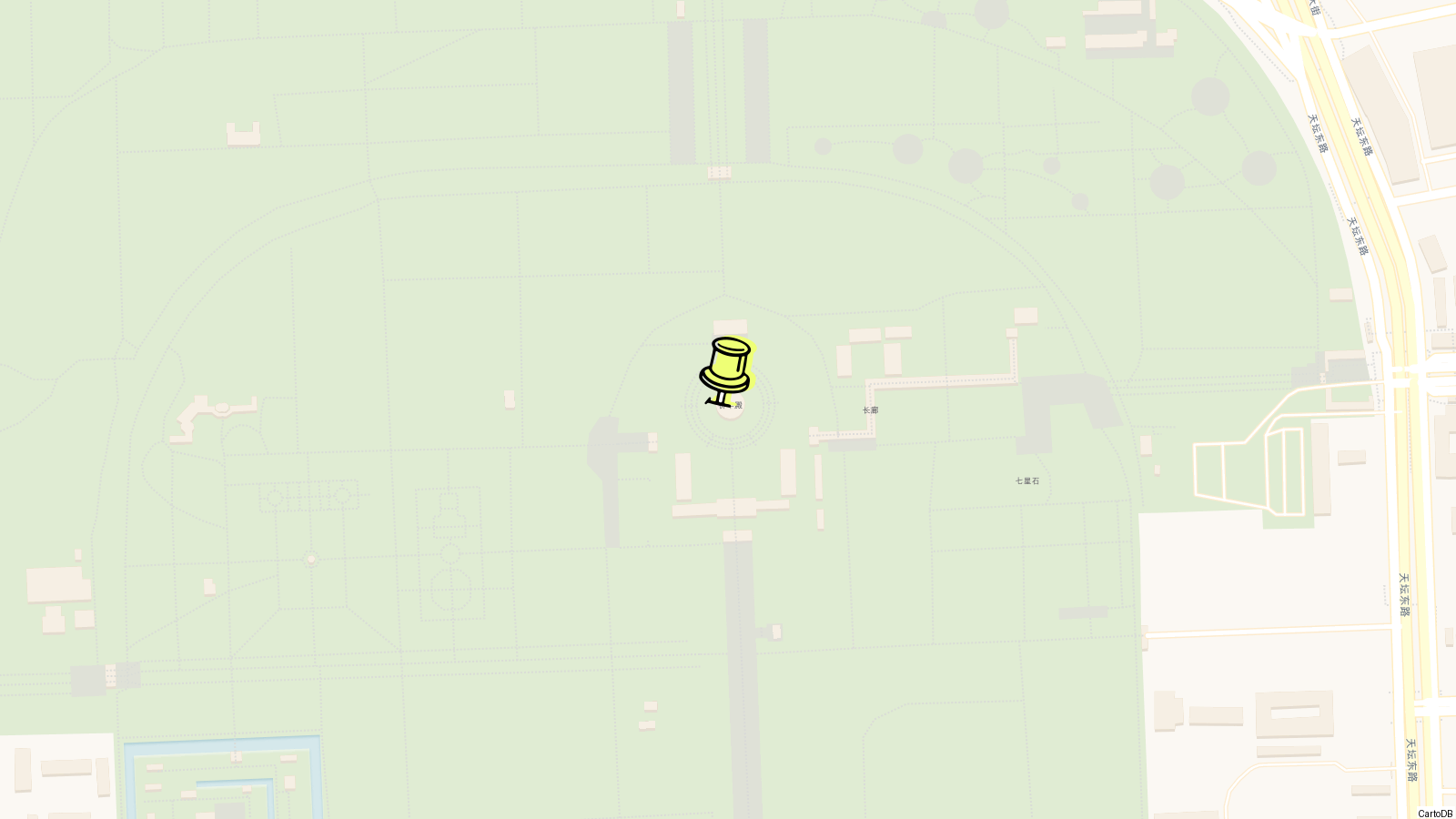
From the Vault, the Vermilion Steps Bridge, a 360-metre raised walkway, climbs gently north to the Hall of Prayer for Good Harvests. Inside, the 28 pillars are the calendar: four inner ones for the seasons, twelve middle ones for the months, twelve outer ones for the two-hour periods of the traditional day, with the middle and outer rings together standing for the solar terms. Every roof in the precinct carries the same dark blue tiles, the colour of heaven. Just east of the hall, the Seven-Star Stones stand for the seven peaks of Mount Tai, the old mountain of heaven worship.
The western half
Most visitors never leave the axis. The Fasting Palace and the Divine Music Administration lie in the western half of the park, and the walk out to them is where the crowds thin and the woods take over. Allow two hours for the axis alone and half a day if you add the west side and a proper look at the morning park; walking the whole grounds takes real time.
Tips
-
Arrive at 06:00, when the park gates open, and treat the two hours before the halls open at 08:00 as the main event. The tai chi, dancing and choir groups are a morning thing; by late morning it is a monument with a queue.
-
Avoid Mondays if you want the halls. The park is open but the three monuments are shut on Mondays outside statutory holidays.
-
Winter is cheaper and shorter. In the winter half of the year the combo ticket has sold for around 30 CNY and the park-only ticket for 10 CNY, and the halls have closed at 17:00 rather than 18:00, so don’t leave the Hall of Prayer until last on a December afternoon.
-
Find the Three Echo Stones. On the paved path between the Imperial Vault’s gate and the hall itself, three flagstones in a line north to south are the spot for the courtyard’s other acoustic trick; try it before the tour groups arrive.
-
Leave by the West Gate. Line 8 from Tianqiao station runs straight to Qianmen, which puts the old gate and Tian’anmen Square at the end of your visit without a change of train.
-
Don’t pair it with the Forbidden City on the same day. Both are half-day walks on a fixed axis. Give this the morning and the Forbidden City another day.
-
Read the numbers, not the plaques. Nine steps, nine rings, four and twelve and twelve pillars: the symbolism is in the counts, and once you know to count you’ll see it without a guide.
Nearby
Hongqiao Pearl Market is a short way from the park. The top two floors are jewellery, with pearls, coral, turquoise and amber, the floor below is small stalls selling decent pearls and beads, and the lower floors are bags, clothing and electronics. Bargain hard and expect a physical hard sell on quiet weekdays.
National Natural History Museum stands at 126 Tianqiao South Street near the West Gate, Tuesday to Sunday 09:00 to 17:00, free. Founded in 1951 and renamed in 2023, it holds more than 200,000 specimens, including a mounted Mamenchisaurus and feathered dinosaurs from Liaoning.
Longtan Park is a lake park with boats for hire and teahouses, open 06:00 to 20:30 for 2 CNY: from Temple of Heaven East Gate station walk 300 metres south to Longtan Road, then 500 metres east.
Qianmen (Zhengyangmen), the Ming gate of 1419 that guarded the southern entry to the Inner City, sits south of Tian’anmen Square with Dashilanr, the old shopping cross-street, beside it; the station is on Lines 2 and 8. The Summer Palace, in the northwest of Beijing, is the other imperial ground worth a full day, but not the same one.
Know this destination? Help us improve
Your local experience is valuable to other travelers.