Porto Cathedral
Romanesque fortress-church with a tiled Gothic cloister

Visit details
Overview
The Sé do Porto is the Romanesque cathedral on the hill where the Roman settlement began, started in the second half of the 12th century on the site of a chapel founded by Henry of Burgundy in 1108, and one of the oldest monuments in the city. It looks like a fortress, two square towers and a crenellated arch over a rose window, and it is where João I married Philippa of Lancaster in 1387, the alliance that still holds between Portugal and England.
The visit is the Gothic cloister with its Baroque azulejos, the silver altarpiece, Nasoni’s loggia, and the terrace over the roofs to the river, which is the first and best view of Porto for anyone arriving at São Bento below; entry to the cathedral is €3, or €6 with the bishop’s palace next door.
History
A pre-Romanesque church stood here in 1147, when the crusaders who helped take Lisbon passed through. The present building was begun in the second half of the 12th century and worked on until the 16th, a narrow barrel-vaulted nave with aisles, its stone roof held up by flying buttresses, among the first in Portugal.
Around 1333 the Gothic funerary chapel of João Gordo, a Knight Hospitaller in the service of King Dinis, was added, and the cloister was built in the 14th and 15th centuries under João I. The Baroque changed the outside: in 1736 Nicolau Nasoni added the loggia on the side facade, and in 1772 a new main portal replaced the Romanesque one and the tower cupolas were altered; inside, the Romanesque apse was pulled down in the 17th century for a Baroque chancel with paintings by Nasoni. During the War of the Oranges a party of Spanish soldiers briefly held the cathedral before the townspeople retook it; a marble plaque backed with magnetite behind the altar commemorates the dead.
Visiting
Open daily, 09:00 to 18:30 from April to October and to 17:30 in winter; Mass is at 11:00. Outside, read the facade: the Baroque porch, the Romanesque rose window above it under a crenellated arch, the two towers with their buttresses and cupolas, and on the north side Nasoni’s loggia of 1736.
Inside, the nave is Romanesque and dark. In a side chapel is the silver altarpiece of the second half of the 17th century; the chancel is Baroque, its altarpiece designed by Santos Pacheco and carved by Miguel Francisco da Silva between 1727 and 1729; the three red marble holy-water stoups are 17th-century and the baptistery has a bronze relief of the Baptism of Christ by Teixeira Lopes. The south transept leads to the Gothic cloister, lined with blue azulejos of 1729 to 1731 by Valentim de Almeida illustrating the Song of Songs, with sarcophagi from the old Romanesque ambulatory; upstairs are the chapter house with Pachini’s painted ceiling of 1737 and the terrace with tile panels by António Vidal and the view.
Tips
- The cloister and the terrace are in the €3 ticket; the nave alone is free but is the least of it.
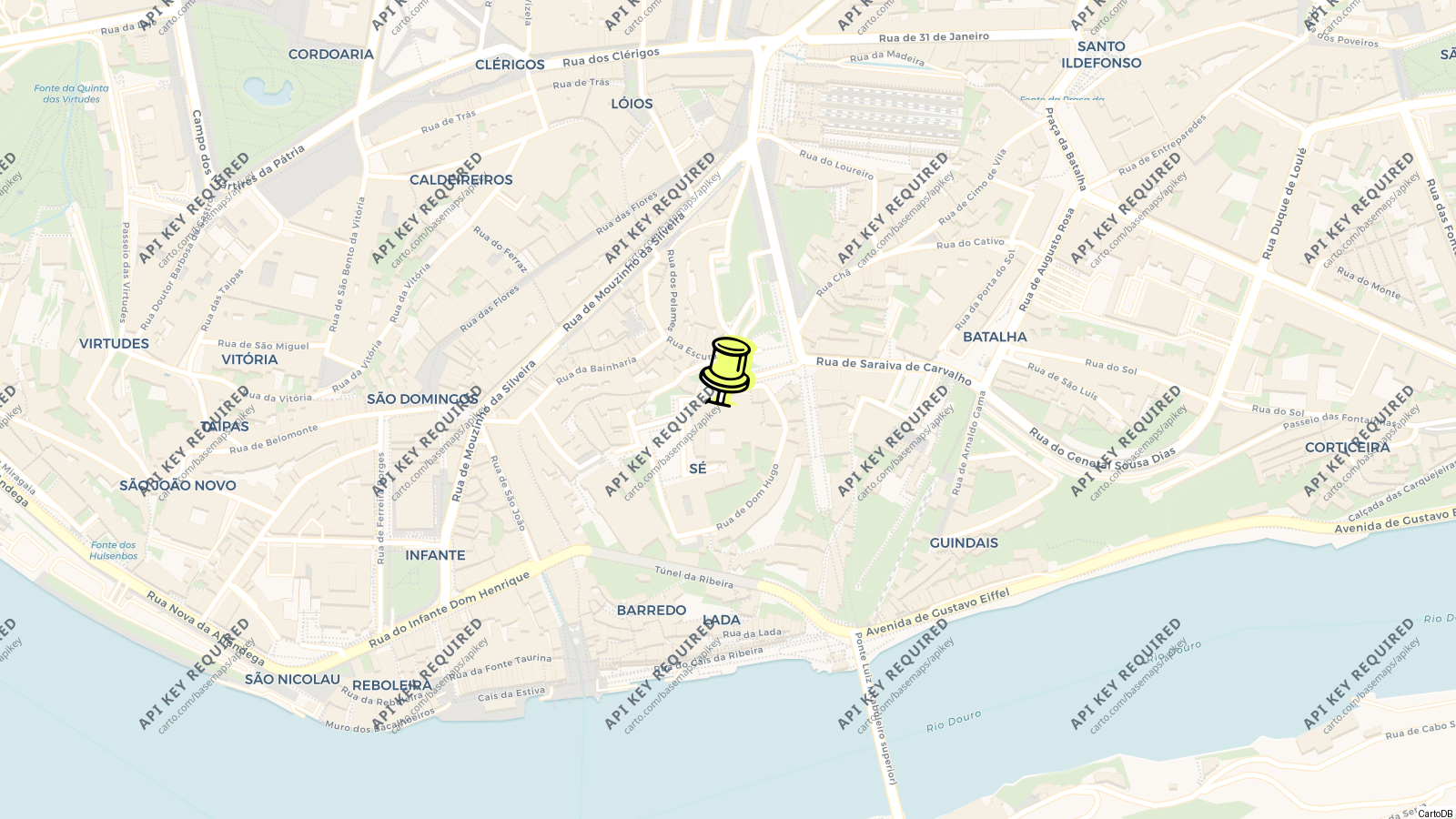
- The Terreiro da Sé outside is the classic viewpoint over the Ribeira roofs and the bridge, free and at its best in the morning light.
- The stairway from the cathedral square down to the river, below the tourist office, is the one spot in the centre where Wikivoyage warns of drunks and incidents; take the road after dark.
- Combine with the Bishop’s Palace on the €6 ticket if you like Baroque staircases; skip it if you are short of time.
Nearby
- São Bento station: five minutes downhill.
- Luís I bridge upper deck: five minutes.
- Ribeira: ten minutes down the stairs.
- Clérigos tower: ten minutes.
Know this destination? Help us improve
Your local experience is valuable to other travelers.