São Bento railway station
Twenty thousand tiles of Portuguese history in a station hall

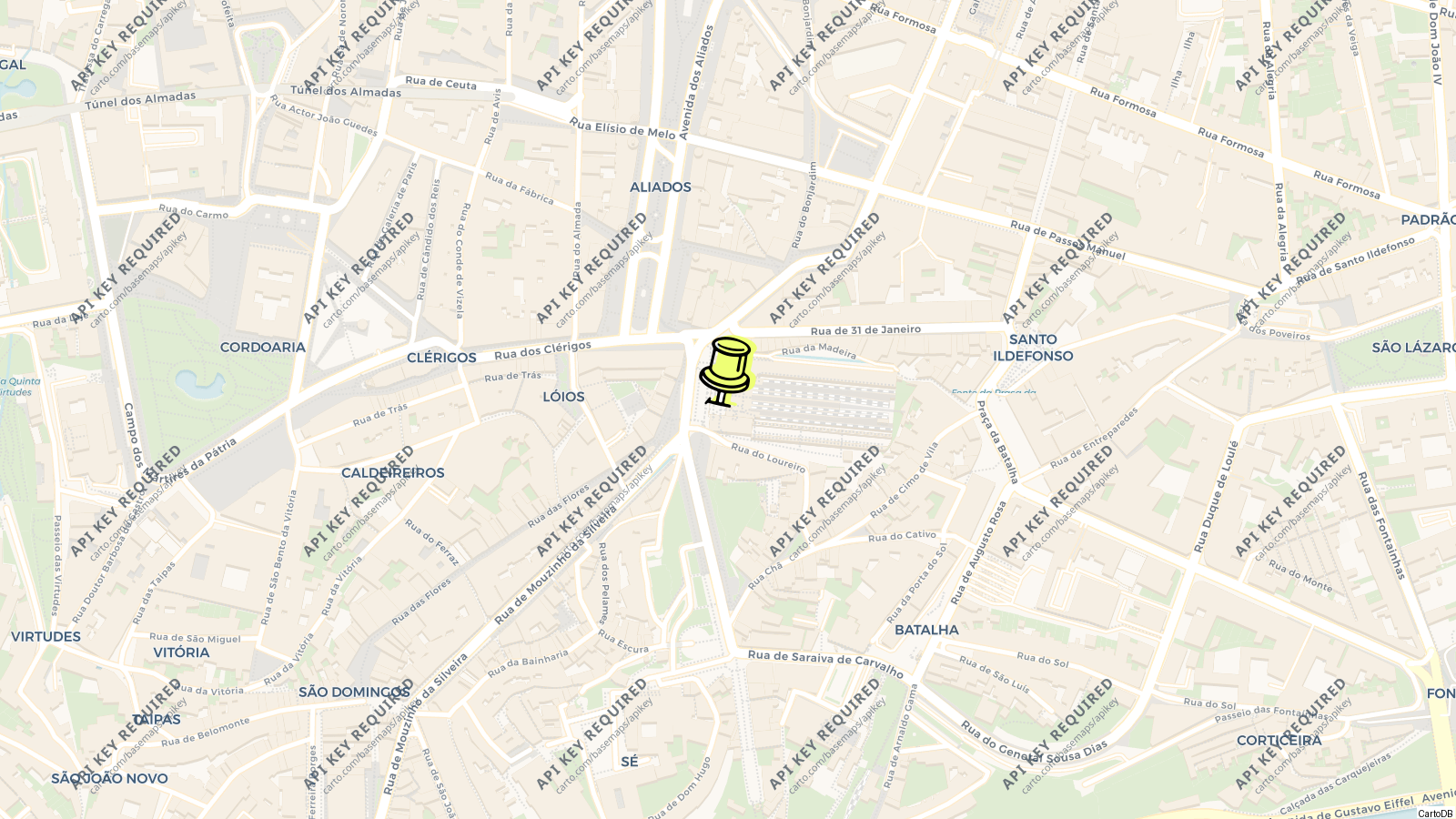
Essential info
Visit details
Overview
São Bento is the railway terminus in the centre of Porto, built from 1904 to the Beaux-Arts plans of José Marques da Silva, and its entrance hall is lined with some 20,000 azulejo tiles by Jorge Colaço depicting the country’s history and its country life. It is a working station, the terminus of the suburban lines to Braga, Guimarães and Aveiro and of the Douro line to Pocinho, and it costs nothing to walk in.
The tile panels took eleven years to install and are the finest public azulejos in the north: the entry of João I and Philippa of Lancaster into Porto in 1387, the conquest of Ceuta, the battle of Valdevez, the Douro grape harvest, all in blue on white, under a coloured frieze of the history of transport.
History
The station stands on the site of the Benedictine convent of São Bento da Avé Maria, ordered by Manuel I in 1518, burned in 1783, rebuilt, and demolished in 1892 when its last nun died. The tunnel through the Batalha escarpment was finished in 1893 and the first train arrived in 1896, before there was a building; King Carlos laid the cornerstone in 1900.
Marques da Silva, trained in Paris, designed the U-shaped granite building facing the Praça de Almeida Garrett; construction began in 1904, the city fell out with him and removed him in 1909, and the whole project took thirteen years. Colaço laid the first tiles on 13 August 1905 and finished in 1916, with tiles made at the Sacavém factory. The station was listed in 1988 and restored from 1992.
Visiting
The hall is open whenever the station is, which is almost always: from 04:15 on weekdays and 05:20 at weekends until just after midnight. Stand in the middle and turn. High up runs the coloured frieze of transport through the ages; below it the great monochrome scenes. On the north wall, the battle of Valdevez of 1140 and, beneath it, Egas Moniz offering his life to Alfonso VII of León after the siege of Guimarães. On the south, João I and Philippa of Lancaster riding into Porto for their wedding in 1387, and below, Henry the Navigator at the conquest of Ceuta in 1415. On the wall towards the platforms, the procession of Nossa Senhora dos Remédios at Lamego, the pilgrimage of São Torcato, a cattle fair, and four scenes of work: the vineyards, the harvest, the wine boats going down the Douro and a watermill.
Beyond the hall are the platforms for the suburban trains; long-distance services use Campanhã, 3 km east, and a local train covers the five minutes between the two on the same ticket.
Tips
- Early morning, before the tour groups, is the only time the hall is empty enough to see the lower panels.
- The panels are captioned in Portuguese only; the scenes above are identified in the order given here, left to right from the entrance.
- The Douro line to Régua and Pocinho starts here, and the river views begin about an hour out; the morning trains fill in summer.
- The metro station of the same name is underneath, on line D, which crosses the upper deck of the Luís I bridge.
Nearby
- Sé do Porto: five minutes uphill.
- Clérigos tower and Livraria Lello: five minutes.
- Rua das Flores down to the Bolsa and the Ribeira: ten minutes.
- Avenida dos Aliados and the Bolhão market: five minutes.
Know this destination? Help us improve
Your local experience is valuable to other travelers.