Lloret de Mar
Costa Brava resort town with five Blue Flag beaches, a modernist cemetery and 17 heritage sites in an open-air museum

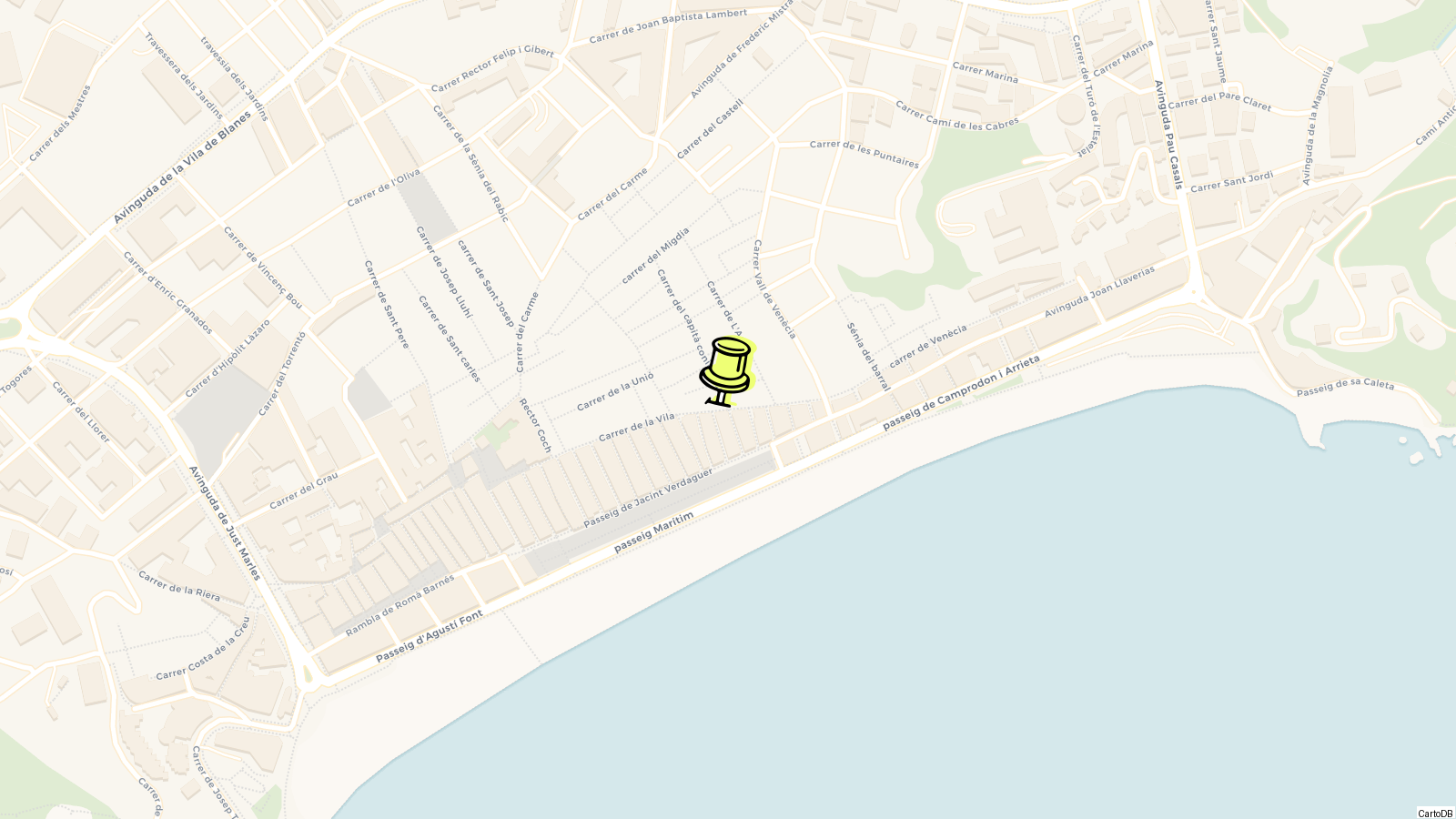
Visit details
Overview
Lloret de Mar is a package holiday resort on the Costa Brava, 40 km south of Girona and 75 km northeast of Barcelona, built around a town beach of 1,630 m with seven more beaches and coves spread along its 9 km of coast. It is the largest sun and sand destination in Catalonia by hotel capacity and the fifth largest in Spain, with roughly 30,000 beds across more than 120 establishments.
That scale is the first thing to understand about the place. Around 38,400 people live here, and in 2013 the town logged 1,017,206 visitors and just under five million overnight stays, four fifths of them foreign. In July and August the seafront works like a small city; in February you can walk the whole beach and pass a dozen people.
The reason to come is the coast: five Blue Flag beaches (Lloret, Fenals, Santa Cristina, Canyelles and Sa Boadella) plus the smaller Sa Caleta, Cala Banys and Treumal, linked by a camí de ronda that clings to the cliffs between them. The reason to stay a second day is the layer most visitors never notice. The town council runs 17 heritage sites under a scheme called MOLL, the Lloret Open Museum, taking in Iberian hilltop settlements, an 11th-century castle, a Gothic parish church, four outlying chapels, a Noucentista clifftop garden and a modernist cemetery.
Most of those 17 sites cost nothing. The heritage service charges for only eight of them, and the dearest is 6.10 EUR. The rest, including the chapels, the historic centre and the cemetery, are simply open. If you have a rainy afternoon or a day when the beach is too full to be worth it, the MOLL sites are the obvious fallback, and several of them sit within fifteen minutes of the seafront on foot.
Foreign residents make up around 40 per cent of the population, arriving mainly from North Africa, Latin America and Asia, so Catalan and Spanish share the streets with a good deal of English, French and Arabic. That mix runs through the food and the shop signs as much as the accents.
History
People were living on the hills above this bay long before anyone built on the sand. Three Iberian settlements have been excavated in the municipality: Montbarbat from the 4th century BC, Puig de Castellet from the 3rd, and Turó Rodó from the 2nd. Puig de Castellet is the one you can walk around, and it is unusually legible.
Built around 250 BC, between the First and Second Punic Wars, Puig de Castellet sits at 195 m and was occupied for only about fifty years before being abandoned around 200 BC. The enclosure is pentagonal, with 11 rectangular spaces of one to three rooms built against the inside of the wall, three kilns, water collection pits, and entrances covered by towers. It was a lookout as much as a village, watching the sea on behalf of the larger settlements inland.
The name first appears in writing in 966, as Loredo. For the next five centuries the population kept its distance from the water, clustered inland near the Chapel of Les Alegries, because the shoreline was not safe from pirate raids. Only in the 15th century did the centre of gravity shift down to the bay.
The Castle of Sant Joan went up in the 11th century on the ridge between the Lloret and Fenals beaches, under Sicardis of Lloret. What you climb today is a restoration, and the reason is a single afternoon in 1805.
The parish church of Sant Romà was built between 1509 and 1522 in Catalan Gothic, a single nave with defensive features, by the master builders Bartolomé Ruffi, father and son, and Pere Capvern of Girona, at a cost of 3,000 Catalan pounds. The church burned in 1936, during the Civil War, but pieces stored in the loft survived, including a reredos commissioned in 1541 from the painters Pere Serafí and Jaume Fontanet.
Nineteenth-century emigration is what gives Lloret its odd architectural richness. Between roughly 1800 and 1840 townspeople left for the Americas, above all Havana and Matanzas, and the ones who came back with money, the indianos, spent it publicly. Their money paid for the modernist side chapels added to Sant Romà in 1916 by Bonaventura Conill i Montobbio, a follower of Gaudí.
It also paid for the cemetery, which is the single strangest thing in town. Indiano families funded a new burial ground commissioned in 1892 from the architect Joaquim Artau i Fàbregas and laid out like a miniature city, with avenues, promenades, squares and blocks.
Josep Puig i Cadafalch designed the Costa i Macià family vault in 1902, carved with gargoyles and Dance of Death imagery. Conill i Montobbio built a run of hypogea between 1903 and 1909, among them the Durall i Suris tomb of 1903 with its angel and cross, and the Esqueu i Vilallonga vault of 1909, which carries a dragon and the inscription Ego sum vita. The cemetery belongs to the Association of Significant Cemeteries in Europe and sits on the European Cemeteries Route.
The last piece of indiano money went into a garden. Doctor Raül Roviralta i Astoul commissioned the Santa Clotilde Gardens in 1919 from Nicolau Rubió i Tudurí, who terraced them down a clifftop above Sa Boadella cove. Tourism arrived at almost the same moment: the first summer villas were built in 1918 and the first hotel, the Costa Brava, opened in 1920. The Civil War stopped that for a generation, and the mass building only began in the 1960s.
Even the mock fortress above Sa Caleta belongs to this in-between period rather than the Middle Ages. Castell d’en Plaja was built in 1935 as a summer house for the Girona industrialist Narcís Plaja, to a design by the architect Isidor Bosch.
Visiting
Nothing about the town itself is ticketed. The beaches, the camí de ronda, the historic centre and the cemetery are all free to walk into, and only eight of the 17 MOLL heritage sites charge admission, the dearest at 6.10 EUR. Children under 12 go free at all of them.
Start on the sand. Platja de Lloret runs 1,630 m by about 45 m of coarse white sand, straight through the middle of town. At the northern end stands the Dona Marinera, a 2.4 m bronze of a fisherman’s wife made in 1966 by Ernest Maragall. Above her sit Castell d’en Plaja and, on the 40 m promontory behind it, the Iberian remains of Turó Rodó.
Walk south and the beaches get smaller and quieter: Fenals at 700 m of coarse sand, Sa Boadella at 250 m, then the fine sand of Santa Cristina (450 m) and Treumal (400 m), with Canyelles at 450 m round the other side of town. Cala Banys and Sa Caleta are rock rather than sand.
The link between them is the camí de ronda, part of the GR-92 Mediterranean trail, which covers 583 km of the Catalan coast in total and about 30 km within Lloret, from the Cadiretes massif to the river Tordera. The northern leg to Tossa de Mar is 12 km and rated high difficulty, a run of steep climbs and drops with some paved sections that need care. The southern leg to Blanes is graded moderate to challenging and passes through oak and pine woodland. Both follow paths originally cut to patrol the coast against raiders and smugglers, which is why they hug the cliff edge rather than the easy line.
Santa Clotilde Gardens are the one paid sight worth planning around. Adult entry is 6.10 EUR and reduced entry 3.10 EUR for seniors, students, families and visitors with disabilities; the gardens open 10:00 to 20:00 from April to October, 10:00 to 18:00 in February and March, and 10:00 to 17:00 from November to January, with last admission an hour before closing and no pets allowed. They are at Paratge de Santa Clotilde, above Sa Boadella, on +34 972 370 471.
The Maritime Museum occupies Can Garriga, an indiano house on the seafront at Passeig Camprodon i Arrieta 1 to 2, and covers five themed areas from Mediterranean trade to Atlantic voyages. Entry is 4.10 EUR, or 2.00 EUR for pensioners, students, visitors with disabilities and family card holders. Between 15 June and 15 September it opens Monday to Saturday 10:00 to 13:00 and 16:00 to 20:00, Sunday 10:00 to 13:00 and 16:00 to 19:00; in winter it starts at 09:00 and shuts at 18:00, with last admission 45 minutes before closing.
The modernist cemetery is free and, unusually, keeps longer hours than anything else in town: 08:00 to 20:00 from April to October and 08:00 to 18:00 from November to March, on the Camí del Repòs off the Blanes road, about 200 m from the Sant Quirze chapel. Sant Romà church, on Plaça de l’Església, is a working parish rather than a museum: mass is at 19:00 Tuesday to Saturday and at 11:00 and 19:00 on Sunday, so time a look inside around that.
Puig de Castellet is the hardest to catch. It opens on Saturdays only, 17:00 to 19:00, and only in July and August, for 3.10 EUR.
Four tourist offices hand out maps. The central one is at Avinguda de les Alegries 3, on +34 972 365 788; the seafront office is at Passeig Camprodon i Arrieta 1, on +34 972 364 735; there is a third at the bus station on Avinguda Vila de Blanes 37 and a summer info point at Fenals beach. Between 13 June and 14 September the first two open daily 09:00 to 20:00; from November to February the central office runs Monday to Saturday 09:00 to 16:00.
Tips
- Buy heritage tickets at the door, not in advance. There is no online booking system and no combined pass; the eight paid MOLL sites are priced individually between 3.10 EUR and 6.10 EUR, and everything else in the scheme is free.
- Under-12s get in free everywhere, and concession rates for pensioners, students and visitors with disabilities run roughly half price.
- If you are here between October and June and want the castle, come on a weekend. Weekday visitors find it shut.
- The paid sites all close on 25 December and on 1 and 6 January; the castle also closes on 26 December.
- Do the cemetery early. It opens at 08:00, it costs nothing, and the modernist vaults photograph far better in low sun than at midday.
- Smoking is not permitted on any Lloret beach. Bring the sand ashtray habit from elsewhere and you will be asked to put it out.
- The Tossa leg of the camí de ronda is 12 km and rated high difficulty, not a stroll. Start early, carry water, and allow for the climbs.
- No railway reaches Lloret. The nearest station is Blanes, with a shuttle bus every 30 minutes and roughly 80 minutes total to Barcelona.
- By road it is about 80 km and an hour from Barcelona, 30 km and half an hour from Girona, and 115 km or 90 minutes from Perpignan.
- Dofi Jet Boats run coastal ferries linking Lloret with Blanes, Tossa de Mar and Calella, which beats the bus for the short hops in summer.
- Four taxi ranks work 24 hours all year, with 4 to 7 seater cars; fares and rank locations are on taxi-lloret.com, and the urban bus routes are on lloretbus.com.
- Shops open around 09:00 or 10:00, shut for lunch from about 13:00 to 16:00, then run to 20:00 or 20:30, stretching to 23:00 in summer. Bars close at 03:00 and clubs at 05:00.
- Banks keep short hours: Monday to Friday 08:30 to 14:00 and Saturday 08:30 to 13:00, so sort cash on a weekday morning.
- Santa Clotilde does not admit pets, and last entry is a full hour before closing, which catches people out on the short winter days.
Timing your trip around events
The Rally Costa Brava runs in November and has done since 1953, making it the oldest event of its kind in Spain; a separate historic rally for vintage cars was added in October from 2003. Carnestoltes in February is run jointly with Blanes and Tossa de Mar. The Mediterranean International Cup, a youth football tournament with elite clubs, fills hotels in April, and the Medieval Fair falls in November alongside the Sant Romà festivities. Twice a year, in February and December, the tirada a l’art brings the old beach-seine fishing method back onto the sand as a demonstration. Rally and tournament weekends push room rates up sharply, so check the dates before booking a quiet off-season break.
Know this destination? Help us improve
Your local experience is valuable to other travelers.