Royal Monastery of San Lorenzo de El Escorial
Six kings tower over you in the Patio de los Reyes courtyard before you even set foot inside Philip II’s granite maze from 1563

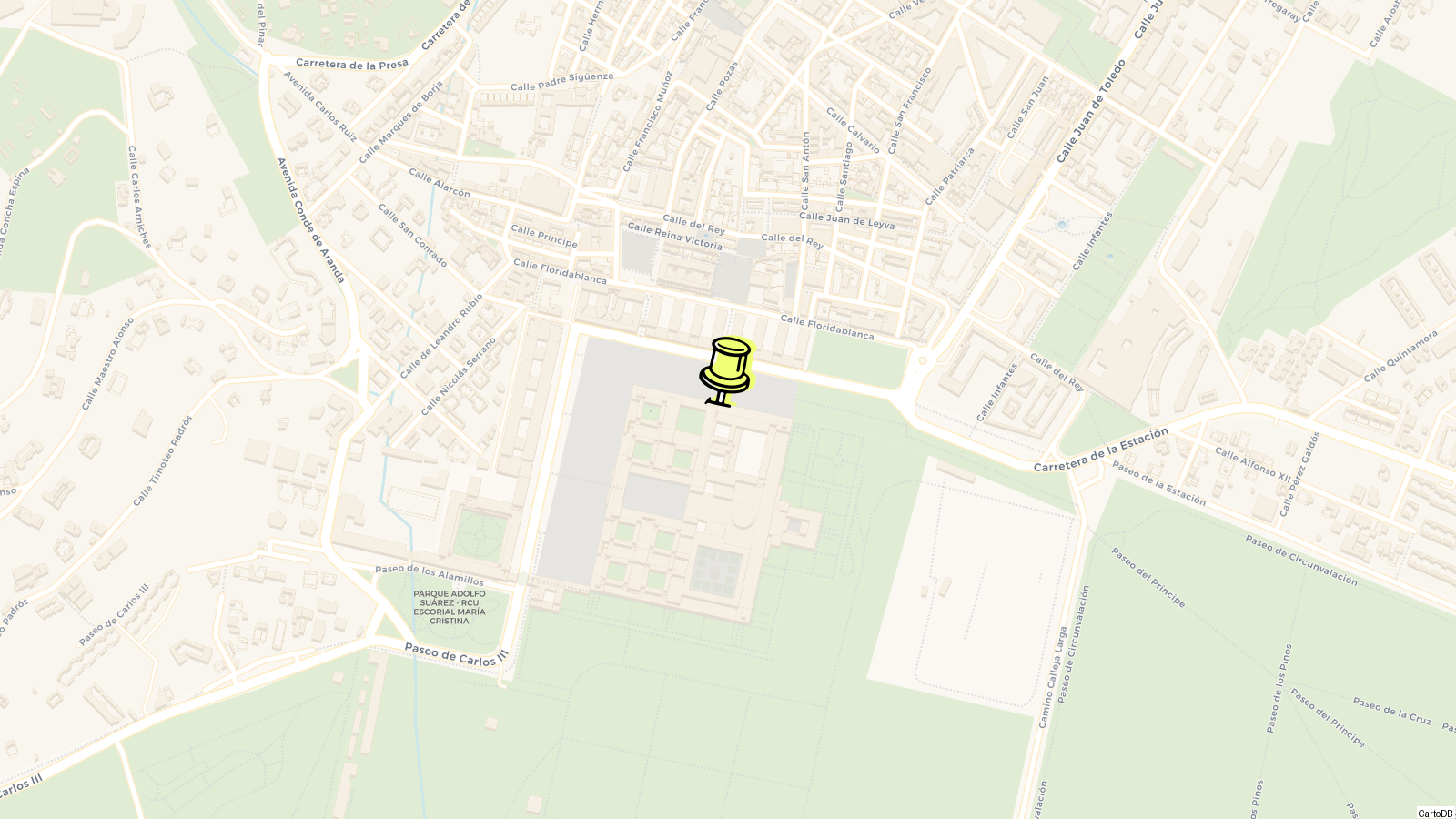
Visit details
Overview
Philip II started building El Escorial in 1563, and you won’t find another place in Spain that jams so many functions, monastery, royal palace, basilica, pantheon, library, museum, school, hospital, into one grid of granite. This isn’t some cozy royal retreat either: the scale hits you before you even step through the main gate facing the Patio de los Reyes, a courtyard with six larger-than-life statues of Old Testament kings. The complex sprawls over 94,000 square meters and rises on a plateau just over 1,000 meters up in the Sierra de Guadarrama, about 45 km northwest of Madrid.
The design is all straight lines and right angles, austere and almost fortress-like, with few decorations on the outside. That’s the Herrerian style, born right here, more severity than bling, all gray granite pulled from the nearby sierra. Come for the symbolism: Philip wanted the ground plan to echo Solomon’s Temple and even the gridiron on which Saint Lawrence was martyred (Philip’s personal patron saint and the monastery’s dedicatee).
It’s a UNESCO World Heritage Site as of 1984 and one of five such sites in the Madrid region.
Inside, the library is loaded with illuminated manuscripts and topped with painted barrel vaults showing the seven liberal arts. It’s not just books: there are antique globes and astronomical instruments lined up for inspection. The art collection runs deep, think Velázquez, El Greco, Titian, Tintoretto, plus cabinets of religious relics that seem endless.
El Escorial isn’t just about royal life. It’s also a mausoleum for the kings and queens of Spain for the last five centuries, housing the Pantheon of the Kings beneath the basilica. The place has always been run as much like a public institution as a royal one, there’s still a school, Real Colegio Alfonso XII, operating inside the complex.
Visitors these days come for all of it: the art, the crypts, the echoing basilica, the shell-shaped staircases, the formal gardens, and the wide sweep of history you get wandering inside. April is a hot month for crowds thanks to cherry blossoms and school trips. If you only want royal palaces, skip to Madrid, but if you want to walk through Spain’s money, power, and religious ambitions, this is the building that tried to contain it all.
History
Philip II laid the first stone of El Escorial on April 23, 1563, on empty ground 1,032 meters up the slopes of the Sierra de Guadarrama. The site wasn’t picked for the view, but as a strategic location close to Madrid and far enough from city intrigue. Philip was motivated by two things: a promise to build a grand memorial for his father, Emperor Charles V, and a vow after Spain’s unexpected victory against France at the Battle of St. Quentin on August 10, 1557, Saint Lawrence’s feast day. That’s how the place got its full name, San Lorenzo de El Escorial.
He hired Juan Bautista de Toledo, who had worked on St. Peter’s Basilica in Rome, to design something different from anything else in Europe at the time: severe, boxy, made of local granite, and organized on a grid that deliberately echoed a grill (as in the one Saint Lawrence was martyred on). After Toledo died in 1567, his protégé Juan de Herrera took over and stamped the place with what locals still call “estilo herreriano”: straight lines, sharp corners, and hardly any decoration. All of it is unmistakably Spanish and not at all Italian Renaissance.
The project swallowed nearly 21 years, finishing in 1584. But the timeline itself became a running joke, when Spaniards say something is “like the work of El Escorial,” they mean it is taking forever. The end result looks like a palace from outside and a monastery from within, doubling as dynasty headquarters, seminary, and a truly extravagant royal mausoleum.
Why the Shape and Size?
The gridiron floorplan isn’t purely about the martyred Saint Lawrence: Philip II read up on the Temple of Solomon and wanted a blueprint that matched its proportions, symbolism, and even its double-courtyard layout. So when you’re in the Courtyard of the Kings, flanked by Old Testament statues and red marble stairs, you’re tracing a path the king intended as a statement: this is the Spanish monarchy’s seat and a religious center of gravity all at once.
Burials began almost as soon as it was finished. Charles I and Isabella of Portugal were the first royal bodies to be transferred to the Pantheon of the Kings beneath the basilica. That crypt, all dark marble and bronze, has just 26 burial slots, though it took centuries to fill. Every Habsburg and Bourbon monarch since Charles I rests down there, except for Philip V and Ferdinand VI, who chose other spots. Philip II himself died here too, after endless days ruling from his famously austere private rooms, bed facing the altar so he could attend mass even while dying of gout.
The Rules of Burial
To get a spot below, kings (and sometimes queens) had to meet the strict “parent of a monarch” standard. If not, they went to the Pantheon of Princes, finished in 1888, where dozens of infants, princes, and non-reigning consorts rest. There are two “pudrideros,” literally “rotting rooms”, where royal bodies decompose in special urns before being interred in their final marble slot (a process that takes about 50 years). Only Augustine monks and the royal family have ever set foot there.
Over its history, El Escorial has hosted everything from major royal events to Franco-era state ceremonies. It survived the Napoleonic occupation (which looted parts but left the skeleton intact), a huge fire in the library in 1671 that destroyed over 5,000 manuscripts, and more recently a 6.5 million euro renovation that added solar panels, LED lighting, and vehicle charging stations.
Philip II’s original Augustinian monks are still present, though the royal residence and school now occupy much of the living quarters. Throughout the 17th and 18th centuries, the building morphed into a catch-all: more than a royal necropolis, it was the academic center, seminary, political archive, and royal gallery loaded with works by Titian, Velázquez, El Greco, and others (many remain on-site, see “Culture” for specifics).
Changing Roles
Post-monarchy, the place drifted through republican Spain, Civil War, and Franco’s dictatorship. In the 1980s, Spain finally got El Escorial listed as a UNESCO World Heritage Site (November 2, 1984), cementing its status as both national symbol and star day-trip from Madrid. Even now, major state ceremonies, royal family masses, and school graduations use the basilica, which is still open for business (and burials).
The 2024-2026 upgrades have brought back areas like the Hall of Battles and the art galleries, which had been dormant for decades, and now you enter via the front courtyard, just as the king planned. Underneath the solemn exterior and the fixed daily rhythms (monks’ prayers, tourists’ selfies, government events), El Escorial remains a monument that still does its original job: a physical record of Spain’s biggest ambitions and hangups, layered onto several tons of mountain granite.
Visiting
Tickets cost €14 for adults, €7 for students up to 25 and seniors, free for kids under 5, and you pay at the entrance to the main complex, right at the Patio de los Reyes (Courtyard of Kings). You’ll pass security, scan your ticket, and walk straight into one of Spain’s most oversized plazas, flanked by gridded granite. Spring and autumn weekends get crowded, this place saw over 446,000 visitors last year, thanks in part to Madrid daytrippers, so book online if you want to avoid a line. Summer hours (April–September) are 10:00–19:00; winter (October–March) close an hour earlier. Closed Mondays.
The core visit is a fixed circuit that takes you through a portfolio of Spanish monarchy and faith. The first knockout is the Basilica, a massive, echoing space with a marble-floored narthex, huge dome, and the red marble high altar. Stand directly under the dome: it’s 90 meters above your head. In most areas, no photography is allowed, especially in the basilica and pantheons.
Next up is the Pantheon of the Kings, an underground chamber lined with polished marble and gilt, where almost every Spanish monarch since Charles I lies interred, the sarcophagi stacked in geometric order. Then you’ll snake past the smaller Pantheon of the Princes, where royal family members who never wore the crown now rest. The Hall of Battles is a corridor plastered with 16th-century frescoes showing Spanish victories (San Quintín, Higueruela).
Do not miss the library, it’s the showoff room, 54 meters long with an arched, fresco-covered ceiling and antique globes on display. Shelves hold thousands of illuminated manuscripts, some facing outward, spines in, per Philip II’s rules. Most tours shuffle you through in a few minutes, but if you lag at the back of a group, you get a better look at the ceiling. The route may also include royal apartments, the bedroom where Philip II died is furnished with his original bed and a small window set at mattress level so he could watch mass while sick.
For art, the permanent collection covers works by Titian, El Greco, Velázquez, Tintoretto, and others, displayed in galleries that reopened after recent renovations. Some halls are still rotating after a multi-year revamp, but you’ll find at least 99 major European paintings on view.
Plan on two to three hours for the main visit, at least 45 minutes more if you want to wander the formal gardens out back or check out the Casita del Príncipe, a smaller royal lodge about 20 minutes’ walk around the perimeter. Audio guides are €4, available in several languages, or join a staff-guided tour (English usually at 10:45am) for an extra €22.
If you want to explore deeply
The public route skips most private monastic areas, but two spots are worth squeezing in: the Courtyard of the Evangelists, a gardened patio centered on a domed pavilion, with Renaissance sculpture, and the recently reopened architecture museum, with models, scaffolding tools and original 16th-century blueprints. Beeline here if you nerd out on stonework. For the gardens, try to arrive on a weekday when local school groups aren’t swarming. Admission is sometimes free for EU residents on late Wednesday and Thursday afternoons (check signage at the ticket window, as dates vary year to year).
Tips
-
Mondays are a lost cause: the monastery is always closed. The rest of the week, plan to get there when doors open (10:00) if you want to dodge the buses from Madrid and the bulk of tour groups.
-
In summer (April–September) the place stays open one extra hour (until 19:00), but they start herding folks towards the exit about 75 minutes before closing. In winter (October–March) you’re done at 18:00.
-
Tickets are cheaper and lines much shorter if you buy online ahead of time at Patrimonio Nacional’s ticket site. Last admission is about an hour before closing, but staff may not let you in if you cut it late, especially on crowded days.
-
For the full experience, add an audio guide from the front desk (€4; several languages) or book a guided tour (English tours usually start around 10:45, Spanish at 10:30). The official guided visit costs €22 (standard), €15 (reduced), plus a 77-cent booking fee if you buy ahead.
-
Set aside at least 2–3 hours for the main circuit. If you also want to stroll the gardens or the Casita del Príncipe, tack on another 45–60 minutes.
-
Photography is tightly controlled. Most rooms, especially the basilica, the pantheons, and the library, ban photos or limit them to quick phone snaps without flash or tripod. Even where permitted, staff will call you out if you try to linger too long with your camera.
How to avoid the worst crowds
Buses from Madrid show up late morning, and school trips pile in on Fridays. In spring, April is especially packed, locals come for the gardens and the weather. Go midweek, right at opening or after 16:30, and you’ll have the echoing marble halls closer to yourself. National holidays (like October 12, Spain’s National Day) bring heavy crowds and, sometimes, free admission, so weigh big lines against the savings.
Wheelchair and accessibility notes
Level access at the main entrance, most principal spaces have ramps or lifts (ask staff for assistance). That said, the original Renaissance staircases you’ll see throughout can’t be made accessible. Wheelchairs available on request.
Eating and drinking
There’s a cafeteria inside, but it’s utilitarian, think basic sandwiches, not gourmet. For something better, walk out to the plaza, and grab a menú del día at any of the eateries facing the monastery (expect €14–18 for the full three-course lunch).
-
No backpacks or large bags: security will ask you to check them at the entrance.
-
The microclimate bites in winter, despite Madrid’s mildness, up here at 1,032 meters altitude, indoors can feel chilly and the courtyards colder. Pack an extra layer.
-
Renovations are ongoing as of 2025–26, expect scaffolding in some areas, especially the painting galleries and main courtyards. Most spaces, including the key chapels and the Hall of Battles, remain open, but sections can close with little warning.
-
If you’re making a day trip from Madrid, Cercanías line C-8 is the way to go: under an hour from Chamartín or Atocha, cheap and frequent. Taxis from the Renfe station to the monastery cost just a few euros if you don’t want the hill hike.
Know this destination? Help us improve
Your local experience is valuable to other travelers.