Royal Spanish Academy
Since 1713, the Royal Spanish Academy on Calle Felipe IV decides which words officially count in Spanish,just steps from the Prado.

Visit details
Overview
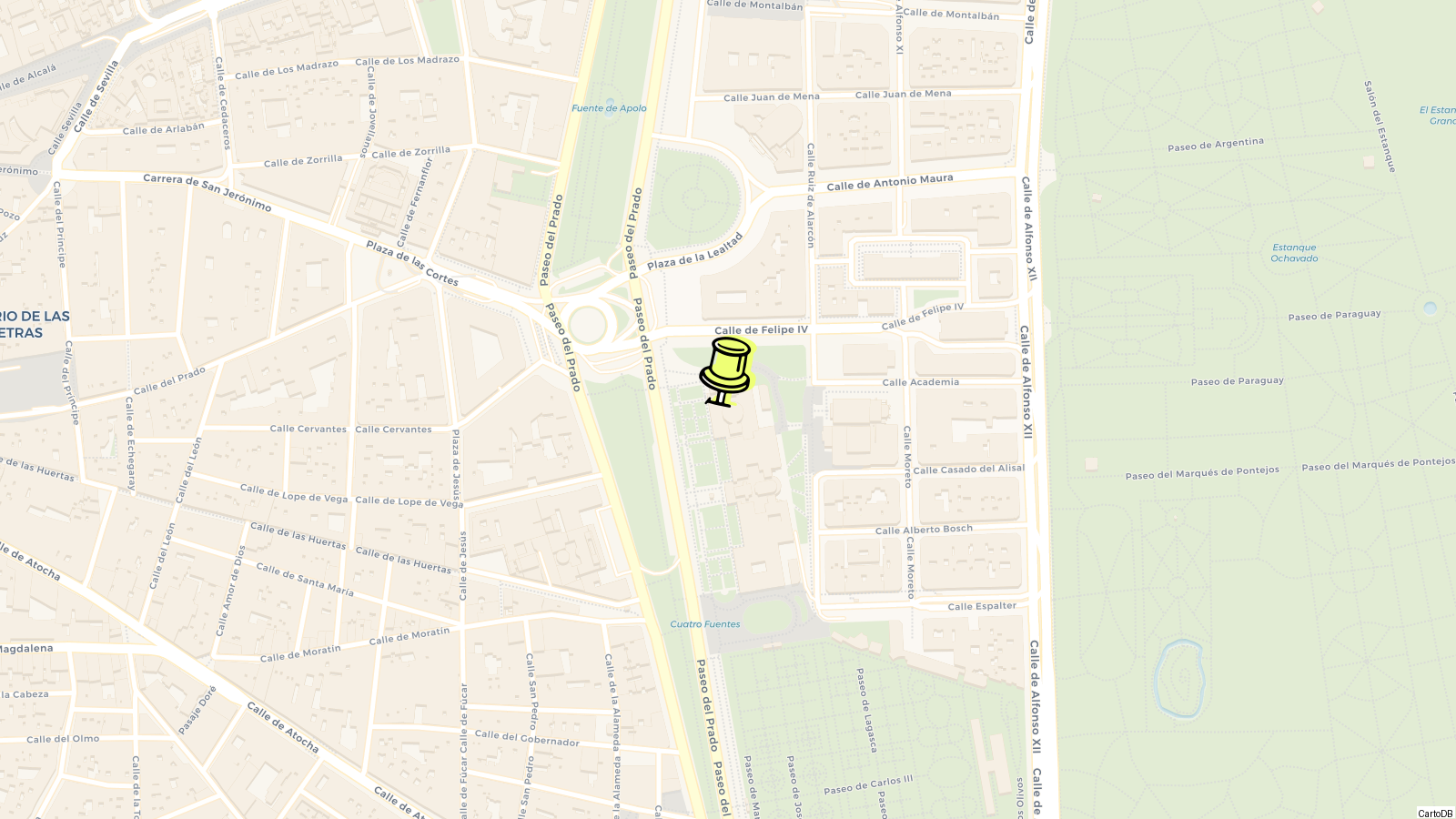
The Royal Spanish Academy (Real Academia Española, RAE) has been setting the official norms for Spanish since 1713, working out of its building at Calle Felipe IV, 4 in Madrid, right next to the Museo del Prado. As of 2026, it remains the language’s referee, if you’re ever arguing about how to spell güey in Madrid versus Buenos Aires, these are the people who decide.
This isn’t just a Spanish institution; the RAE runs point for 23 related academies across Latin America, the U.S., and even Equatorial Guinea and the Philippines, trying to keep everyone on the same linguistic page. Their emblem is a melting crucible with the motto “Limpia, fija y da esplendor”, which translates bluntly as “It cleans, fixes, and gives splendor”, and that’s pretty much their attitude: standardize now, argue later.
Most people know the RAE for its massive online dictionary, which is free and updated regularly. This isn’t some dusty academic relic: every time you wonder if a new slang word or a Latin Americanism “counts” as real Spanish, this dictionary settles the bet. It’s as relevant for a literature student as for someone texting in Spanglish.
The RAE’s building itself looks severe from the outside, think 19th-century institution, not palatial grandeur, but it’s a landmark if you’re strolling near the Prado or Retiro. Inside, it houses a research library and archives mainly aimed at linguists and scholars, not tourists. If you visit, you won’t get a flashy museum experience, but the sense of gravity is real, a home base for the people who decide what makes Spanish official, and what doesn’t.
Why the RAE still matters
The RAE didn’t always rule the dictionary. Back in 1713, eight “novatores” founded it in a noble’s private library because Spanish had nothing to match France’s or Italy’s official dictionaries. Their first dictionary dropped in 1780; the spelling rules that drive everyone nuts today date back to their 1741 “Ortografía”, and by 1844, Spanish spelling in Spain was officially whatever the RAE said.
What does that mean now? If you’re studying or working in Spanish, you will run into RAE rulings in school, the news, and even WhatsApp debates. This is where the split between peninsular Spanish, Latin American usage, and “real talk” gets hashed out in committee, and slowly, after a lot of argument, shows up in the official books.
Collection
If you think the Royal Spanish Academy is just about grammar, take a look at the actual stuff they’ve produced. Their main collection is centered on dictionaries and reference books that have shaped how Spanish is actually written and spoken, not just in Spain but across dozens of countries.
Main Publications
- Diccionario de la lengua española: This is the standard Spanish dictionary, the first edition dates to 1780, the most recent (the 23rd) is from 2014. You can access it for free online at https://dle.rae.es or use it on site if you’re a researcher.
- Ortografía de la lengua española: The spelling rules first came out in 1741, but you’ll see the most impact in the 2010 edition, which actually reflects the consensus of 22 national academies, not just Madrid’s. It’s the go-to for anyone arguing about “sólo” versus “solo.”
- Nueva gramática de la lengua española: Last edition in 2009. This is not a slim volume, to be exact, the “complete edition” runs over 3,800 pages.
- Diccionario panhispánico de dudas: Introduced in 2005. This “Pan-Hispanic Dictionary of Doubts” clarifies those grey areas that drive editors mad, like where to put the accent on “guion.”
- Diccionario esencial de la lengua española: Launched in 2006 as a more streamlined dictionary, think of it as the RAE’s pocket version, made for students and anyone who wants the basics fast.
- Diccionario del estudiante and Diccionario práctico del estudiante: From 2005 and 2007, these are aimed squarely at the secondary school crowd.
- Diccionario de americanismos: Out since 2010, this one collects words and meanings from all over Latin America.
The Physical Archive and Manuscripts
The RAE’s building houses some actual relics: early printed dictionaries, manuscripts, and the minutes books dating to the first session in 1713. Access is not for tourists, you need a researcher’s letter and an appointment, and they’re strict about IDs and schedules (usually Monday to Thursday, 9:30–14:00; closed in August). Free, but you can’t just drop in. Most people working in these archives are professors, linguists, or postgraduate students.
If you get access to the Archive, you’re looking at floor-to-ceiling classic tomes, plus unique items like hand-written corrections or correspondence from when orthographic standards were hotly debated. Some requests are handled digitally, so if you only want a particular 19th-century citation, sometimes staff will simply send you a scan and spare you the bureaucracy.
They also keep the original statutes of the Academy (1715), along with letters from other European academies and objects like the distinctive RAE armchairs and inkwells. The emblem you’ll spot everywhere, a fiery crucible , dates to the very foundation.
Journals and Serial Publications
The Boletín de la Real Academia Española is the official journal; they’ve been putting it out since 1914, and it covers everything from minute grammatical debates to tributes to past members. Recent issues focus a lot on international collaborations and the tangled process of updating the main dictionary.
Back issues of the Boletín are surprisingly readable for non-academics, especially the sections on language change, if you want to see the arguments that resulted in “solo” losing its accent, this is where you’ll find the details.
Can You See Any of This on Display?
Unless you’re there for work, you’ll mostly see closed doors and maybe a tour as part of an academic group. The collection isn’t set up as a public exhibit. Instead, the main hall sometimes has glass cases featuring first editions or commemorative copies during special events, but there’s no permanent museum wing. The real access is digital, with the RAE website carrying full texts of older works and searchable databases for almost every major project.
Not Just Books, International Work
A big chunk of the RAE’s recent output is invisible except in diplomacy and publishing: harmonizing Spanish standards with those of every other language academy from Bolivia to Equatorial Guinea. Updates to the Diccionario and major rulebooks are only published after months of debate with all member states, and that’s why the 2010 Ortografía and 2014 dictionary took so long to drop.
If you compare how Spain, Mexico, and Argentina handle words like “vosotros” or local slang, those differences are now footnoted and cross-referenced in official works, meaning publishers, journalists, and teachers all use the same standards even outside Spain. That’s why a Colombian newspaper and a Madrid academic textbook will quote the same rules, even if pronunciation is another story.
Visiting
Walk south from the Museo del Prado and you’ll spot the Royal Spanish Academy’s neoclassical façade at Calle Felipe IV, 4. The building itself isn’t normally open to walk-in tourists. Visiting is limited and strictly controlled, think study appointments, research, or special events, not casual tours.
Exterior and Surroundings
You can freely walk up and view the exterior. The entrance gate is marked with the Academy’s emblem, a crucible with “Limpia, fija y da esplendor”, and impressive stonework dating to its inauguration in 1894. There are no grounds or gardens to wander, but you’re steps from Retiro Park if you want somewhere to linger.
Access and Appointments
If you’re a researcher, you can request access to the library (with accreditation), generally Monday–Friday, 9:00–14:00, outside vacation periods. The archive also takes visits by prior written request, Monday to Thursday in the same slot, but closes for all of August. To request, email or call +34 91 420 14 78.
You won’t find rotating exhibitions, gift shops, or public lectures in the building. The Academy’s public face is mostly digital, go to rae.es for their online dictionary and events calendar. Sometimes during Madrid’s “Open House” weekends or special cultural programs, they offer guided group visits in Spanish. These are free but require early sign-up on their website due to high demand and extremely limited capacity.
Group Visits and Exceptional Openings
The few open days, usually tied to cultural programs like Open House Madrid, let you see parts of the interior in small guided groups. Expect to see the entrance hall, grand staircase, and the academic assembly hall where language reforms have been debated. Group sizes are small (about 20), sign-up opens 2-4 weeks in advance, and spots fill within hours. Tours last about 45 minutes, usually in Spanish only, with a guide who’ll show off period busts, portraits, and antique dictionaries.
Photography indoors is sometimes prohibited and bag checks are routine. Don’t bother showing up on the day and hoping for a waitlist: admission is strictly for those with a confirmation email.
Getting There
The Academy sits between the Prado and Retiro. Metro stops Atocha (L1), Estación del Arte (L1), or Banco de España (L2) all get you within a five-minute walk. Renfe Cercanías at Madrid-Atocha brings you from anywhere in the metro area. Several EMT buses stop at nearby Alfonso XII and Puerta del Sol.
| Metro Station | Line | Walking Time |
|---|---|---|
| Estación del Arte | L1 | 5 min |
| Banco de España | L2 | 6 min |
| Atocha Renfe | L1/Cerc. | 9 min |
For out-of-town visitors, taxis from Madrid-Barajas to this quarter cost €25–35 flat.
What You’ll Actually See
At street level: the façade, bronze coat-of-arms, and a discreet plaque with the year 1894. On rare open days, you’ll see the assembly hall lined with books and academic regalia, the seats are assigned to academy members, each marked by a letter of the Spanish alphabet. If you get access to the library, it’s gorgeous: high ceilings, carved wood galleries, and shelves lined with every edition of the Diccionario de la lengua española since 1780.
The Iconic Armchair Setup
Each member sits in a specific seat labeled with a single letter. Seats are awarded for life, and some letters (like V, W, X, and Ñ) remain occasionally vacant. If your timing’s right on a group tour, guides sometimes name-drop famous authors who held the “T” or “G” seats, the walls carry their portraits.
Publications on Display
Sometimes the entry showcases milestones like the first printed 1780 Dictionary or the shifting rules of Spanish spelling. Everything references real debates held here, not just linguistic theory. These are usually for viewing, not to touch.
History
In 1711, eight self-described “novatores” started meeting in the library of the Duke of Escalona’s palace at Plaza de las Descalzas Reales in Madrid. They were annoyed that Spain had nothing like France’s Académie Française: no official dictionary, no consensus on how Spanish “should” be written or spoken. So, on 3 August 1713, their group formally became La Real Academia Española (RAE), with the goal “to fix the voices and words of the Castilian language in their greatest propriety, elegance, and purity.” Their inspiration was clear: model themselves after the Accademia della Crusca in Florence (founded 1582) and the Académie Française (1635).
King Philip V granted “real” (royal) status a year later, on 3 October 1714. At first, the RAE met at Valverde, 26, but soon moved to a building at the corner of Alarcón and Felipe IV, right by where the current headquarters opened in 1894.
Their motto, “Limpia, fija y da esplendor” (“cleans, fixes, and gives splendor”), shows up under a crucible in flames on their coat of arms. “Collective utility” was their thing: this wasn’t just a literary club, it was about making Spanish coherent for everyone who used it.
The RAE’s first big job was the official Diccionario de Autoridades, published in six volumes between 1726 and 1739, which featured examples from major authors to show how each word was really used. By 1741, they started formalizing spelling with the first edition of the Ortographía (later Ortografía). Not everyone cared, until 1844, when a royal decree made the Academy’s rules the law of the land, at least in Spain.
Evolution and Influence
The Academy didn’t just set rules and forget about them. They’ve overhauled spelling and grammar many times: major reforms landed in 1959 (Nuevas Normas de Prosodia y Ortografía) and later in 1999 and 2010, when the Ortografía became a cooperative effort with the Association of Academies of the Spanish Language, now there are 22 other affiliated academies across the Spanish-speaking world.
The Diccionario de la lengua española (DLE), first published in 1780, is still updated and free online, and the RAE keeps a running list of changes reflecting everyday Spanish. Since the late 20th century, the Academy has gradually opened up, less obsessed with “pure Castilian”, more responsive to how the language works in Latin America and even among young people online. The RAE’s work is now collaborative, gradual, and sometimes a bit controversial but always directly linked to what you’ll find in Spanish-language newspapers, websites, and even WhatsApp chats in 2026.
From the start, being an “académico de número” was a serious, lifelong job: you got a seat, literally named after a letter (of the Spanish alphabet), and had to help craft debates on grammar, spelling, and vocabulary. There have always been 24 core members; now they’re joined by corresponding academies across Latin America and by an increasingly international pool of linguists, writers, and scientists.
Not Just Dictionaries
Early Academy publications weren’t just dictionaries and orthographic guides, they published classic Spanish literature (with lots of footnotes and commentary), and in the 20th century, expanded into pan-Hispanic grammars and legal lexicons. Their Diccionario panhispánico de dudas (2005) marked a shift towards solving the issues real people face, like figuring out the “right” gender for certain words, what counts as valid in Mexico versus Spain, or how digital communication is bending the language every day.
No matter how official they’ve become, the RAE is still just a group of very committed people arguing (and sometimes agreeing) about what “good Spanish” means. If you’ve ever been corrected for writing solo without an accent or using leísmo, you can blame, or thank, the Academy for setting those ground rules.
Tips
-
The building at Calle Felipe IV, 4 isn’t open for regular visits. If you want to access the library or archive, you’ll need to request an appointment in advance and justify research credentials. The reading rooms operate Monday to Friday, 9:00–14:00. Academic holiday periods (particularly August and around Semana Santa) mean full closure.
-
The headquarters is right next to the Prado; the closest metro stations are Estación del Arte (L1) and Banco de España (L2). If you’re coming by Cercanías, Atocha is about a 10-minute walk. Buses on lines 10, 14, 19, 27, 34, 37, and 45 stop in the area.
-
There’s no gift shop, café, or regular exhibitions. This is an academic institution, not a tourist attraction, don’t expect the experience you’d have at the Prado or Reina Sofía next door.
-
Group tours and special events are rare, but keep an eye on the official website (rae.es) for occasional open days or book launches. These are sometimes announced last minute.
-
If you’re planning research, bring your passport or national ID, access to the library or archive requires it. Expect to sign in at the main entrance and follow building security protocols.
-
No photos inside. The façade on Felipe IV is textbook neoclassical and worth a photo from the street, especially early morning before the Prado crowds take over.
-
The area gets packed on weekends and holidays as people crowd into the Prado and Retiro. For some peace, weekday mornings are best, less foot traffic, quieter streets, easier to get a taxi or ride from the museum zone.
-
You won’t find Royal Spanish Academy souvenirs or books for sale here, pick up any RAE dictionaries or grammar books at major bookstores (like La Central) or online. The official online dictionary is open and free for all (dle.rae.es).
-
If you’re hunting down a specific manuscript or rare edition, email both the library and archive; staff are usually efficient but strictly business, so keep your request short and clear. Spanish is preferred.
Need a certificate or language clarification?
If you ever need a linguistic certification or clarification for an official document, don’t show up in person, the RAE handles these exclusively online via its “Enclave de la lengua” portal or email channels. Response times can be slow (weeks, not days), especially around major Spanish holidays.
Know this destination? Help us improve
Your local experience is valuable to other travelers.