Royal Palace of Madrid
With 3,418 rooms and suits of armor on display, this Baroque palace towers over Madrid’s Plaza de Oriente just steps from the Ópera metro stop.

Visit details
Overview
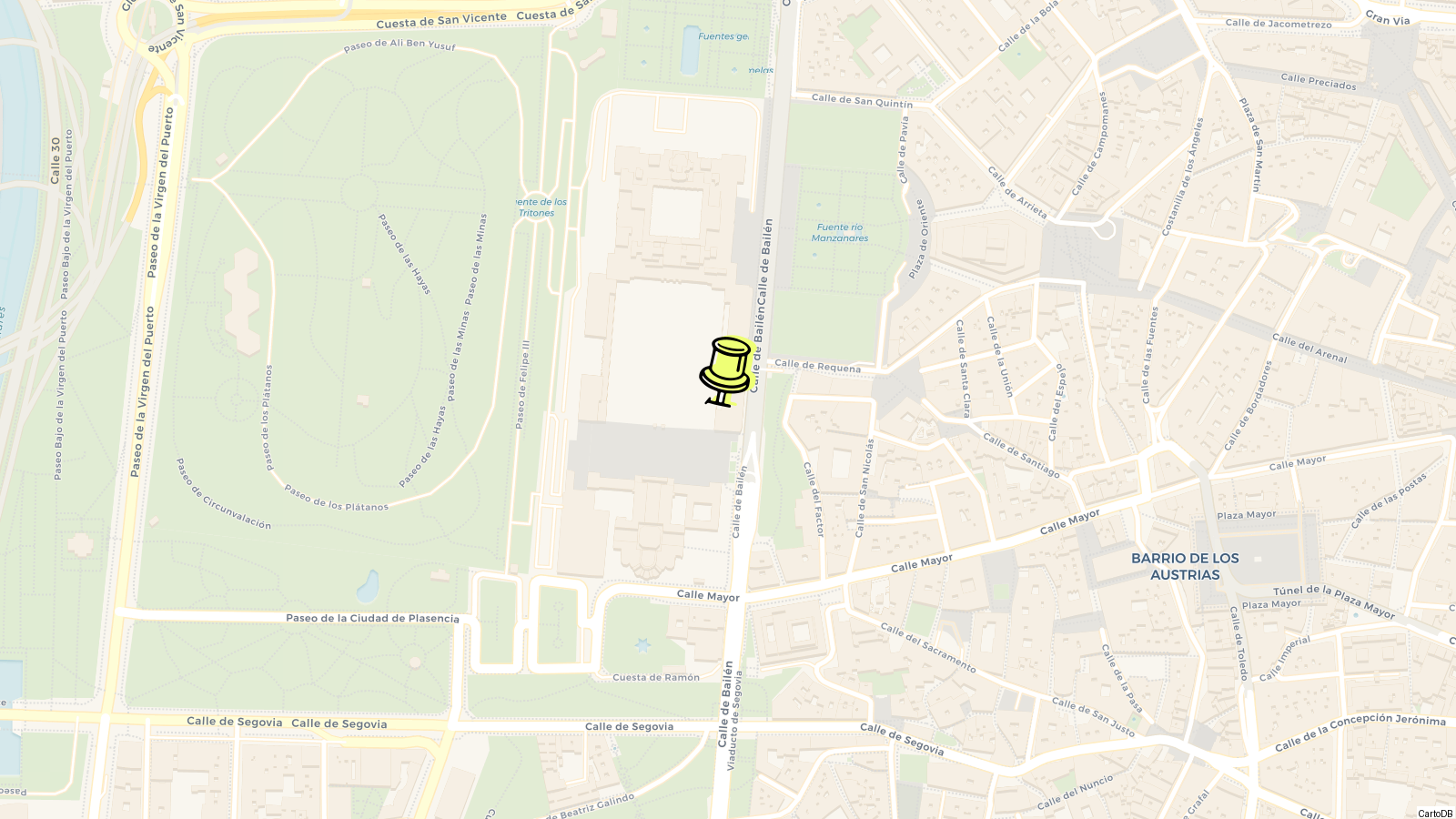
The Royal Palace of Madrid, located on Calle de Bailén right by the Ópera metro stop (Lines 2, 5, R), is a Baroque and Classical-style monument with over 135,000 square meters and 3,418 rooms, it’s not just the biggest palace in Spain, but one of the largest in Europe. Built starting in 1738 where a once-massive Moorish fortress stood, the current building is a mix of show-off architecture by Filippo Juvara, Francesco Sabatini, and Juan Bautista Sachetti.
Most visitors come for the official stateroom route, grand staircases, bulletproof lions, ceiling frescoes (by Tiepolo, Giaquinto, Mengs), oversized chandeliers, and entire rooms decked in porcelain. The Throne Room is unapologetically ornate. The palace holds originals by Caravaggio, Velázquez, and Goya, and its collection includes the world’s only complete Stradivarius quintet. Parts of the Royal Armoury display tournament armor made for Charles V, nothing like a typical “arms room” in a small-town castle.
You don’t see it all at once, the visitor route rotates, and the actual royal family lives at Zarzuela Palace in the outskirts, not here. The Palace still hosts state events, so occasionally areas are closed with little notice.
Summer hours run 10:00–19:00 (Mon–Sat) and 10:00–16:00 (Sun). Entry is €18, but if you have EU or Latin American ID, you can go from Monday to Thursday for free during the last two hours (17:00–19:00 summer, 16:00–18:00 winter). Tours take around 45 minutes for the main rooms, add 30 more for the Armoury.
The Palace sits opposite Plaza de la Armería and the neo-classical Almudena Cathedral, and is flanked by the Sabatini and Campo del Moro gardens, open-air options if the main building is especially crowded or partly closed. If you want stately rooms, museum-level art, and a crash course in Spanish royal opulence, this is where to start.
Collection
Start with the fact that you’re not going to see more than a fraction of the palace, just the visitor route, which focuses on ceremonial halls, royal apartments, the Armoury, and a handful of one-off collections. The layout changes every few months so even repeat visits can look different.
Main Halls & Route
As of 2026, self-guided entry is €18 and you’ll move through about 25 rooms in the main palace. The usual highlights: the Grand Staircase with Giaquinto’s ceiling fresco, the Throne Room (where every surface is velvet or gold), the Hall of Columns (where royal banquets and EU signing ceremonies happen), and the Royal Chapel. You’re herded in single direction, no backtracking.
If you like decorative arts, look up: the ceilings are loaded with frescoes by Tiepolo, Mengs, and Giaquinto, and you’ll spot paintings by Goya and Caravaggio scattered through state rooms.
State Rooms Breakdown
- Grand Staircase: Marble lions flank the first landing. You enter under Religion Protected by Spain, typical 18th-century ceiling propaganda.
- Hall of Columns: Chandeliers from Paris, and if you get lucky, you can peer into adjoining rooms sometimes added to the circuit.
- Throne Room: Possibly the most Instagrammed room in Madrid. The ceiling is all Tiepolo; the rest is velvet, mirrors, giant clocks, and Ferdinand VI’s twin thrones (no sitting allowed).
- Gasparini Room: Madness in rococo, shells, mirrors, bright greens and pinks. This was actually King Charles III’s dressing room.
- Banquet Hall: Windowed, three rooms squashed into one, end-to-end table set for 120+ if there isn’t a state dinner coming up.
- Porcelain Room: Yes, the walls, ceiling and lamp are all porcelain, basically a human-sized jewelry box.
- Stradivarius Room: Two violins, one viola, two cellos, all real Stradivari, displayed under glass.
- Crown Room: See the actual crown and scepter used for Spanish royal proclamations (not coronations), plus the collar of the Order of the Golden Fleece.
Royal Armoury
Downstairs and included in your ticket: armour, swords, and tournament gear from the 16th century onwards. Charles V’s tournament armor is here, and it’s not a replica, it’s the battered gilded set you can see in old paintings of him (check Prado Museum; same helmet). Allocate 30-40 minutes if you like battle gear, less if you just want to see the suits of armor and move on.
The best pieces are near the entrance: a parade shield by Filippo Negroli, damascened in gold, and pieces worn by Philip II at Lepanto. Some English captions, not exhaustive, but the arms alone are worth a stop for military history nerds.
Music & Instruments
Don’t miss the Stradivarius Room in the apartments of Infante Luis. Madrid has the world’s only complete Stradivarius string quintet, one viola, two violins, two cellos, built as a private set in 1696 for Charles IV. You can’t hear them played except during rare royal events, but if you have even a passing interest in instruments, this is bucket-list material.
Temporary Exhibitions and Gallery
A combined Palace + Royal Collections Gallery ticket is €24. If you care about tapestries, miniatures, or want to see a Caravaggio or Velázquez up close, the Gallery is worth the upgrade. If not, stick with the main Palace. Check Patrimonio Nacional for showings, especially in winter when key rooms can be closed for state functions.
Not On the Standard Route
There’s more to the complex than what is in your ticket. The Royal Library (with illuminated manuscripts, filigree bindings), the Royal Pharmacy (ceramic jars, measuring spoons), and the private Chapel are off-limits except on occasional guided tours, these are usually gone in Spanish, book well ahead.
Private areas: For the deeply curious, specialized tours of the private quarters and kitchens happen 3-4 times per year, usually in Spanish, with tickets sold on the official site. Expect to book 1–2 months ahead for those.
Royal Grounds
When you step outside: directly north, the Sabatini Gardens are open and free every day. They’re symmetrical, with reflecting pools, statues, and benches, much more compact than the sprawling Campo del Moro gardens (entry is free but entrance is around the back of the palace, via the Cuesta de San Vicente).
How Long to Allow
Self-guided visit: plan 45 minutes if you go quick, 60–75 if you want to linger in every room. Add 30 minutes for the Armoury or 45 for the Gallery. Most people spend around an hour and a half total. There is no café or food inside the Palace, but plenty of options nearby on Calle Mayor and Plaza de Oriente.
Photography Policy
No flash or tripods, but otherwise photos are allowed (except in Stradivarius Room and a couple rooms with temporary exhibits, look for signs).
Accessibility
There’s a step-free route via ramps and elevators. Wheelchairs are available if you leave ID at the main desk. Strollers are not allowed inside rooms but can be checked at the entrance.
Gift Shop & Facilities
Gift shop is after the exit; it’s predictable: mugs, scarves, fridge magnets, but also some good local licores and history books. Restrooms are just past the ticket check and again by the Armoury. There’s no cloakroom in summer, but backpacks are okay if worn frontwards.
Pro Tip: Free Hours
If you have an EU or Latin American passport, entry is free Monday–Thursday during the last two opening hours (17:00–19:00 summer; 16:00–18:00 winter). ID check is strictly enforced, and the queue forms an hour ahead. The catch is you’re herded in with the crowds, still, €0 is hard to argue with if you’re on a budget.
Visiting
Entry is €18 per adult for a standard self-guided ticket, which lets you into the main palace route and the Royal Armoury. If you want the “Palace + Gallery” combo (with the nearby Royal Collections Gallery), it’s €24. Kids under 5 are free, and there are discounts for seniors, students, and large families; just remember to bring ID for proof.
Entry lines can be brutal in the late morning and midday, come before 10:30, or after 17:00 for a quieter slot. Monday to Thursday, EU and Latin American citizens can get in free for the last two hours (summer: 17:00–19:00; winter: 16:00–18:00), with passport or national ID, show up a bit earlier since they start queueing for the free slot well before it opens, and the ticket office closes an hour before the palace does.
You’ll start in the Plaza de la Armería and enter through the main gate, security is similar to an airport, but rarely takes more than 10 minutes. Once inside, the visitor path is fixed: ground floor up a grand staircase, then a loop through the ceremonial rooms, Throne Room, Hall of Columns, Porcelain Room, Gasparini Room, Banqueting Hall (look up at those frescoes by Tiepolo, Goya, and Mengs, they’re the real thing), plus the Royal Chapel and the Crown Room with the royal regalia on display. The tour route changes occasionally, they rotate which salons are open.
The Royal Armoury is properly worth your time. It’s separate but included in your ticket. Expect a 30-minute circular route with some rare medieval armour, 16th-century Milanese pieces, and huge horse bardings, kids love this bit.
Budget about 45 minutes for the ceremonial rooms, another 30 for the Armoury. Audioguides are €5 extra, but if you’re a history nerd, go for the real human guide, it’s much livelier and covers things the audioguide skips.
Photography is banned in most rooms, except in certain hallways and the main stair (posted signs make it clear). Strollers, large bags, and food are not allowed inside, there’s a left-luggage at the entrance.
The route: a walkthrough
- Entrance & Security: Plaza de la Armería, left-baggage if needed.
- Grand Staircase: Marble lions, ceiling fresco by Giaquinto (“Religion Protected by Spain”).
- State Rooms: Throne Room (Tiepolo fresco), Gasparini Room (craziest Rococo in Madrid), Porcelain Room (floor to ceiling porcelain), Hall of Columns (used for major ceremonies, check the bronze Charles V).
- Banqueting Hall: Three original ceiling frescoes remain; count the place settings if it’s laid out.
- Royal Chapel: Sculptures, music stands, and a heavy gold reliquary.
- Stradivarius Room: If included, here’s the palace’s prized string quintet, five original Strads.
- Crown Room: See the actual royal scepter and crown.
- Armoury: Exit state rooms, separate entrance downstairs; collection of arms, horse armour, and tournament pieces.
On the way out, the gift shop is below the main staircase. Best thing for a snack nearby is the cafés along Calle de Bailén.
Access and hours
- Summer (Apr–Sep): Mon–Sat 10:00–19:00, Sun 10:00–16:00.
- Winter (Oct–Mar): Mon–Sat 10:00–18:00, Sun 10:00–16:00.
- Last admission/sale: entry and ticket office close one hour before posted closing.
- Christmas Eve and New Year’s Eve: closes around 15:00, last ticket at 14:00.
The closest metro is Ópera (Lines 2, 5, R), about a 2-minute walk. No parking at the palace itself, but Plaza de Oriente garage is nearby (expect €3-4/hour rates).
History
The fire that gutted the old Alcázar on Christmas Eve 1734 left barely a wall standing; the place had already been a fortress, a home for Trastámara kings, and, under the Habsburgs, a brooding, draughty residence that nobody loved. The blaze burned for four days. Most of what survived (including Las Meninas, flung out the window by desperate hands) was saved because the king was in the habit of moving things over to Buen Retiro Palace.
Philip V, the first Bourbon, wanted something completely different from the stiff Spanish style. In 1738, his chosen men, Filippo Juvara, Giovanni Battista Sacchetti, and Francesco Sabatini, broke ground on what would become the new palace. Inspiration came from Bernini’s unbuilt Louvre, not from Spanish tradition. The spot had been a Muslim fortress in the 9th century, back when Madrid was a frontier post of al-Andalus, so the move wasn’t so much a fresh start as a new layer slapped on top.
Charles III moved in in 1764, decades after Juvara’s first plans. It took another hundred years for all the extensions and huge makeovers to finish: Ferdinand VII wanted Parisian grandeur, but his grandson was set on Victorian flourishes (lots of parquet, forget the marble). Séquels of architects kept adding and subtracting until the Palacio you see now solidified by the late 19th century.
The design was always over the top, because the Bourbons were staking their claim over Madrid, deliberately. Juvara wanted to build somewhere else (maybe by the river), but Philip V made him stick to the old fortress site, as if to erase the Habsburgs by layers of stone. After Juvara’s death, his student Sacchetti handled endless tweaks: a square layout, wings for sightlines, classical flourishes. Sabatini (the same guy behind Madrid’s city gates) built the stately main staircase and dreamed up galleries that only partly materialized.
The palace’s role kept mutating with Spanish politics. It briefly became the “Palacio Nacional” during the Second Republic. When civil war bombings left their mark in the 1930s, restorers carefully rebuilt everything to match old blueprints, right down to lost moldings. Not every wall or statue is as old as it looks.
The ground the palace stands on has real layers, a 9th-century Islamic fortress, a medieval royal castle, the burned-out Alcázar, a Bourbon showpiece, plus civil war scars and post-Franco renovations. That’s at least six eras baked into one building. In 2004, the central courtyard became the party site for the royal wedding banquet of Felipe and Letizia. Even when the current monarchy moved out to Zarzuela Palace, the Salón de Columnas was where Juan Carlos I abdicated in 2014. If you spot a Spanish flag on the roof, it still means there’s a state function happening today.
The statues lining the exterior weren’t just for show: they were made for the rooftop balustrade, but an engineer declared them too heavy, so they were scattered across the gardens and squares nearby. Sabatini Gardens, named after the architect but only built in the 20th century, used to house the royal stables, demolished to make way for manicured hedges now open to anyone.
During the Spanish Civil War, the palace took real damage. Later repairs matched the original decorative flourishes, so some rooms are faithful reproductions built after 1939, not untouched artifacts. Even so, the archive and rooms hold pieces like the only complete Stradivarius string quintet, telling you this is still a living palace, not just a relic.
Tips
-
Buy your ticket online from Patrimonio Nacional) to skip the main ticket office queue. If you want the English guided tour, those fill up especially in summer, book ahead.
-
If you’re an EU or Latin American citizen with a passport, you can get in for free Monday to Thursday, 17:00–19:00 in summer (April–September) or 16:00–18:00 in winter (October–March). Lines are long and you need original ID (not a copy or a photo), so arrive at least 30 minutes before the free slot opens or you might not get in.
-
The palace is busiest 11:00–15:00. Go at opening (10:00) or during the last hour for fewer crowds. If you want photos of empty halls, arrive as early as possible.
-
No large backpacks, umbrellas, or luggage allowed inside. There’s a free cloakroom, but it only takes small items.
-
The Armoury and temporary exhibits close 30–60 minutes before the palace itself. Don’t leave them for the end unless you’re sure about closing times that day.
-
The Royal Gardens (Sabatini and Campo del Moro) are free to enter year-round. The best spot for exterior shots is the Sabatini Gardens, go late afternoon for soft light.
-
Guided tours in English run Mon–Sat at 10:45, 11:45, 15:15; Sun at 10:45, 11:45, 14:15. No need to join one unless you really want context, audio guides are well-produced and cheaper.
-
Bring water, especially in summer. Inside is cool, but lines and gardens get hot. No food or beverages sold inside.
-
No photos inside the throne room or some temporary exhibitions; staff will stop you.
-
If you want to see the Stradivarius Room or Crown Room, check with staff at entry, as access sometimes rotates by day.
-
Holidays (especially December 24 and 31), the palace closes early (about 15:00; last ticket one hour before). Check hours before going.
-
The Ópera metro station (Lines 2, 5, R) is the easiest access point, about a 5-minute walk to the main entrance.
Extra tips you won’t find in most guides
- The “last entry” means it: both palace and ticket office close a full hour before official closing time, and security will clear rooms without warning. Don’t cut it close or you’ll miss half the final route.
- Want to see an event or changing of the guard? The ceremony in Plaza de la Armería is on Wednesdays and Saturdays at 11:00 (unless there’s an official act). It’s free and outside, but draws a crowd, so get there a bit early.
- If you’re short on time, hit the main staircase, Royal Chapel, Hall of Columns, Throne Room, and the Armoury, that’s the “highlight reel.”
- For a splurge, the Palace + Royal Collections Gallery combined ticket (€24) is good value, especially on rainy days when you want more indoors.
Know this destination? Help us improve
Your local experience is valuable to other travelers.