Viloria de Rioja
Camino village of 37 people in Burgos province, birthplace of Santo Domingo de la Calzada and keeper of his baptismal font
Visit details
Overview
Viloria de Rioja is a village of 37 people in eastern Burgos province, on the Camino Francés, and the birthplace of Santo Domingo de la Calzada, the 11th-century priest who rebuilt the pilgrim road between Nájera and Redecilla del Camino. Almost everything a visitor comes for stands within a hundred metres: the parish church keeps the font he was baptised in, and the ruined house he was born in sits directly opposite it.
The municipality covers 7 km² and lies 67 km northeast of Burgos by road, in the Montes de Oca comarca. It stands at 801 m, on the Burgos side of a boundary that the landscape ignores: the “de Rioja” in the name comes from the village’s closeness to La Rioja and the likeness of these fields to the lower Tirón and Oja country next door, a sub-district long called the Riojilla.
Set your expectations by the town hall’s own directories. The one for bars and restaurants is empty. The one for beds lists four: a private pilgrim albergue, two rental cottages sleeping four each, and a two-star hotel on the Plaza Mayor. That is the whole commercial life of the place.
Which makes this a twenty-minute stop for most people, and a deliberate overnight for a few. Walkers reach it at kilometre 552 of the Camino Francés, 14 km on from Santo Domingo de la Calzada. Drivers come the other way, from the cathedral city the saint founded back to the field village he left.
History
The village dates from the late 9th century, when Count Diego Rodríguez, credited with founding Burgos in 884, retook Oca and its territory and anchored a new military line on Pancorbo, Cellorigo, Cerezo and Ibrillos. Settlement followed the soldiers, and most of the villages around here were founded in that push.
It is first documented in 1028, in a deed from San Miguel de Pedroso in which a nun, doña Jimena, gave land bordering a vineyard at “Villa Oria” to that monastery. The name reads either as Villa de Oro, a village favoured with something worth having, or as the villa of a woman named Aurea or Oria who may have founded it.
The paper trail thickens quickly after that. In 1043 a charter of San Millán de la Cogolla records King García of Navarre granting property “in the bounds of Villorie”. In 1079 the village mill belonged to the monastery of San Martín de Berberana, and later passed to San Millán. In 1092 Rodrigo Ordóñez, standard-bearer to Alfonso VI, and his wife María listed their holdings in Viloria among a long donation to San Millán; that document is kept in Burgos cathedral. None of it describes a place of any size. It describes a farming hamlet that monasteries collected rents from.
Domingo García was born here in 1019 to a farmer, Ximeno García, and his wife Orodulce. The monasteries of Valvanera and San Millán de la Cogolla both turned him down, so he went to live as a hermit in the oak woods of Ayuela instead. A locust plague changed his life: Gregorio, bishop of Ostia, arrived in Calahorra as papal envoy to deal with it, ordained Domingo, and worked with him until his death in 1044. Their first joint project was a wooden bridge over the river Oja for pilgrims.
Alone after 1044, he cleared forest and laid a stone causeway that pulled the main pilgrim route away from the old Roman road and made Nájera to Redecilla del Camino the through line. He replaced the wooden bridge with stone, and built a hospital, a well and a church for travellers. Alfonso VI visited him in 1090 and handed him the road works along the whole Camino; his church was consecrated by the bishop of Calahorra in 1106; he died on 12 May 1109, aged 90, in the town that had grown around him and now carries his name. He is the patron saint of Spain’s civil engineers.
After the saint, very little. Viloria was crown land for most of its history, apart from a spell as a lordship of the counts of Argote, and it was run in church matters from the diocese of Calahorra rather than Burgos. When the old regime ended it became a constitutional council in the district of Belorado, with 104 inhabitants; around 1850 Madoz counted 44 houses, one of them the town hall, a primary school and a parish church dedicated to the Assumption, and noted a damp climate and chest complaints.
The census series runs 104 people in 1842, 234 in 1857, 243 in 1900, and a high of 249 in 1930. Then the long drain: 218 in 1950, 159 in 1970, 95 in 1981, 61 in 2001, 50 in 2011, 38 in 2021. Note where the peak sits. Viloria emptied out with rural Castile in the 1950s and 1960s, not because anything happened to it in particular. The Diputación currently lists the municipal corporation as a mayor and a single councillor.
The Camino brought the village back into the record in 2015. When UNESCO extended the Spanish Camino listing to the Camino Francés and the northern routes, the retrospective inventory of associated components filed by Spain entered Viloria de Rioja at number 1217.
Visiting
Nothing here is ticketed, gated or staffed. You walk in, and the two things worth seeing are both on the same short street.
Church and birthplace
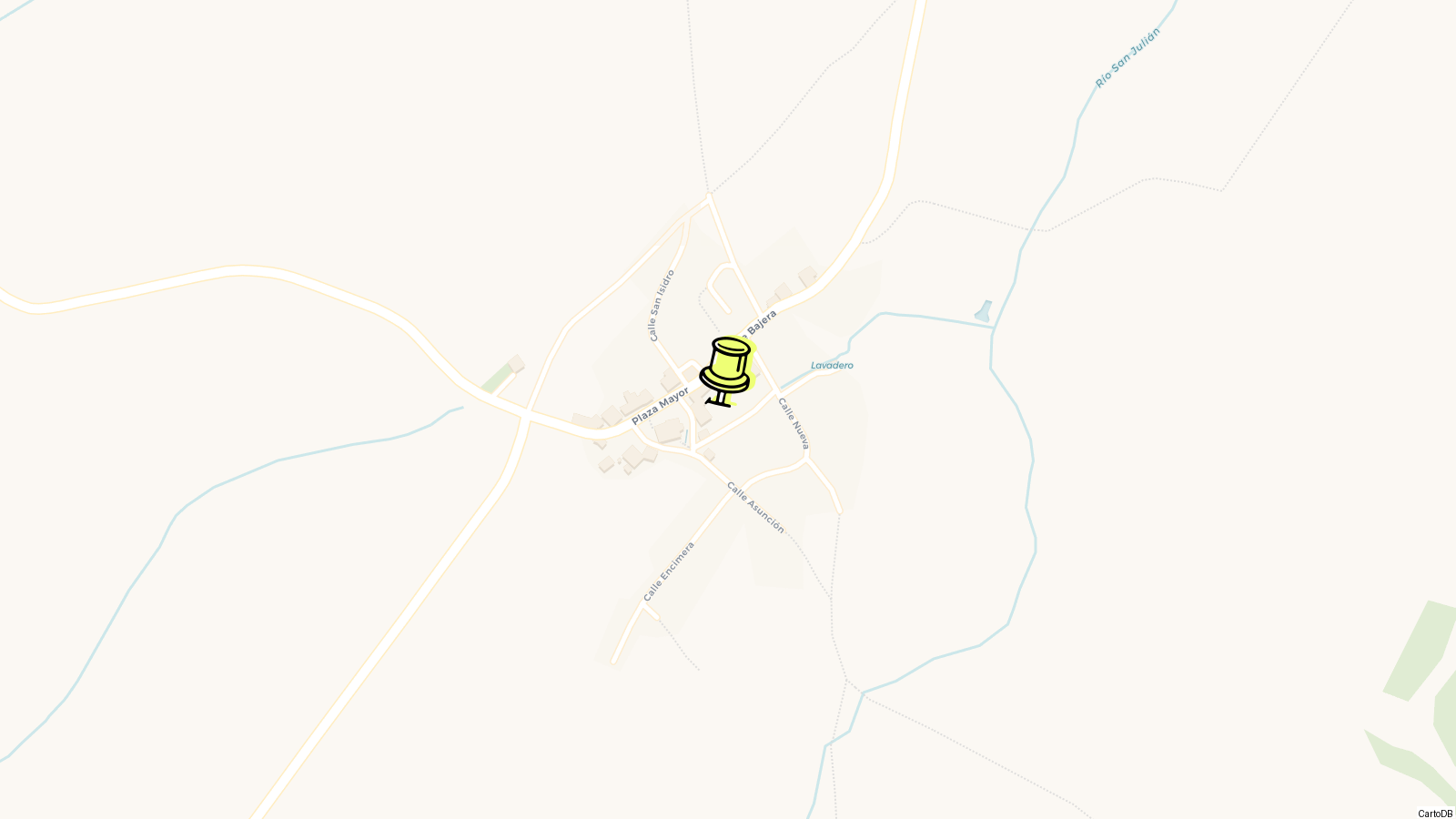
The parish church is dedicated to the Assumption and holds the font in which Santo Domingo was baptised; the ruins of the house where he was born stand opposite the church door. The ruins are just that, low walls behind a rail, and they take two minutes. The font is the reason to bother, and it is the part you cannot count on: the church publishes no opening hours, so the realistic plan is to ring the town hall on 947 580 150 a day or two ahead and ask.
Walking through
For pilgrims this is kilometre 552 to Santiago, and the village sits in a tight cluster of stops: Grañón is about 8 km behind, Redecilla del Camino about 4 km behind, Villamayor del Río about 4 km ahead and Belorado about 8 km ahead. Redecilla del Camino has the tourist office and the municipal albergue; Villamayor belongs to the municipality of Fresneña. None of this is hard walking. The route through here runs flat and open across cereal country.
Sleeping and eating
Four places to stay appear on the town hall’s list, all bookable only by phone: the private Albergue Acacio & Orietta at Calle Nueva 6 (947 585 220 or 679 941 123), the rental cottages Casa del Herrero at Calle La Asunción 3 and El Herrero II at Calle Asunción 1, four beds each (626 058 117), and the two-star Mi Hotelito Viloria at Plaza Mayor 16 (947 585 225 or 676 390 240). Ring before you arrive rather than after; in a village this size, an unanswered phone usually means nobody is home.
Food is your own problem. With no bar or restaurant on the municipal register, the nearest reliable kitchens and shops are in Belorado, and eastwards in Santo Domingo de la Calzada. The town hall itself is at Plaza Mayor 1.
Tips
-
Bring food and water in. There is no shop, no bar and no restaurant, and the municipal register of bars and restaurants has no entries at all.
-
If the font matters to you, phone first. The church has no published opening hours and the town hall number, 947 580 150, is the only listed line for the village.
-
Book beds by voice. None of the four places on the town hall’s list takes online reservations, and two of the three private houses share a single mobile number.
-
Walkers should not plan a resupply here. Treat Belorado, 8 km on, as the next real services stop, and Grañón or Redecilla del Camino as the last ones behind you.
-
Driving is the easy option if you are not walking: 67 km northeast of Burgos, and a short detour off the corridor that links Nájera, Santo Domingo de la Calzada and Belorado.
-
Give it twenty minutes and move on, unless you are sleeping here. The church, the ruins and the Plaza Mayor are the whole visit, and there is nothing to fill an afternoon with.
-
Sources disagree on the postcode: Spanish Wikipedia gives 09259, the Diputación’s municipal record gives 09270. Use the town hall address, Plaza Mayor 1, Viloria de Rioja, Burgos, if you need to post anything.
Know this destination? Help us improve
Your local experience is valuable to other travelers.