Ponte Vella
Ponte Vella is a medieval footbridge built on Roman foundations in Ourense, Spain. Located at the intersection of N120 and Rua Progreso, it spans the Minho River.

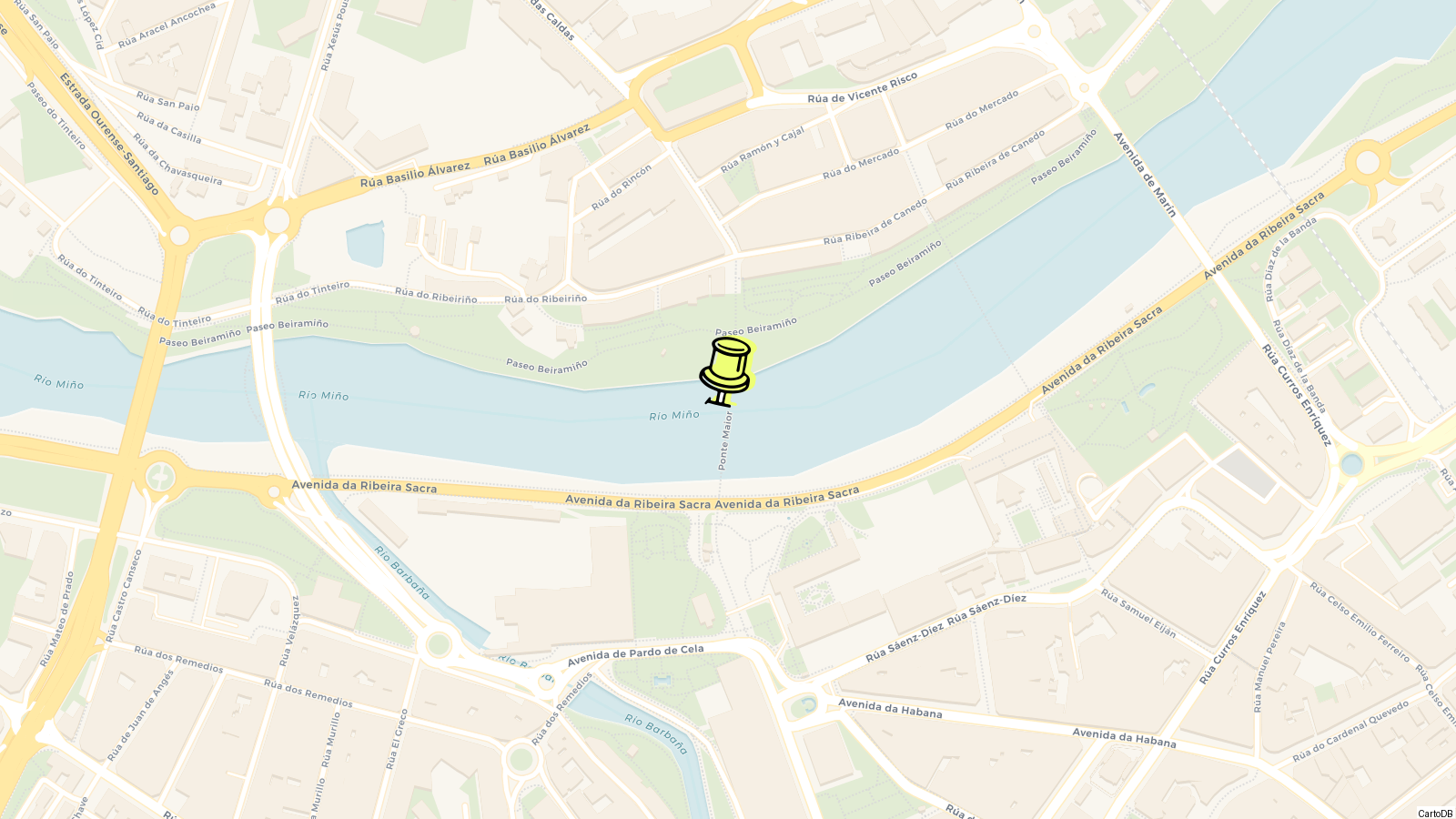
Overview
Ponte Vella stretches 370 metres over the Miño River, a long, sloping arc of granite that stands out as Ourense’s landmark crossing. Most people walk here to scan the view upriver from the highest point (38 metres above the water), or to follow the route pilgrims have taken for centuries on the Camino de Santiago’s Vía de la Plata.
Once this bridge controlled almost all traffic heading north from the city centre towards Santiago de Compostela. Until 1816, it was the only place carriages could cross the Miño in Ourense. That monopoly is long gone, but Ponte Vella remains a city symbol, so much so it appears, alongside a vanished defensive tower, on the Ourense coat of arms.
The bridge’s role on the Vía de la Plata means that nearly every modern pilgrim enters Ourense via this crossing. Today, pilgrim markers still line the approach, though you’re just as likely to meet locals or day-trippers walking dogs or sitting briefly to watch the river. The tower, once standing at the bridge’s city end, was demolished long ago, but its silhouette is paired with the bridge in the civic heraldry on display at city hall and tourist offices.
It’s all pedestrian these days, vehicles have been banned since more practical crossings opened downstream. The bridge’s seven surviving arches (originally eleven) draw early-morning joggers, students heading into town, and anyone ticking off the city’s big sights.
Tourism guides still list Ponte Vella among the top historical stops in Ourense. If you want a sense of scale, the central arch alone spans 43 metres, for its time, it was considered the biggest bridge in Spain.
Walking the length takes less than 20 minutes unless you linger for photos or river views. The official coordinates (42° 20′ 43.7″ N, 7° 52′ 07.4″ W) are frequently cited in local materials, a detail appreciated by hikers, cyclists, and geocaching fans looking for precision. Ponte Vella’s role as “civil architecture” (its technical classification) belies the fact that for hundreds of years, this bridge was the city’s most important piece of infrastructure.
If you’re anywhere in Ourense, it’s hard to miss, the bridge links Avenida das Caldas with Progreso, and even locals treat it less as a relic and more as a piece of lived-in city.
History
Roman origins
Romans controlled the bend in the Miño River here by the first century CE, drawn by Ourense’s thermal springs and the need for a permanent crossing. They built the first known stone bridge at this spot, anchoring a road that locked Ourense into the regional trade lines. The earliest arches below today’s deck go back to that Roman period, though constant floods and use made frequent rebuilding compulsory.
Roman bridges weren’t built for decorative effect: Ponte Vella was pure hard infrastructure, a critical leg for controlling the northwest of Roman Hispania. The original structure’s technical details are gone, but signs of early work in the surviving lower piers have led researchers to argue the bridge’s basic alignment has hardly shifted for two millennia. “Vella” means “old”, but in local pride it often means “essential”.
Medieval rebuilds and expansion
Floods, war, and sheer centuries hammered the original stonework, forcing major overhauls in the Middle Ages. By the 13th century, chronic repairs had essentially transformed Ponte Vella from its Roman base into a new, much grander bridge. Records show that by the late medieval period, the bridge was regarded as the biggest in Spain, an immense span for its day: its main central arch still measures about 43 metres, and stands 38 metres over the water. Seven of its current eleven arches trace back to these medieval phases.
Medieval Ourense gravitated around this crossing. Town walls tightened to its ramparts, and tolls from travellers crossing the bridge funded everything from ecclesiastical property to civil defence. Early drawings and heraldry show a fortified tower at the city end, long since lost. The bridge was so crucial that when it flooded out or war damaged it, authorities rushed repairs; a disabled bridge cut off access for pilgrims to Santiago as well as food and wine supply for the city.
Modern role and heritage protection
Ponte Vella survived into the industrial age as Ourense’s sole carriage crossing until 1816, when a new bridge finally took the pressure off. After that, it took on a new role, more pedestrian than transport link, especially once car traffic was banned with the arrival of extra bridges in the 20th century.
Its symbolism for Ourense outlasted its usefulness to modern traffic. Ponte Vella features in the city’s coat of arms, standing for endurance and continuity. In 1961, it was declared a Monumento Histórico-Artístico, giving it protected status and funding to prevent further decay. Meticulous maintenance has kept the bridge walkable and public, no tickets, no barriers, just an open span of stone that connects centuries.
Legends and the Camino
The bridge’s presence is more than just stone, it marks a milestone for Camino de Santiago pilgrims following the Vía de la Plata, who have crossed here for centuries as they edge closer to Santiago de Compostela. Ponte Vella isn’t some side street: walk it in the early morning and you’ll share the stones with everyone from dog walkers to international wanderers, still following the same northward path set out in the Middle Ages.
Local legend wraps the bridge in superstition and civic pride. For Ourense, it’s more than a physical crossing, it’s the city’s trademark, stamped onto official seals and woven into folklore. Even after centuries and new crossings, ask a local about “the bridge” and there’s no confusion about which one.
Visiting
Head straight onto Ponte Vella from Avenida das Caldas‑Progreso, no tickets or barriers, just ramped approaches wide enough for cyclists and strollers. Expect to share it with locals on foot: cars haven’t crossed here since the 20th century, when new road bridges opened and this became a pedestrian route. Allow 20 minutes if you want to inspect the arches, linger on the span, and grab photos over the Miño before continuing. There’s no admission charge, it’s open access, all hours.
If you want the geodata, you’ll find Ponte Vella at 42° 20′ 43.7″ N, 7° 52′ 07.4″ W. The approaches give you a good sense of the gradient, this isn’t a flat deck but a continuous slope, arcing up to the central arch. At the highest point you get views to both banks, Ourense centre behind you, the river and distant church towers ahead.
The best vantage is at the midpoint, right atop the central arch, which rises about 38 metres above the water and stretches 43 metres across. Stick your head over the parapet for a vertical drop to the Miño: it’s dramatic without being theatrical. The original Roman-medieval stonework is visible in seven of its surviving eleven arches, the shifting shapes and repairs tell you when floods or centuries forced a rebuild.
Of the original eleven arches, the four that are missing were lost to reconstructions and the rise and fall of the river level. The bridge you walk now fuses Roman foundation with medieval and modern repair, so the stones and span dimensions aren’t symmetrical. The central arch itself is among the longest granite vaults built in Spain before concrete, a design that was once called the biggest in the kingdom but now feels understated amidst new bridges downstream.
Most people take photos at both ends: one with the bulk of the granite arches receding behind; one facing back to the city and towers. It’s part of the Camino de Santiago’s Vía de la Plata, so you’ll hit pilgrims crossing if you come spring or autumn.
One end lands you back in central Ourense; the other meets quieter residential hills with routes towards Santiago. If you want to cross and return, factor steps or long sloping ramps at either entry, accessible but not entirely flat.
In practical terms, there’s no visitor office, ticket booth, or shop by the bridge. Everything you need, water, food, directions, is back in the city centre, a short walk. The bridge is in the city’s official list of civil architecture and earns protected “Monumento Histórico‑Artístico” status since 1961, but those plaques are easily missed if you’re moving quickly across.
Tips
-
No cars or bikes allowed: Ponte Vella is for pedestrians only, so you won’t need to dodge traffic while crossing.
-
It’s always open and free. No entry barriers, tickets, or closing times, walk across any time, even late at night.
-
Expect about 20 minutes for a relaxed visit, including photos from both ends and a pause halfway for river views.
If you move quickly, you’ll get across in five minutes, but it’s worth slowing down at the central arch for a look up and down the Miño river. Benches appear near the start and end. If you linger for sketches or photos, give yourself 30–40 minutes.
-
Surfaces are granite and can be slick after rain, especially on the slope towards the city centre end.
-
There are no toilets, shade, or vendors on the bridge itself. Take water if it’s hot and don’t expect cover.
- The approach from Avenida das Caldas-Progreso is wide and stroller‑friendly. Early morning and dusk are quietest if you want photos without people.
Late afternoons see commuters and pilgrims crossing (it’s part of the Vía de la Plata Camino de Santiago route). If you want emptier shots, avoid 17:00–20:00. Sunsets are best viewed from the old town side looking west, but take care: the western sky can burn out photos in summer.
-
If you’re following the Camino de Santiago’s Vía de la Plata, look for shell markers set into the paving, this bridge doubles as an official Camino crossing.
-
No special dress code (it’s outdoors), but bring a rain jacket, Ourense’s weather is unpredictable, and umbrellas are nearly useless in the wind.
Know this destination? Help us improve
Your local experience is valuable to other travelers.