A Guía lighthouse
lighthouse in Spain

Overview
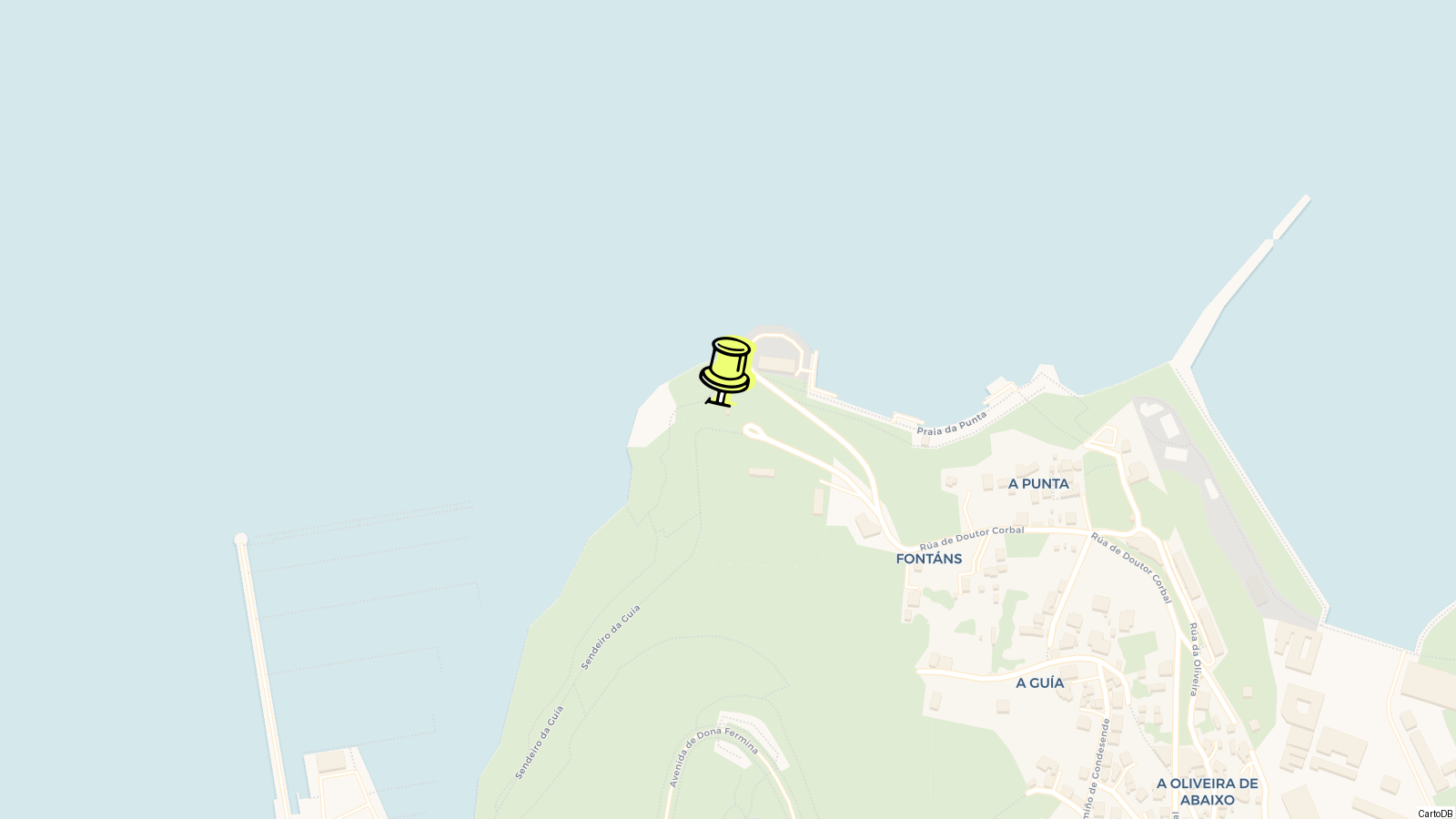
No fence, glass, or security guard gets between you and the view at A Guía lighthouse. This early-20th-century signal tower, set at the crest of Monte de A Guía, marks a stopgap between the busy city below and hundreds of empty blue kilometres to the horizon. Expect a sea wind, sharp pine scent, and the sound of ferries crossing the Ría de Vigo as you look out towards the Cíes Islands.
Monte de A Guía rises some 100 metres above sea level, forming one of Vigo’s main green spaces and the city’s natural balcony over the Galician coast. The spot is too far from the old centre to attract tour groups, but it’s busy on weekends with locals and the odd cyclist pausing for a break after the climb.
The summit’s exact coordinates are latitude 42.25955° N, longitude –8.70211° W. The hill’s role as both city park and lookout explains the relentless pace of local joggers passing by in the early morning. From here, you can easily scan the Morrazo Peninsula off to the east and spot the shipping lanes heading towards the open Atlantic.
A Guía lighthouse is officially a viewpoint, not a tourist monument, managed by the Port Authority of Vigo. The actual tower is fenced, so you can’t climb it or step inside, but everyone is welcome to walk up to the enclosure corner, which sits open-air and completely free. You’re here for the location, not the building.
Panoramas are why anyone makes the trip: this is probably the broadest viewpoint over the whole Vigo ría and the Cíes Islands. You get full context, the layout of the city, the shape of the bay, the outline of the Atlantic beyond.
Monte de A Guía is more than just a lighthouse stop. Ornamental oaks and pines line the upper slopes, and there’s a botanic path at the base for walkers who want a break from tarmac. A paved seafront promenade (Paseo del Borde Marítimo) connects the hill with small beaches such as A Punta and A Lagoa. Even cyclists get their own lane along this 712-metre stretch from the old lighthouse to A Lagoa beach.
If you care about the rhythm of a real Galician city, not just the postcard shot, come late afternoon, join a handful of locals on the ledge, and take your time. The city is right there, a fact that’s easy to forget until the wind shifts and the port’s cranes come back into view.
History
Pre-Roman and Ancient Traces
Petroglyphs with concentric circles, estimated to be around 4,000 years old, trace the earliest human presence at Monte de A Guía. You’ll spot these prehistoric carvings along a path on the hill. In 2024, improvement works revealed archaeological remains of a castro (Iron Age hillfort), confirming that the summit was used for settlement long before the port city of Vigo took shape. Nothing from the Roman era survives here, but the hill kept its strategic weight right through the centuries.
The petroglyphs, carved onto granite, follow the classic Galician pattern of concentric circles, usually linked to Bronze Age ritual or territory marking. The castro remains show that in the first millennium BC, Celtic-speaking peoples built fortified villages along Galicia’s rías. Excavations in 2024 picked up wall lines and pottery but no artefacts on public display yet.
Early Navigation and Legends
Long before lighthouses, the story goes that fishermen’s wives would light bonfires on Monte de A Guía to steer boats home through winter fog. The spot’s role as a guide point for returning sailors is more than legend, this exposed headland marks the entry to the Ría de Vigo, a natural amphitheatre for shipping and trade.
Such customs echo wider Galician seaboard tradition. Other promontories in the region had signal fires for navigation, but A Guía’s proximity to the bustling Vigo port meant the tradition lasted into the 19th century, long after oil lanterns began to appear along the coast.
The First Modern Lighthouse: 1844
In April 1844, A Guía’s first lighthouse switched on, making it the earliest built in Galicia after the Roman-era Tower of Hercules in A Coruña. This original tower (now vanished, but site-marked) was basic compared to the great lights of other Spanish ports, but it signalled a shift, Vigo’s shipping and fishing needed fixed navigation aids as trade ramped up.
Galicia’s coastline had several centuries of shipwrecks and murky routes. Until A Guía, no new lighthouses had risen on this coast after antiquity. The 1844 beacon used whale oil lamps and a simple lantern chamber; upgrades trickled in as the city grew. Reports from port records and the Port Authority of Vigo suggest the light was quickly overshadowed by newer, more visible towers, prompting investment in a better structure just decades later.
The 1914 Lighthouse and 20th-Century Shifts
The current A Guía lighthouse tower dates to 1914, built directly next to the older 1844 model and promptly taking over as the main beacon for the ría. Its silhouette, simple, white, utilitarian, isn’t about spectacle. This lighthouse worked in tandem with others across the ría, directing cargo ships, steamers, and fishing boats back towards Vigo’s docks.
The 1914 project repurposed the site, improving lamp technology and allowing for better sector visibility. At the time, maritime traffic in Vigo spiked as the city industrialised and the ría became a key port for exports and rail travel. Contemporary reports place the golf-ball headlamp’s visibility at 13 nautical miles, good enough for night crossings from the Morrazo peninsula. After automation in the postwar years, the lighthouse became less essential for day-to-day port management, but remained a visual reference for locals and any boat entering the bay. The Port Authority of Vigo still manages the structure.
The Chapel: Pilgrimage and Patronage
Right beside the lighthouse stands the chapel of Nuestra Señora de las Nieves (Virxe da Guía), whose present form is a 1951 design by Manuel Gómez Román. While religious use on the summit goes back further, likely late medieval or Baroque, the mid-20th-century chapel has become a symbol of the neighbourhood and marker for anyone cresting the hill.
Postwar reconstruction of the chapel had both practical and morale purposes in a city battered by the Civil War and dictatorship. The new building blended popular Galician forms (granite, semicircular arches) with the modernist lines favoured by Gómez Román. The altar’s display of maritime ex-votos, the boat models left by surviving sailors, kept the seafaring tradition alive. Today the annual romería blends religious ritual and outdoor eating, a rare holdover of pre-lighthouse pilgrimage customs.
Visiting
No ticket, guide, or appointment needed. The entire site is free and unfenced, though you can’t enter the lighthouse itself, expect to walk right up to the structure and position yourself at the edge of its stone-paved platform for 180-degree views over the Ría de Vigo and across to the Morrazo peninsula. All the best photo spots are outdoors, so leave interior-architecture fantasies at home.
From the platform, scan west across the water for the profile of the Cíes Islands, east towards the city centre, and south down the rugged coastline. The boundary fence only encloses the lighthouse’s base, with a small accessible corner giving you the classic vista everyone photographs. The exposed setting means you’ll catch every change in the Galician weather, fog banks rolling in, clear skies, or the sun dropping behind the isles. Benches and low walls built into the viewpoint let you linger without perching on bare rock. Cyclists and runners often pause here, especially at sunset.
You can walk straight up the paved, well-maintained trail to the summit at 100 metres above sea level, or drive and park in the designated pull-off area below. If using public transport, city bus 17 drops you at the foot of Monte de A Guía and it’s a 5–10 minute uphill walk from the nearest stop. The paved path is not flat: expect short steep ramps. Several wooden staircases branch off for detours to Cala do Faro and the botanic trail.
A loop walk takes in pines, oaks, and small beaches like A Punta and A Lagoa at the base of the hill. You aren’t locked into a single trail, explore side paths through mixed woodland, or drop down to the Paseo del Borde Marítimo for sea-level views.
The forested slopes are laid out with ornamental planting (mostly native species), plus information panels on the local botany and birdlife. Pick up the marked botanic trail if you’ve got twenty minutes: it circuits the lower hillside, looping past clusters of maritime pine and mature holm oaks. Benches crop up at the best vantage points over the beaches. Paths are regularly maintained, but expect mud after rain and the odd root across your stride. Wooden stairs link the upper park with Cala do Faro, a small cove popular with local swimmers in summer.
You’ll spot the nearby chapel (Virxe da Guía, Nuestra Señora de las Nieves) on the same summit if you want a bonus stop. Entry is free, with regular opening hours every day of the week, but that’s strictly the adjacent religious site, not the lighthouse. The two stand side by side but serve different purposes.
If you visit in August, you might catch the annual romería tied to the chapel rather than the lighthouse itself. Outside event times, the peak is rarely crowded on weekdays, but weekends get busier with local families and picnickers, especially when the weather is good.
Tips
- Paths up Monte de A Guía are paved but can be quite steep in sections. Trainers or sturdy shoes are a good idea, especially if it’s damp.
The final 100 m climb from the nearest road puts you on a stone terrace at the base of the lighthouse. The surface is even, but if you’re coming from the Paseo del Borde Marítimo or the lower beaches, expect sharp inclines for the last stretch.
- No entry possible: you can’t go inside the lighthouse itself, no matter the season. You can walk right up to its perimeter and take in the views.
If you see a gate in the fence open, it’s probably maintenance, not a change in visitor policy. There’s no ticket and no signage about restricted hours for the grounds, but respect barriers and don’t try to slip in. The lighthouse is managed by the Port Authority of Vigo and isn’t equipped for visitors.
- Sunset is the main event. The wide Ría de Vigo and the Cíes Islands line up directly west of the tower, so arrive 30–40 minutes before sunset if you want a front-row spot for photos as the sun drops behind the islands.
On clear evenings, expect company from amateur photographers and families. Weeknights tend to be quieter. There’s no lighting at the platform itself, bring a torch if you’ll be descending after dark, as the forested park gets pitch-black and local buses wind down their service by 23:00.
- There’s no café or shop on Monte de A Guía. Bring water and anything you want to eat, especially if you plan to linger.
If you’re walking up from the harbour area, the last supermarkets and bakeries are at the bottom of the hill. If you continue down to A Punta or A Lagoa beaches, these are small coves with no commercial services, just sand and rocks. Don’t count on public toilets, the only facilities are at the chapel, and these are only open during its opening hours (09:30–11:00, 17:00–20:30).
-
If you’re aiming to combine the lighthouse with a visit to the ermita, check the schedule. The chapel is open daily but only for brief windows in the morning and late afternoon, and outside those times the door is locked. Near August 5, expect crowds for the annual romería.
-
The marked botanic trail at the foot of the hill features oaks and pines. For a shady alternative to the road, pick up this route near the promenade to circle the base and ascend in stages.
Interpretive panels detail some local species, and the trail eventually connects to the paved paths up to the lighthouse platform. It can be slippery after rain. Watch for petroglyph markers indicating the prehistoric rock carvings.
Know this destination? Help us improve
Your local experience is valuable to other travelers.