Castillo de San Sebastián
Essential info
Visit details
Overview
Climb the steps from Praza do Rei and the past flickers through the present. The white slab of Vigo’s city hall sits where a 17th-century fortress once held the bay, and a stretch of granite parapet is all that’s left of it. The Castillo de San Sebastián is less ruin than ghost: a few turrets, a parapet, a piece of garden, all stitched into the modern square.
The fortress went up in 1656 under Philip IV, alongside the city walls, when Vigo was bracing for English raids on the ría. It took its name from a hermitage to Saint Sebastian, the local saint invoked against plague, that was torn down to make room. Then English forces landed in 1719, hammered the walls, and the castle never fully recovered. Hospital, barracks, ruin, parking lot: the site cycled through uses until 1964, when the army handed it to the city.
What you can actually see today is the result of a 1970 demolition that cleared most of the curtain wall to build the current city hall, finished in 1976. A few segments of granite, turret stumps, parapet, a stretch of garden, were left in place as a memorial to the fortress that once defined this end of Vigo’s old town. The plaza is open all day, free to walk, and works best as a quick stop on the way to or from the Casco Vello below.
History
The Castillo de San Sebastián stands on ground that first carried an hermitage dedicated to Saint Sebastian, the saint invoked locally against the plague. In the 17th century, with threats from English and Portuguese forces intensifying, parts of the older fortress called ‘Penso’ and its chapel were torn down so Vigo could build modern defences. The new castle rose in 1656, on the orders of Philip IV, directly alongside new city walls ringing the old town.
No original plans survive, but the structure showed all the Renaissance military tricks: thick low walls for cannon resistance, angular bastions, and integrated parapets, forming a coordinated line with the nearby Fortaleza del Castro. Both castles, with their walls, turned central Vigo into a walled garrison. The site was chosen specifically for its line of sight over approaches by sea and land; English attacks from the Ría de Vigo were a real threat at that time.
Only decades after its construction, the castle took a severe blow. In 1719, English forces landed in the bay and battered the fortress, leaving it heavily damaged. From that point, military focus shifted uphill to the more defensible Fortaleza del Castro, and San Sebastián slid into partial abandonment.
The English landed as part of the Anglo-Spanish War (1718–1720), aiming to knock out Spanish naval resources. They destroyed much of the castle, ruined parts of the city’s defences, and kept control of Vigo for several weeks before withdrawing. The original curtain wall never fully recovered. After retreat, Spanish authorities invested less in repairing San Sebastián, preferring the hilltop position and thicker walls of O Castro.
During the Napoleonic era, the site’s role shifted again. By the start of the 19th century, the battered fortress was turned into a hospital, and later served as a barracks through various periods of unrest. In 1964, the Spanish military finally passed it to the city council, sealing the end of its armed role.
The Peninsular War and later Carlist conflicts meant that almost every fortification in Galicia saw new uses, defending, supporting troops, or converting to makeshift hospitals or depots. As weapons outpaced the old walls, San Sebastián fell further out of use as a military post. The 1964 handover meant the city could finally decide the site’s fate without Ministry of Defence vetoes.
The 20th century delivered the final blow to San Sebastián’s structure. Plaza del Rey was redeveloped in the late 1960s, and in 1970, most of the main wall was demolished to clear ground for the current city hall. Construction finished in 1976, with only fragments of the ancient castle, mainly turrets, parapet segments, and part of a garden, still recognisable.
Critics at the time decried the loss of heritage for the sake of a concrete government block. The southern perimeter was especially damaged, and the connection with the rest of the old city vanished under pavement and modernist architecture. No comprehensive archaeological study took place before the demolition, so any artefacts or structural history beneath the walls is likely lost.
Now, only columns and garden ruins remain, but their outline still sketches the defensive ambition of 17th-century Vigo. Linked with the upper Fortaleza del Castro, the site served as both a symbolic and literal wall around the historic centre.
While the modern city hall dominates Plaza del Rey, the fragments of San Sebastián offer a rare glimpse of Vigo’s uneasy relationship with its past, part protected, part erased for new priorities. The surviving watchtowers were restored just enough to keep them standing, but not enough to return their original form. Interpretative signs today note the former layout, the connections to the city walls, and the regular English and Portuguese threats that shaped their design.
Visiting
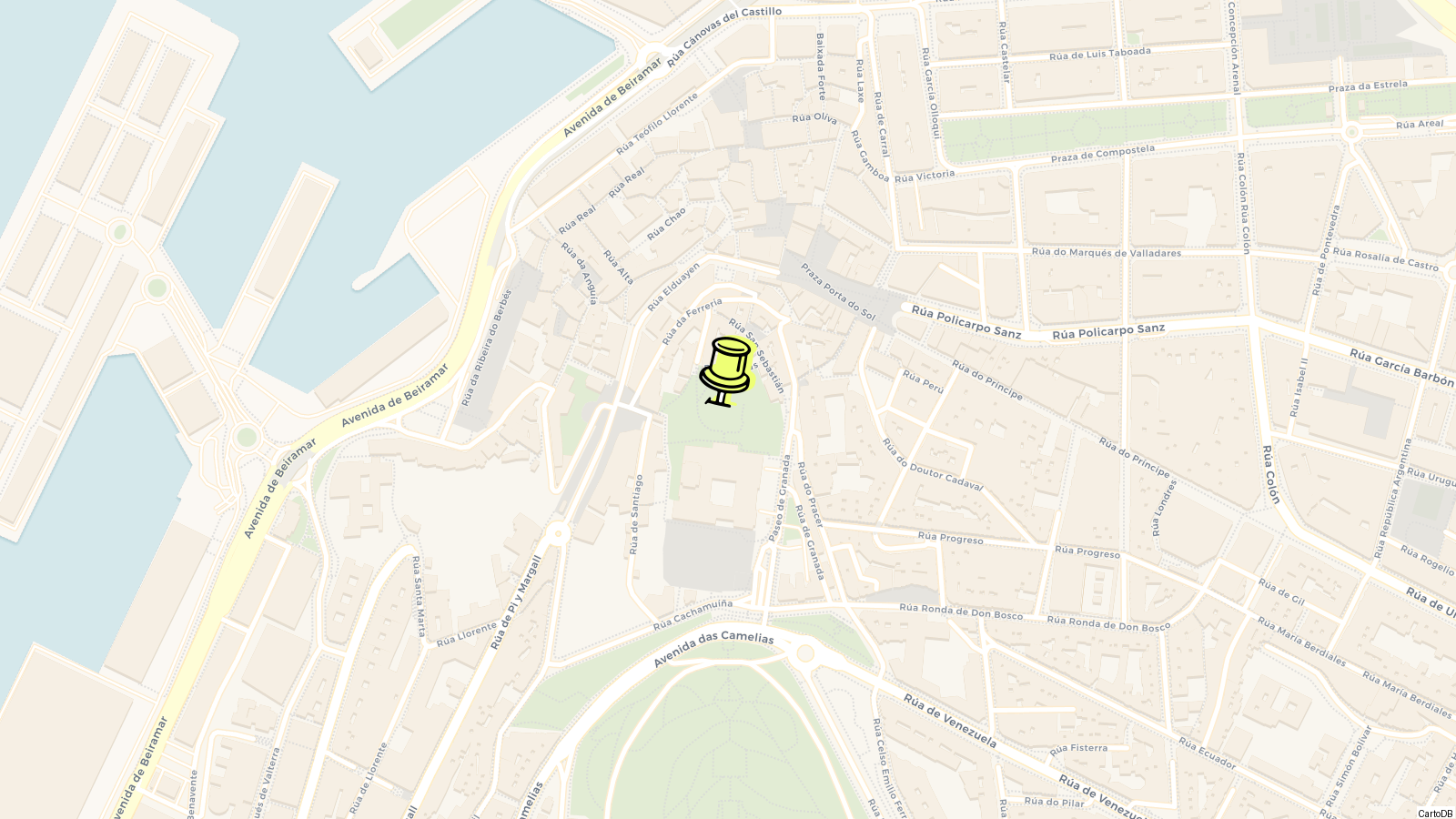
The Castillo de San Sebastián sits right in the centre of Vigo, next to the Ayuntamiento (city hall). You’re not getting turrets and battlements here, most of the original 17th-century structure is gone. What survives is a ring of garden, scattered cannon platforms, some stone walls, and a couple of turrets that outline the former footprint.
The gate is always open from 9:00 to sunset, all week, free of charge. There’s no ticket desk, queue, or security to worry about, just wander in. On bright days, you’ll see a few pensioners playing chess, dog walkers, and families letting kids clamber over the stones.
The official closing time tracks sunset, which changes throughout the year, figure 18:00 in December, 22:00 in June. There’s no lighting after dark. The atmosphere can go from pleasant to grim quickly if you linger too late, so plan your daylight hours accordingly. There’s no fencing or obvious path to steer you, but everything is open access unless specifically roped off for an event.
The draw? Perspective. Climb the battered ramp toward the remaining turrets and you’ll get views across the ría, the modern city, and up to the Fortress of O Castro a few hundred metres away. This spot is built for photos, not for lingering, no café, no shade, just benches and some interpretive signage about the old fortress.
The real skyline moment comes on a late-afternoon visit if you time it right. You’ll see dock cranes lining the estuary, traffic flowing along the Alameda below, and ferries heading out to the Cíes Islands. On cloudy days, all of Vigo feels close, muffled by the mist, but you can still trace the outline of the city walls that once ran from this corner up to O Castro.
There’s zero sense of a “museum”. Don’t expect curated rooms or audio guides. Most of what’s left is outdoors, but the old casemates are sometimes used for exhibitions or local events, especially during the festival season.
When events happen, you’ll find posters around the Ayuntamiento and on the castle gates. These might be small art shows, jazz nights, or community festivals in the gardens. The site is small, so even during a local event, you’re rarely jostling in a crowd. Just turn up if you see the activity, no advanced booking for these pop-up happenings.
Kids can run freely on the grass and climb parts of the wall (within reason), but this is not a full play park, mostly open stonework and seating. Locals use it for a quick stroll or to cut through the Ayuntamiento’s plaza. You’re not spending more than half an hour here unless you sit for the view, sketch the silhouette, or join an event.
The Camino Portugués de la Costa passes close by, and you’ll sometimes spot shell-carriers pausing at the site for a break on their way through Vigo.
The site forms a milestone for pilgrims walking the coastal route up from Portugal, offering a spot to take in the estuary and catch their breath before the climb toward O Castro. Many choose it for a group photo, this is the closest the Camino gets to the heart of municipal Vigo.
Tips
- Entry to Castillo de San Sebastián’s grounds, gardens, and parapets is always free. Just show up, no ticket or booking needed as of 2025.
There isn’t a staffed entrance or ticket desk, and you won’t find guided tours tied to the ruined castle directly. The area is usually open to visitors during the stated hours, so it’s straightforward: walk in, wander, and leave whenever you like. Temporary events or local festivals may close off sections, there’s no central website for last-minute updates.
- The castle is open daily from 9:00 until sunset, but the exact closing time shifts month to month. Overcast or stormy days may see it shut earlier. Aim for daylight hours, there’s no night lighting and the ruins are not set up for evening visits.
Most of the open-access area consists of walkable garden and wall remnants, not museum rooms. No regular staff presence, don’t expect facilities after dark. Visit in the morning if you want fewer locals and more filtered light over the estuary.
- The surviving ruins and parapets are exposed to weather. Bring a rain jacket, there’s no shelter if Galicia lives up to its reputation for sudden showers. The ground can get muddy after rain, and surfaces may be uneven or slick. Trainers or walking shoes beat sandals or city flats.
The original fortress was far more extensive, but demolition in the late-20th century removed much of the historical structure around the new city hall. What’s left runs the length of the small park, not high ramparts or a labyrinth.
-
The site is wheelchair-friendly along main paved paths from the Ayuntamiento side. The sloped grass to the ruined sections, though, isn’t easily navigable. Benches and shaded spots are limited, pack water if you plan to linger.
-
Locals pop in at lunchtime for the view over the Vigo estuary and the Monte do Castro. Early evening (before sunset) is best for photos and quiet.
On clear days you can see beyond the port to the outskirts of Vigo and into the hills behind. The site still sits on the Camino Portugués de la Costa pilgrimage route, so expect some walkers and hikers at all hours.
-
There are no toilets, no café, and no vending machines on the grounds. The closest public toilets are inside the nearby Ayuntamiento building during its opening hours.
-
Dogs on lead are common, and families treat the site as a neighbourhood green space. Respect local use, avoid climbing ruins or dropping litter.
-
If you want to combine your visit, the Fortaleza del Castro is just a few hundred metres uphill. It’s a steeper walk, but the best extension if you’re already here.
Know this destination? Help us improve
Your local experience is valuable to other travelers.