Praia de Samil
Samil Beach is a beach in the parish of Navia, Vigo, Galicia, north-west Spain. At 1,250 metres (4,100 ft) in length and approximately 60 metres wide, it is the largest beach in the city.

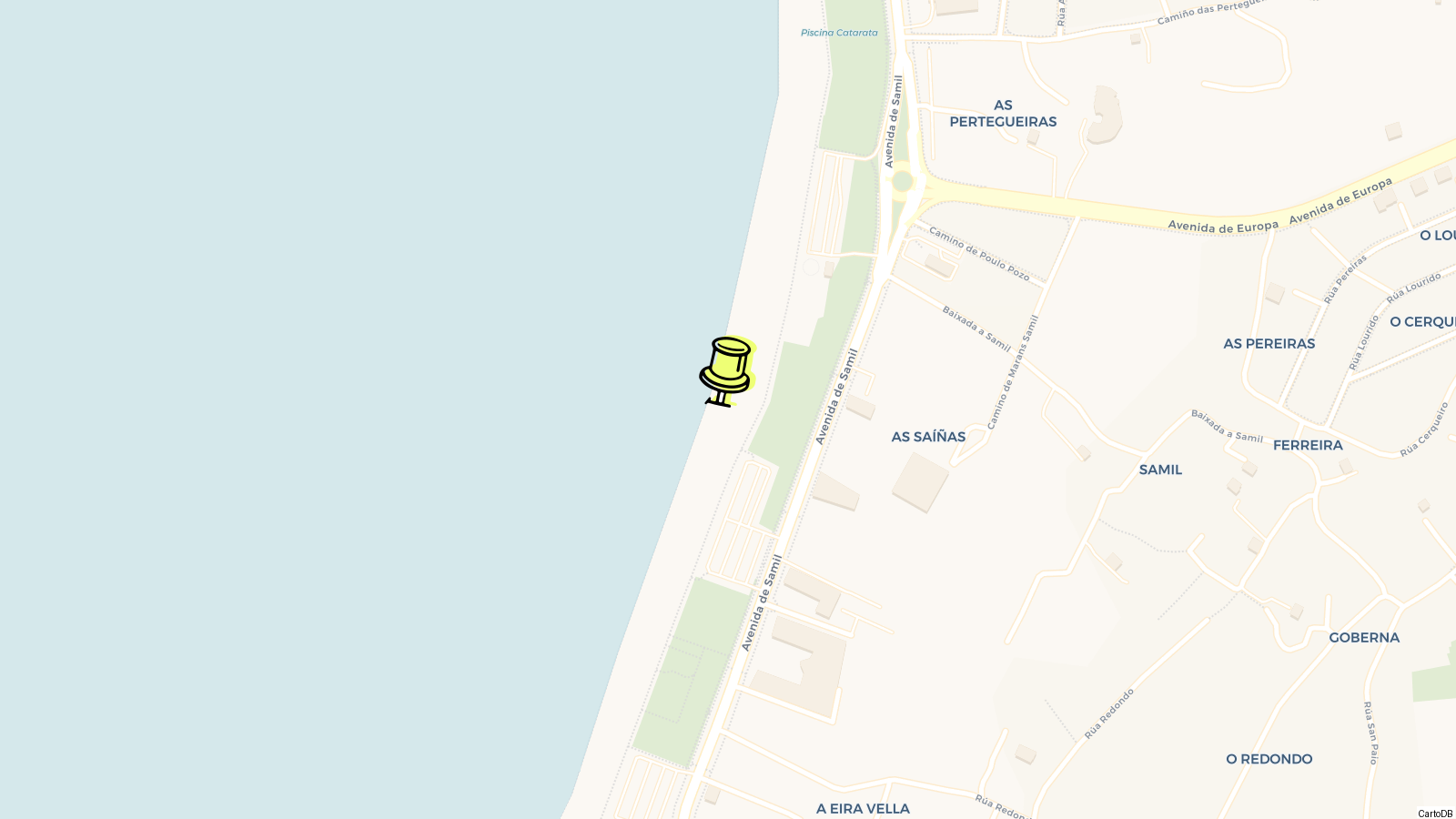
Overview
Praia de Samil is the city beach of Vigo, a 1.25 km arc of golden Atlantic sand at the western edge of the city, facing the Cíes Islands across the mouth of the ría. It is the largest beach in Vigo and the one most locals mean when they say they’re going to the beach for the afternoon.
What it offers, beyond the sand itself, is a long paved promenade lined with cafés, three free public saltwater pools open from late May to late September, a children’s playground, basketball, tennis, paddle and mini-football courts, and a skating rink. The beach is classified as semi-urban, lifeguarded by the Red Cross during the bathing season, and accessible for visitors with reduced mobility.
Samil’s character is family-oriented and busy, not wild. The Atlantic water is cold all year, around 18 °C in summer and roughly 13 °C in winter, and the beach fills as soon as the sun is out, even on winter afternoons. The west-facing arc means a full sunset over the Cíes most clear evenings between roughly April and September. City buses on Vitrasa lines L10, C15A, C15B and C15C run year-round to the promenade.
Visiting
Most of what people call “Praia de Samil” is a 1.7km stretch of wide, yellow sand at Vigo’s urban edge. It’s backed by a paved promenade and a busy road separating the beach from the bulk of the city. Arriving on foot, bike, or local city bus drops you at the promenade. If you’re driving, head straight for the large surface parking at the east end (it’s free, but during summer weekends expect it to fill midday).
Praia de Samil sits at 42.2093°N, -8.7763°W, putting it just west of central Vigo and facing straight out to the Cíes Islands. The city bus network drops you within a few minutes’ walk of the sand; summer routes run more frequently, especially on sunny weekends. There’s more than 1km of public parking, but queues at both ends on peak afternoons are normal.
Don’t expect wildness or solitude here. In June–September, the sand fills with big family groups and groups of teenagers; the promenade gets noisy with kids on scooters. Lifeguards watch most of the length, flagged posts and loudspeakers warn you off if jellyfish or rough surf threaten. Swimming is almost always permitted, but pay attention to the daily colour-flag at each central tower.
The crowds drop sharply outside July and August. Early mornings and any day outside school holidays, you might find mostly local dog walkers and joggers. City crews clean the sand each night during summer. Lifeguard services and supervised swimming areas operate June through mid-September, with coverage between 11am and 8pm most days (may be shorter in June and September, depending on staff). Flags are standardised: green means normal swimming allowed, yellow signals caution (usually small surf), and red means out of the water, no exceptions enforced strictly near the towers.
What you get between the promenade and the water is a flat, fine, clean sandbank. Tides leave a wide, hard-packed strip perfect for walking. No rocks or reefs interrupt the main swimming zone, though if you wander to the far west end, watch for slippery algae patches near the walkways. The sea stays chilly even in August, but most locals still wade in.
Benches and grassy areas between the beach and road give you some shade, but the sand itself is exposed. There are a handful of public playgrounds and sports courts backing the promenade. In peak summer, ice-cream and snack carts roll up, but for shaded cafés or sit-down meals you’ll need to head away from the sand, the closest options sit up the main road along the bus lines.
During local festivals or holiday weekends, temporary pop-up vendors and a few food trucks set up on the pavement, usually at the east end nearest the main car park. Rental kiosks for pedalos or inflatable play structures have appeared in high summer some years, but aren’t permanent; don’t count on equipment hire.
For families, the broad beach and play areas make it an easy half-day. For actual swimming, check the daily lifeguard flag and mind the undertow after big Atlantic swells. There are no sunbed or umbrella rentals run by the city.
If you want showers at the end of your swim, stick to the central sections. For a quieter day, aim early or come midweek outside peak July–August. You can’t wild-camp, and there are no city-authorised overnight motorhome spots right on the promenade. For full facilities (locker rentals, beach gear), you’ll need to look in the core of Vigo.
History
Early use and natural development
Praia de Samil sits at the western edge of Vigo, today surrounded by urban sprawl, but for most of its history it lay well beyond the town’s limits. Until the late 19th century, Samil was a sand dune belt used for fishing, shellfish gathering, and occasional summer grazing. The Ría de Vigo, the estuary that shapes this coast, attracted fishing villages long before Vigo itself became a major port.
Vigo’s first expansion toward the sea started in the late 1800s, when workers and traders from the growing industrial town sometimes made the long walk out to Samil on rare days off. The sand was considered unproductive land, and records before 1900 hardly mention it except in fishing and shipping logbooks. Even at the turn of the century, Samil was a place for leisure only if you already lived nearby; municipal transport did not yet reach this end of the bay.
20th-century transformation
Beach swimming wasn’t part of local culture until well after the Second Republic, but by the 1960s, Samil was touted as Vigo’s “urban playa” for a population that finally had the means and time to make use of it. The shift arrived with industrial expansion. As shipyards, canneries, and automotive plants fuelled population growth (Vigo’s population doubled between the late 1950s and early 1980s), the city council started flattening dunes and building access roads. That’s when concrete promenades, parking lots, and swimming pools appeared, in the era’s variant of “Costa” mass tourism planning. If you walk the length of the current promenade, the landscape is the result of this accelerated urbanisation.
For most of this process, planners looked to the Costa del Sol for inspiration, betting on wide, paved walkways and car-centric design. Many of the original pine groves were cleared, and the natural sand-dune ecosystem shrank dramatically. By the 1970s, official guides started promoting Samil as a summer escape for local factory workers, rather than just a village beach.
War and occupation
During the Peninsular War, French troops occupied Vigo in January 1809, but there’s no record of them reaching Samil itself. The action happened closer to the old port, where local resistance ended the occupation by March of that year. It’s not until the 20th century, with urban expansion, that Samil really enters local histories.
There are no known fortifications or battle sites at Samil. The events of 1809 were concentrated around the city centre, now the focus of the annual Reconquista festival on 28 March.
Samil in living memory
If you meet anyone from Vigo born before 1960, odds are they’ll recall Samil as a windswept, semi-wild place, their parents might have fished for cockles on the tidal flats, or biked out when west winds made inland streets suffocating in July. The transformation into a full concrete esplanade is a post-Franco story. Sea-facing cafés and hotels only appeared at scale in the last few decades.
Urban growth policies of the 1980s saw Samil promoted heavily as Vigo’s “playa pública”. Locals still debate whether the 1960s–1990s wave of real-estate and infrastructure building improved or ruined the beach. What’s certain: Samil’s urban face is a direct result of Vigo’s population boom, and its present role, a city beach with bus lines, pools, and year-round activity, is less than 70 years old.
The bigger context: the estuary and the city
Samil’s story is inseparable from Vigo’s. The Ría de Vigo has been the site of historical events like the Battle of Vigo Bay in 1702, but none played out on the sands of this west-facing arc. The beach you stand on was shaped by urban strategy and demographic explosion, not old battles or saints.
The Battle of Vigo Bay, which saw an Anglo–Dutch force attack the Spanish–French silver fleet, happened well out in the estuary waters. Samil was a bystander, a fringe of unremarkable sand then far from any settlement of note.
Tips
- There’s little shade at Praia de Samil, so bring a parasol or risk frying on the sand. The concrete promenade makes flip-flops a better call than bare feet in summer.
Even in June or September, the sand gets hot by midday. You’ll spot locals dragging folding chairs and umbrellas from the car park, especially on weekends. If you forgot a parasol, expect to pay elevated beach-shop prices along the promenade for a basic one, locals don’t bother, they bring their own.
- Arrive by 11am if you want to park within easy walking distance, especially on July and August weekends when the main lots fill up quickly. Street parking further inland is free but means a hotter hike back.
- The public toilets are located at intervals along the promenade but get rough fast during peak periods. Bring hand gel and your own tissue, it’s not always restocked.
Cleaning schedules increase on weekends, but crowds outpace supply. Avoid rushes right after lunch or late in the day. If you’re at the far ends of the beach, facilities are sparser; closest regular cleaning is near main access points.
-
The Atlantic water is cold, all year, even in August. Locals don’t swim for long. Pack a rash vest if you get chilled easily.
-
Don’t leave valuables unattended. Petty theft is rare but not unknown when the beach is packed. Use a zip bag and keep it under your towel or in sight, Vigo is a big metro area with 545,892 residents.
Police patrol on foot along Samil during summer weekends. They move along the promenade and occasionally sweep the sand, but responsibility is mostly yours. If you bring electronics, buddy up with a swimmer or risk coming back to a lighter backpack.
-
No bonfires or camping overnight. Praia de Samil is part of the city’s managed beach system, and rules are enforced even outside July–August.
-
There are no lockers near the sand. If you’re carrying things you can’t get wet, leave them in your car or opt for the minimal-pocket beach approach.
-
The west-facing beach gets a direct view of sunset over the islands on clear nights. The best light for photos is between 8 and 9pm in midsummer.
Know this destination? Help us improve
Your local experience is valuable to other travelers.