Praza de Compostela
park in Vigo, Spain

Essential info
Visit details
Overview
Plane trees, gravel paths, and the steady plash of a central fountain. Praza de Compostela in Vigo is less a square than a long urban park, the kind of place where retirees read newspapers on cast-iron benches while dog-walkers loop the perimeter and the traffic noise gets swallowed by leaves. Locals call the green strip running through it the Alameda, and the whole space is open 24 hours, every day, with no fence and no fee.
The architecture explains why this corner of central Vigo feels like a different city to the granite alleys of the Casco Vello a few minutes downhill. The buildings ringing the square are neoclassical, eclectic, and modernist, with the ornate stone-and-column facade of the Correos (Central Post Office) anchoring one side. Vigo’s tourism office files the whole ensemble under the label Vigo Señorial, the city’s nineteenth-century bourgeois quarter built when the port boom needed somewhere photogenic to put its money.
Most visitors find their way here by accident, walking down from Príncipe or up from the port and realising they need to sit down. That’s the right way to use it. The square hosts the Feira do Libro de Vigo and other open-air events through the year, and at Christmas the centre fills with a market and a tree. Outside those windows it’s a working-day green space, not a sight to tick off.
Visiting
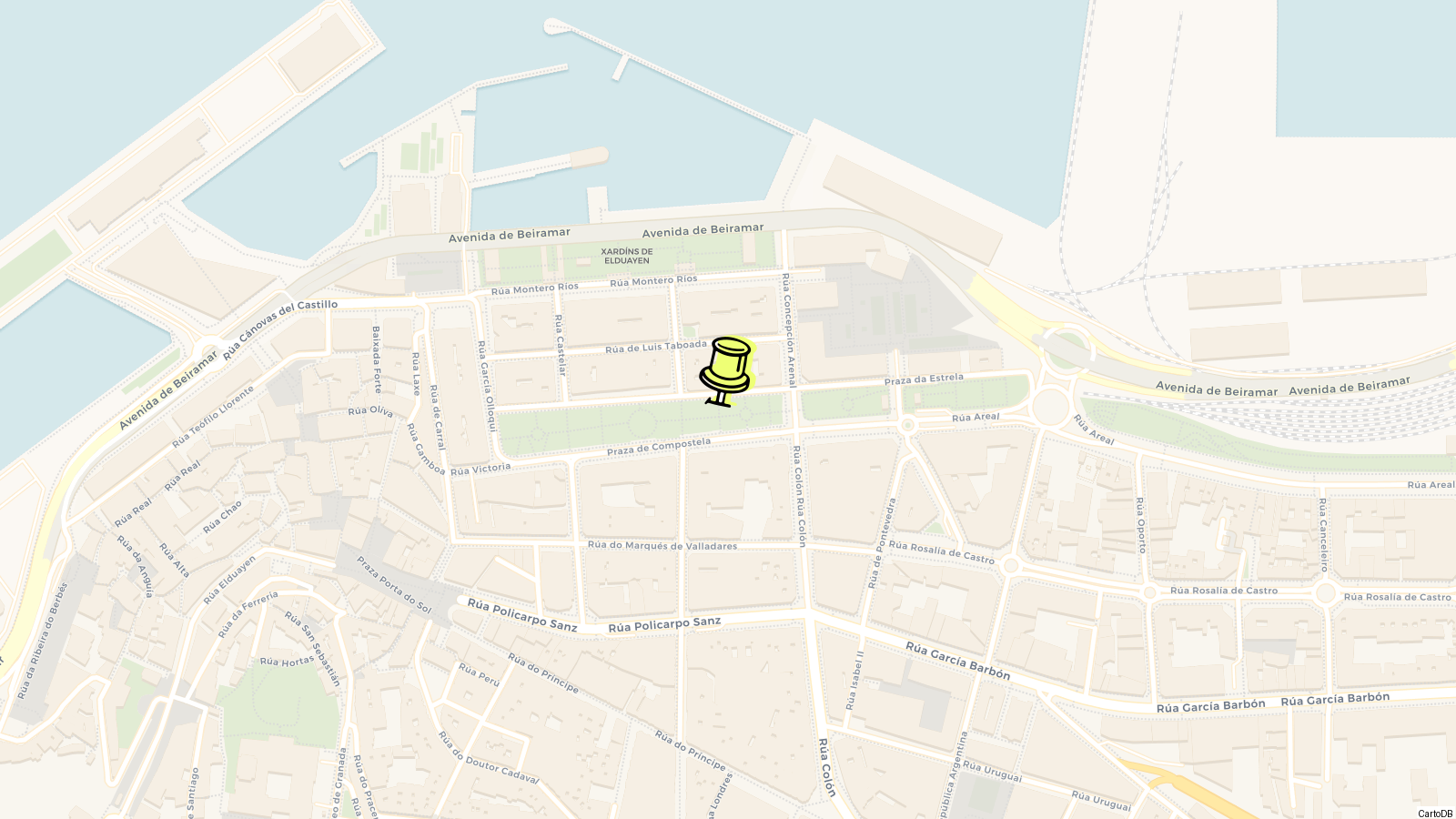
The main entrance to Praza de Compostela is easy to find, it’s located a few blocks east of the old city centre, just past the Alameda de Vigo. No tickets or reservations needed; you just walk in from any surrounding street.
You’re at 42.239444 latitude, -8.721389 longitude, central for most of Vigo’s east-west axis. The square is bounded on one long side by the Alameda de Vigo park, and you can enter from nearly every corner. The north and south flanks are lined with low-rise 19th- and early-20th-century buildings; most ground floors are cafés or offices, so there’s no formal visitor centre.
Most people come here to walk the length of the square or sit in the park. The wide pedestrian area is shaded with mature trees, with benches throughout. If you’re after a place to take a break, pick a seat facing the Alameda or the street for the best people-watching.
The park portion (Alameda) runs parallel to the square on its southern edge. It’s busiest during the late afternoon paseo, when families and older locals come out to socialise. Street performers and market stalls appear for special events but otherwise don’t crowd the square, so there’s plenty of open space on a typical day. No playgrounds or paid amusements, it’s a sit-and-watch sort of spot.
There are no major sights, monuments, or museums inside Praza de Compostela, if you’re looking for them, head toward the waterfront or back up to the old city centre. The draw here is the atmosphere, not a checklist.
Expect to run across a few parked cars hugging the north edge (street parking is still allowed here), but the core is pedestrianised and step-free. Wheelchair and buggy access is not a problem.
Public toilets are rare; your best bet is the facilities in one of the cafés skirting the square, but you’ll be expected to buy a coffee or snack first. There’s no official public WC.
If you’re lucky enough to visit on March 28, locals mark the Reconquista of Vigo with street celebrations that start or pass through here, worth catching if you want to see the square actually full.
Otherwise, thirty minutes is plenty for a pass through unless you’re meeting someone or killing time. No ticket queues, no official guides, no need to plan ahead.
History
You’re standing in a square that wouldn’t have existed before the 19th century. Praza de Compostela is a product of Vigo’s expansion outside its old city walls, part of the urban growth that spun out as Galicia’s biggest port swelled in population. This wasn’t the medieval core, which huddled closer to the harbour. By the late 1800s, the city was bursting, Vigo had to push outward, replacing gardens and marshes with planned grids and open spaces.
All of this grew out of Vigo’s role as a port city on the Ría de Vigo. Nineteenth-century Vigo was shifting fast: the decline of fortress walls echoed all over Spain, and new trends in city planning favoured wider avenues and formal gardens. What’s now Praza de Compostela used to be part of the Alameda de Vigo, a tree-lined promenade typical of every ambitious Galician town. Vigo’s version became a hangout for the emerging middle class, with cafés and bandstands. By the turn of the twentieth century, entire stretches around the square had been filled in with grand apartment buildings and civic institutions.
During the Peninsular War in January 1809, French troops occupied Vigo. Locals point out that Vigo was the first city in Europe to eject French forces during Napoleon’s invasion. The anniversary, called Reconquista, is still marked annually with parades and public events in the city, but Praza de Compostela itself didn’t play a starring role, since the square didn’t exist yet in its modern form.
The original fighting during Reconquista took place in Vigo’s older streets, closer to the port and the city’s fortress. As the population expanded, memorialisation shifted, and modern squares like Praza de Compostela became places to congregate for major urban commemorations, even if they aren’t the battle sites themselves.
The square’s layout reflects early 20th-century urban design. It’s a rectangle, flanked by rows of plane trees, a city park more than a plaza. This pattern echoes the promenades Galicia’s cities installed as symbols of arrival in the modern era. You won’t find medieval or Baroque commemorations or ancient church foundations here; Praza de Compostela is all about urban reinvention.
The early 1900s saw the rise of Vigo’s merchant class. Many of the grand buildings on the square date from about this period, built as residential blocks for shipowners and professionals, and gathering places for local associations. Upkeep and replanting, including replacing the trees lost to storms, have happened piecemeal, keeping the space lively and central to the city’s social life.
Although the square itself hasn’t seen the drama of Vigo’s port (like the 1702 Battle of Vigo Bay, when Anglo-Dutch navies attacked the French-Spanish silver fleet anchored just down the hill), it sits on land intimately tied to the city’s port-driven development. Much of the modern city, including Praza de Compostela, was funded and filled out by the profits – and anxieties – of Vigo’s trading fortunes. Urban planners used these wide-open squares to signal order and ambition to visitors and residents alike.
No single famous monument dominates Praza de Compostela. Rather, the square itself is a symbol of Vigo’s arrival as a 20th-century city: leafy, spacious, and a background to everyday life for nearly a century. Don’t expect statues of saints or kings; here, the main event is the ongoing rhythm of city routines.
Tips
- Check the local calendar before planning a stop, Praza de Compostela fills up during major events like the Reconquista festival on 28 March. If you want a quiet stroll, avoid public holidays.
During big city festivals, especially the Reconquista celebrated on 28 March, the square and the neighbouring Alameda de Vigo become the centre of festivities. Live music, temporary food stalls, and crowds are common. If you’re interested in soaking up local traditions, join during these times, but if you prefer a low-key visit, weekdays outside festival season are best.
- No tickets or entry gates here, it’s a public space, open all day and night. Early mornings (before 10am) are the quietest, and you’ll see locals walking dogs or commuting to work.
The square is busiest around midday and in the evening, when nearby workers and families stop by. If you want uncluttered photos or time to relax on a bench, aim for early hours.
-
Dress for unpredictable Galician weather. Even on sunny days, breezes off the Ría de Vigo can make it colder than expected. A light jacket comes in handy all year.
-
It’s mostly flat, paved ground. Wheelchair users and strollers have easy access from all sides. Benches are scattered throughout, and there’s some tree cover if you need shade or shelter from drizzle.
-
No dedicated public toilets in Praza de Compostela. The nearest facilities are in cafés facing the square, but they may be for customers only. Plan your stops accordingly.
Know this destination? Help us improve
Your local experience is valuable to other travelers.