Puerta del Sol
square in Vigo, Spain
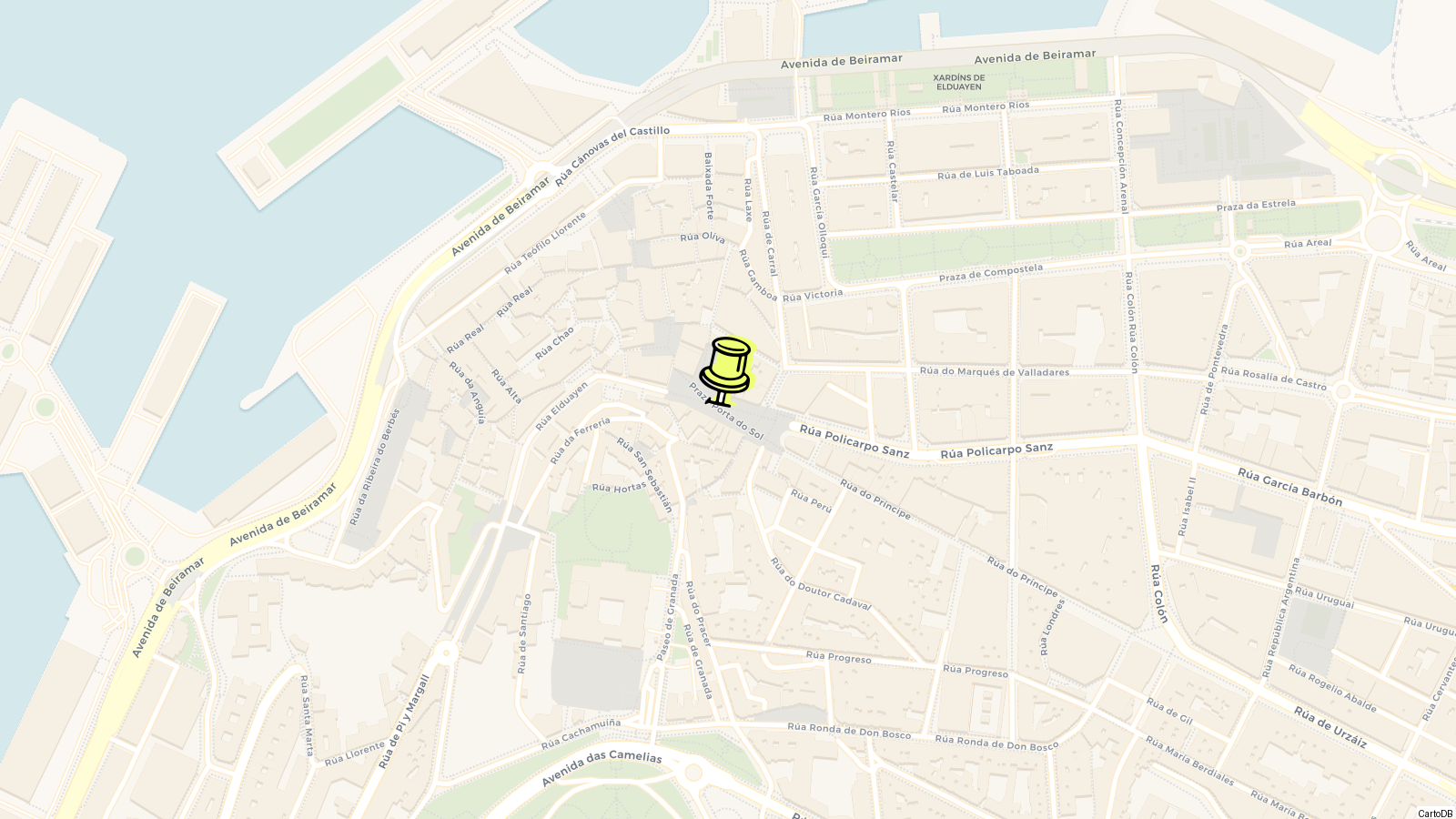
Overview
Eleven metres of aluminium merman, half man and half fish, grips a trident and stares up Rúa do Príncipe. That’s O Sireno, the work Francisco Leiro installed at the centre of Vigo’s Puerta del Sol in 1991, and the reason locals more often call this square El Sireno than its proper name. Don’t confuse it with Madrid’s plaza of the same name. This one is a small, sloping, pedestrian hinge in central Vigo where the old town gives way to the nineteenth-century Ensanche.
The name goes back to one of the seven gates of the seventeenth-century city walls, the one facing east toward the rising sun. Vigo’s defensive ring was built in 1656 with money raised from local citizens and Felipe IV, and Puerta del Sol marks the spot where it once opened. The wall is long gone. What survives is the function: this is still a junction, a place people pass through, the hinge between Calle Príncipe’s pedestrian shopping spine and the avenues running down toward the port.
Look up and the Edificio Simeón fills one side, an ornate iron-and-stone building by Michel Pacewicz showing the Eiffel-school influence that briefly seized Vigo’s commercial classes around 1900. Look down and you’ll find the inclined granite paving sloping eastward, busy by mid-morning and packed when the city switches its Christmas lights on, which still happens here every year.
History
Early origins
Puerta del Sol has anchored Vigo’s city centre for centuries, but don’t expect a medieval gate or Roman ruins here. The real transformation began in the 19th century when the square opened as a civic space, serving as a crossroads for the expanding industrial city. Much of old Vigo’s defensive wall and fortifications gave way as the city tore down barriers and pushed outward. Today, no original gate remains, though the name (“Gate of the Sun”) still marks the spot.
Before the 1800s, this area marked a boundary, both physical and symbolic, between the clustered old port neighbourhoods and the first hints of modernisation. The city’s walls, like those around much of urban Galicia, were systematically demolished during the urban expansion of the 19th century. The square’s opening coincided with a broader period of transformation across Vigo, reflecting the city’s shift from an enclosed coastal port to an outward-looking town tied into Atlantic trade and industry.
19th–20th century: City centre takes shape
By the late 1800s, Puerta del Sol solidified itself as Vigo’s public heart. Tram lines ran past, department stores and cafés lined the square, and protests and celebrations found a stage here. The push-and-pull between traditional port city and modernising industrial hub played out on its paving stones.
At the start of the 20th century, Puerta del Sol was surrounded by new buildings housing Vigo’s rising business class, as the city accelerated into shipbuilding, canning, and trading. The prominence of tram lines and the arrival of electricity transformed daily rhythms. When news of the Battle of Vigo Bay or, later, the Peninsular War spread, locals gathered in spaces like this. During strikes and political upheavals, police and protesters faced off here, Puerta del Sol stayed at the centre of the action.
Franco era into democracy
During the Franco dictatorship, Puerta del Sol, like most prominent city squares, doubled as a site for official parades and, less visibly, silent resistance. Family strolls were matched by notes passed between activists trying not to draw attention. With the restoration of democracy in 1978, the square once again became a space for protest, not just celebrations but protests for labour rights, Galician language, and autonomy.
Puerta del Sol reflected the turbulence of the late 20th century. Even as Vigo’s industrial workforce boomed and declined with the fortunes of fishing and shipbuilding, marches often began or ended here. The square changed physically as well as politically, seeing new traffic schemes and the conversion of surrounding streets into pedestrian-first zones, updating but never erasing its traditional role.
Recent decades
By the 2000s, Puerta del Sol was fully pedestrianised, with the last of the cars rerouted and the city prioritising foot traffic. The square is now defined by modern sculpture and a flow of shoppers and parade-goers rather than any historic stone, not because Vigo has no old buildings, but because Puerta del Sol always pointed ahead.
The modern look is shaped by public art, new lighting, and events organised by the city. The sculptural presence (notably the absence of ancient monuments) sets it apart from other Galician and Spanish main squares, which often have a cathedral or formal town hall. Instead, Puerta del Sol remains the symbol of a city always remaking itself for whatever comes next.
Visiting
Don’t expect entry fees or bag checks, Puerta del Sol is a public plaza, wide open to all. The square sits at the heart of Vigo and has no physical gate or marker you’ll need to queue for. Foot traffic is constant, but unless there’s an event, you’ll never need to wait. Look for the circular stone mosaic in the pavement: you’ve found the centre.
The intersection here connects to several of Vigo’s busiest pedestrian routes. The surrounding streets buzz most in the late afternoon, when locals fill terrace bars after work. If you’re using GPS, the coordinates are 42.237925, -8.725307. Navigation apps recognise “Puerta del Sol” as a set point, and most city buses stop within a five-minute walk. No stairs or steep inclines in the square proper, anyone can access it easily, including with a wheelchair.
The main visual is the “O Sireno” statue, most people use it as a meeting point, and it’ll appear in your photos whether you like it or not. Traffic circles past on just one side now after recent pedestrianisation. No benches, but you’ll get shade from nearby shop awnings. If you’re after a snack, the square is ringed by pavement cafés, some with outdoor tables.
Live events pop up irregularly in Puerta del Sol, but most of the year you’ll just see local musicians and buskers. On March 28, the plaza becomes the centre of the Reconquista festival, commemorating the city’s liberation from French occupation in 1809. The entire square fills with stalls and dancers for a day. Dull weekday mornings, you’ll probably share the space mostly with commuters and delivery drivers.
No toilets or public facilities in the plaza itself, use a café or one of the shopping arcades on adjacent streets.
Lighting is fine for evening walks, but pickpocket risk is like any busy urban spot at night: keep your bag zipped and don’t get distracted scrolling.
Surrounding shops keep standard hours, usually opening late (10:00–14:00, reopening roughly 17:00–20:30). The square itself is never formally closed, so you can pass through 24/7, but after midnight there’s little happening except taxi traffic or the occasional group heading home. During city festivals or public demos, police sometimes reroute buses and block vehicular entry.
Tips
- Don’t expect shade at Puerta del Sol: there are few trees and almost no shelter if it’s raining. Bring a hat or umbrella depending on the weather.
Umbrellas are essential in Vigo during any rainy day, especially since the Galician weather can change quickly even in summer. In winter, when storms roll off the Atlantic, the wind makes it hard to stay dry for long without proper gear.
- The square is on a slight incline, paved in large slabs. Good walking shoes make a difference, especially if you plan to continue up towards other central streets or down to Vigo’s port area.
The paths from Puerta del Sol branch uphill towards Calle del Príncipe and downhill towards the sea. Even locals complain the stretches to and from the port can be slippery in the rain.
- As of 2024, there are no public toilets or permanent seating in the square. Cafés and bars on the edge may let you use facilities if you order something.
The lack of benches means older visitors may want to plan breaks at the nearby cafés. Toilets for the public aren’t available in the square itself, an ongoing complaint among residents, so plan ahead.
- Puerta del Sol is still used for city events and celebrations. If you see barriers or a temporary stage, check for local festivities that could affect access.
March 28 is the big annual exception, with crowds marking Vigo’s Reconquista festival (the expulsion of French troops in 1809). Streets around the square often fill with parades or market stalls around this date. Normal access returns the next day.
Know this destination? Help us improve
Your local experience is valuable to other travelers.