Rande Bridge
The Rande Bridge is a cable-stayed bridge 9 kilometres from the city of Vigo and 18 kilometres from the city of Pontevedra, in the Province of Pontevedra, Spain. It spans Vigo bay across the Rande Strait, linking the municipalities of Redondela and Moaña.

Overview
Two concrete pylons rise out of the Ría de Vigo and a deck strung between them carries the AP-9 motorway forty-eight metres above the water, high enough that container ships pass underneath without ducking. The Rande Bridge is the cable-stayed crossing that ties the city of Vigo to the Morrazo peninsula, replacing the ferries and inland detours that used to cost commuters hours each week. It opened to traffic on 7 February 1981 and now carries roughly 50,000 vehicles a day.
You don’t visit Rande Bridge in the museum sense. It has no entrance, no viewing platform, no parking spot for the curious; pedestrians and cyclists are not permitted on the deck. What you do is cross it, on the AP-9 between Redondela and Moaña, or look at it from one of the shoreline viewpoints around the ria. From sea level it reads as one long sweep of cable; from above it’s the visual signature of the inner estuary, the line that separates the Vigo basin from the open ria heading out to the Cíes.
The bridge was designed by Italian engineer Fabrizio de Miranda alongside Florencio del Pozo and Alfredo Passaro, and it sat among the longest cable-stayed spans in the world when it opened. A 2015-2018 expansion added side platforms to widen the deck, an upgrade that cost more than €143 million. If you’re staying in Vigo and crossing toward Cangas, you’re using it.
History
Rande Bridge started taking shape during the late Franco era, when Vigo’s explosive growth and the Ría de Vigo’s swollen port traffic outpaced ferries and local roads. Construction began in 1973, driven by the strategic need to connect Pontevedra Province across the estuary and link Vigo’s industrial sprawl to the rest of Galicia.
Before the bridge, crossing the Ría de Vigo by car often meant a long detour inland to the O Porriño corridor or queueing for limited ferry services. The decision to build came as local shipyards, canning plants, and Citroën Vigo (the city’s largest employer) lobbied for reliable access for workers and lorries. Initial engineering studies took into account not only the wide channel (the final mainspan is 401 metres) but also the famously deep muddy bottom of the ría, which complicated foundation work. Construction contracts went to a consortium of Spanish firms led by Dragados y Construcciones, a dominant force in major civil works at the time. The bridge’s location, at the narrowing between Rande and Moaña, was chosen carefully to avoid the deeper parts of the channel.
The bridge opened to traffic in 1981, immediately relieving the bottleneck between Vigo and the northern and eastern sides of the estuary. Its inauguration marked a milestone for western Galicia’s modern road network and tied the two shores in a way that ferries never could.
Within a decade, soaring traffic forced several rounds of lane upgrades and regular maintenance, but the original twin pylons and concrete deck survived Galicia’s notorious weather with relatively little drama. A major upgrade project in the late 2010s added extra lanes and retrofitted the bridge to handle increased HGV and commuter loads, especially at rush hour. This work finished in spring 2018.
The 2015–2018 expansion inserted “side platforms”, effectively new lanes, flanking the original deck. This allowed the bridge to support about six lanes in total during peak times. Construction happened mostly at night and with partial closures to keep the traffic moving. The engineering approach avoided interrupting daily commutes, although weekend traffic jams are now once again a routine pain during summer and holiday escapes.
Rande Bridge has also played a minor role in the local historical imagination thanks to its namesake bay’s earlier fame. The Battle of Vigo Bay in 1702 happened right below the modern crossing, when Anglo-Dutch fleets torched the silver-loaded Spanish ships bottling up in the ría. Today, there’s little visible trace of that era at the bridge itself, but if you look north toward San Simón island, you can spot reminders of the bay’s wilder past.
Coins and bits of shipwreck, long pursued by local divers, occasionally turn up on the muddy bottom during routine inspections for the bridge. Officially, treasure-hunting is banned, but the connection between the bridge’s ultra-modern lines and the deep history of the bay itself sometimes makes the local evening news. The battle marked one of the rare moments the estuary drew international focus before the industrial age. Since then, the focus has shifted from naval clashes to logistics and the arteries feeding a city of nearly 300,000 people.
The location has never been just a pretty backdrop; the double pylon towers now anchor one of the busiest motorway arteries in Galicia. The bridge’s completion made daily life and work within Vigo far more closely tied to the north side of the ría than any previous ferry, road, or barge crossing ever could.
Visiting
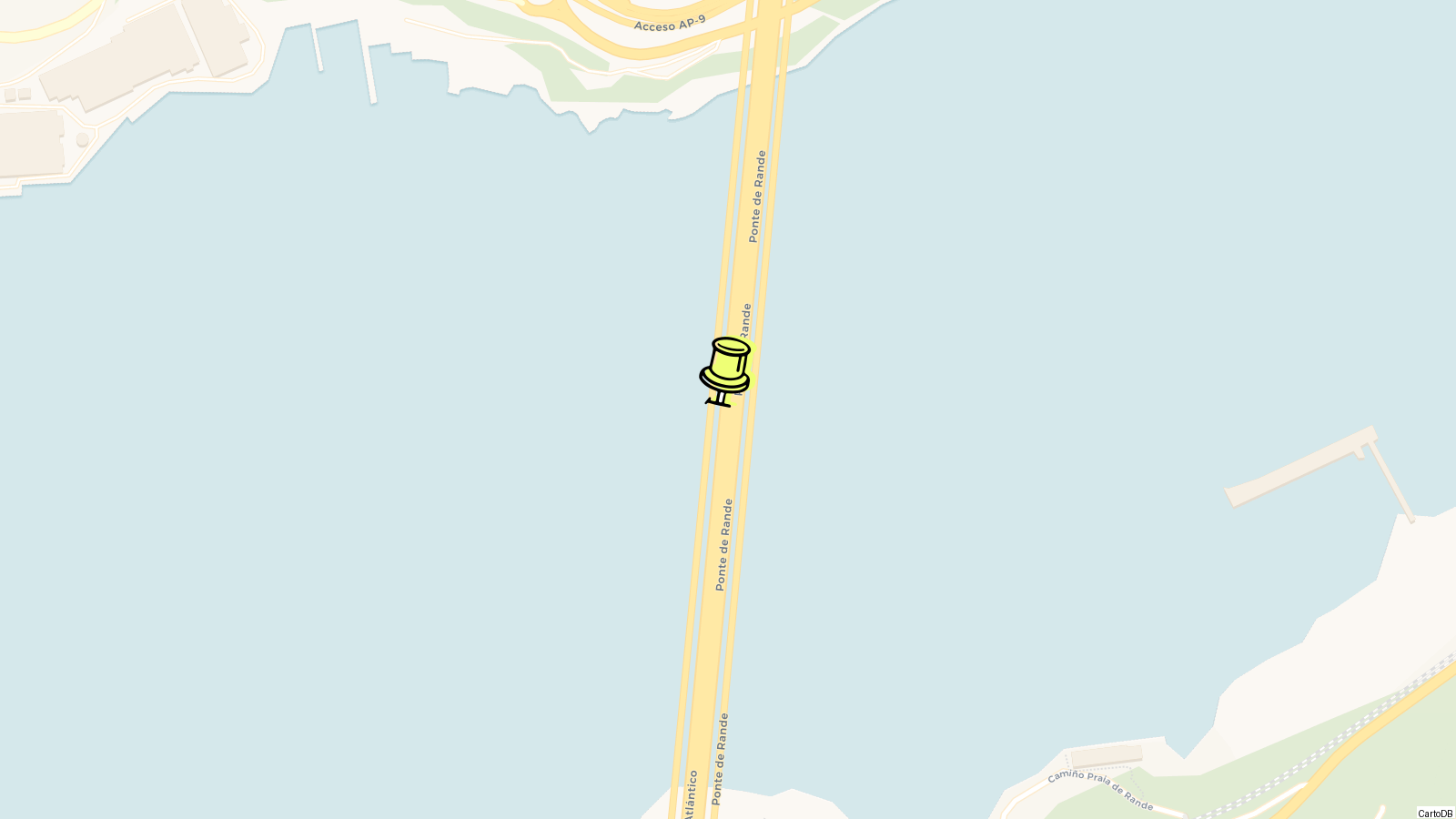
There’s no ticket booth, turnstile, or designated “visitor zone” at Rande Bridge, you’re seeing it as part of the everyday landscape connecting Pontevedra Province with the rest of the Vigo area. The bridge spans the narrowest point of the Ría de Vigo (coordinates: 42.28808, -8.66051), visible from much of the shoreline and especially from higher ground on both sides. No walking or cycling access is permitted; you experience it by driving, taking a bus, or catching glimpses from the water.
Private cars access Rande Bridge on the AP-9 motorway. There’s no pedestrian path, and cycling is not permitted, so don’t count on a close-up tour unless you have a vehicle or join an organised group that rents a bus. For visitors not driving, regional bus routes cross the bridge as well, though check updated timetables, services change seasonally. There are no viewing platforms directly on the bridge. The best photo opportunities come from the shoreline roads and viewpoints around the ria and adjoining hills. If you’re heading west toward Vigo, the approach begins just after the Redondela and Chapela junctions. Eastbound from Vigo, the deck opens out before you after you leave Teis in the city proper.
Don’t expect interpretive panels or on-site signage about the bridge’s history on the approaches, it’s a functional piece of infrastructure above all. The surroundings are mostly residential and industrial, with traffic moving at speed and no reason to linger at either end unless you’re a rail or engineering obsessive.
There’s visible cable tensioning hardware and expansion joints if you travel by car or bus, but sightlines to the ria and the Cíes Islands open dramatically only on clear days. Traffic is often heavy, especially at peak commuting times, since it’s the main Vigo-Pontevedra crossing. If you want to understand the strategic importance of the crossing itself, look to the port infrastructure clustered below, and the sweep of the ria, which the bridge slices across in a single leap. There are no commemorative plaques marking the construction dates, but the bridge’s profile has become one of the identifying features of the greater Vigo coastline.
Tips
- If you’re driving, keep coins or a contactless payment card ready. The Rande Bridge is part of the AP-9 toll motorway, expect to pay a toll to cross in either direction.
The AP-9 tolls vary based on vehicle type and distance travelled, but a standard private car crossing between Vigo and the other side of the ría will be charged under €2. Pay at the automated booths; there’s no need to get out of your car. If driving a rental, check that your provider allows toll payments, most major companies do, but don’t assume.
- Cyclists and pedestrians are not allowed on the Rande Bridge. It’s for motor vehicles only.
- You’ll get the best water-level photos from a boat in the Ría de Vigo, not from the bridge itself.
- Westbound lanes are most likely to see heavy traffic, especially late afternoons heading toward Vigo. Leave extra time if you’re travelling at rush hour.
- Fog sometimes rolls in quickly over the Ría de Vigo, so switch headlights to dipped beam and slow down if visibility drops.
Vigo’s mild, maritime climate keeps snow off the bridge, but rain and mist can make the surface slick even in summer. Watch for high crosswinds as you cross; they can feel intense due to the bridge’s exposure across the water.
- For local drivers, the alternative to paying the AP-9 toll is a long detour inland, looping south and east of the ría on secondary roads. For visitors with a hire car, the toll is almost always worth paying to avoid backtracking.
Know this destination? Help us improve
Your local experience is valuable to other travelers.